OKX Crypto Access Limitations by Country: What’s Allowed and What’s Blocked in 2025
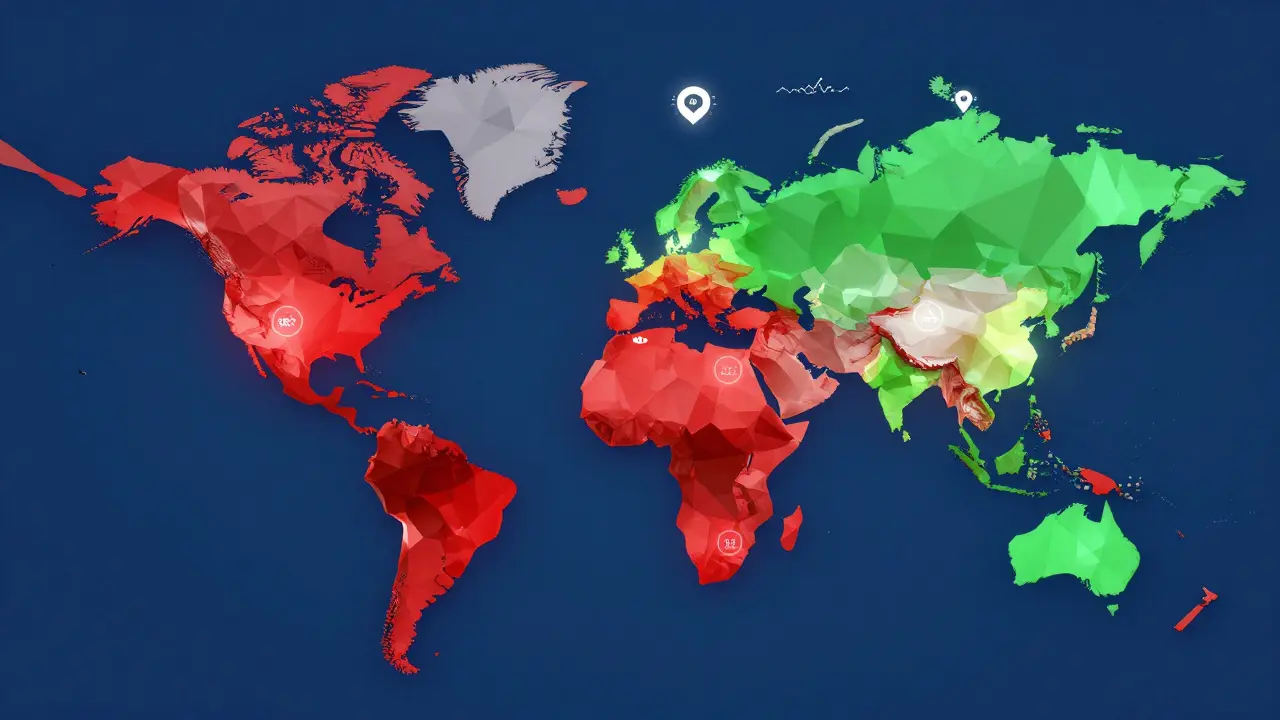
OKX Country Access Checker
Check OKX Access Status
Enter your country to see if OKX is fully accessible, partially accessible, or blocked in your region
If you're trying to use OKX and keep hitting a wall - maybe you see a message like 'Service not available in your country' - you're not alone. Thousands of users around the world face the same issue. OKX is one of the biggest crypto exchanges by volume, handling over $13 billion in trades daily. But access isn't the same everywhere. Some countries can trade everything. Others can't trade at all. And some get stuck with confusing, half-functional access. This isn't random. It's strict, calculated, and changing fast.
Where You Can't Use OKX At All
OKX completely blocks users in several countries. If you're in the United States, Canada, United Kingdom, Malaysia, Singapore, or the Bahamas, you won't be able to sign up or log in - even with a passport or local ID. The same goes for countries under international sanctions: Cuba, Iran, North Korea, Syria, and the Russian-occupied regions of Crimea, Donetsk, and Luhansk.
Even U.S. territories like Puerto Rico, Guam, and the U.S. Virgin Islands are blocked. This isn't about size or popularity - it's about legal risk. OKX avoids these markets because they have strict crypto regulations or are under U.S. financial oversight. Trying to bypass this with a VPN? That’s against their terms. And if caught, your account gets shut down. In September 2025 alone, OKX closed over 14,000 accounts for geolocation fraud.
Where You Can Use OKX - But Only Partially
Some countries aren’t fully blocked, but you lose key features. In Australia, Brazil, South Korea, and the United Kingdom, you can still trade spot markets (buying and selling Bitcoin, Ethereum, etc.). But you can’t trade futures, perpetual contracts, or leverage products. This is a direct result of local regulators stepping in. Australia’s ASIC and the UK’s FCA have made it clear: derivatives are too risky for retail users.
Here’s the tricky part: Singapore appears on the banned list - but only for the global OKX platform. There’s a separate, MAS-regulated entity called OKX Singapore that serves only local residents who pass strict checks. If you're a Singaporean using the main OKX site, you’ll be blocked. But if you're a foreigner living in Singapore trying to use OKX Singapore, you might still be rejected. The rules aren’t simple. They’re layered.
How OKX Knows Where You Are
OKX doesn’t guess. It uses multiple layers of tracking to lock down access:
- IP geolocation - This catches 99.2% of attempts to fake your location, according to their audit report.
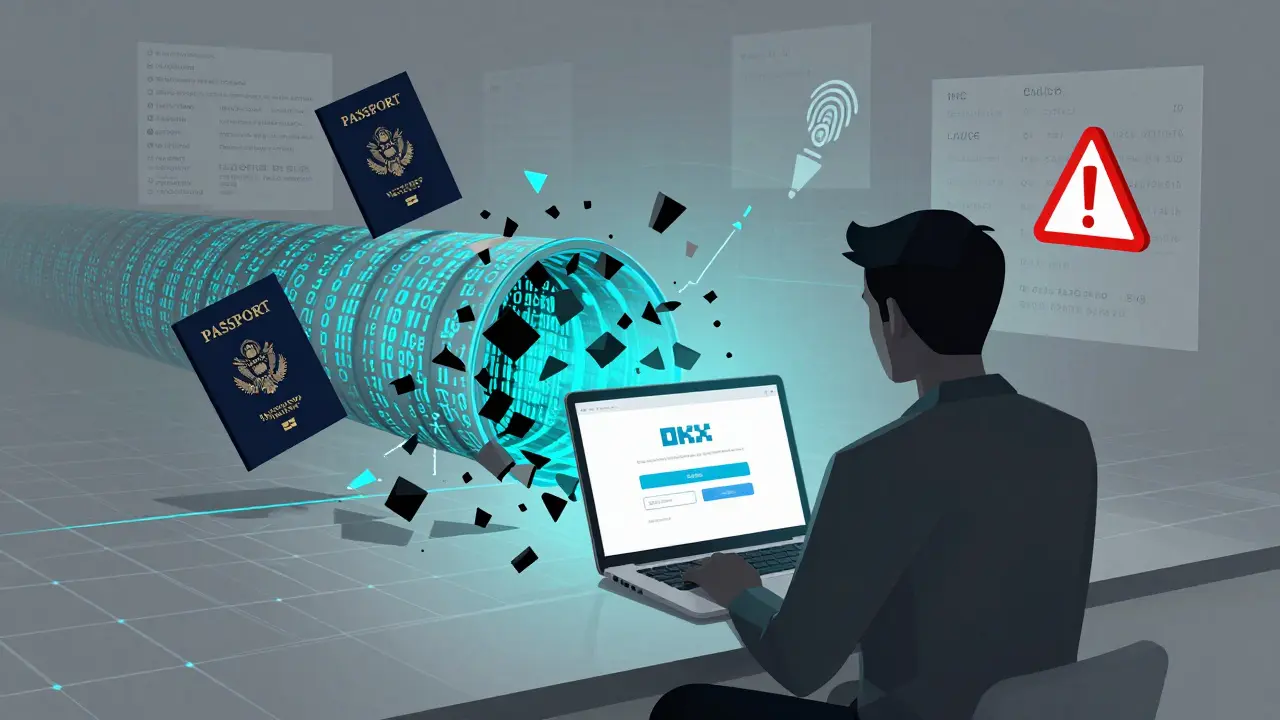
- Device fingerprinting - Your browser, screen size, installed fonts, and even battery level are checked. If your device looks like it’s been used on a VPN before, you get flagged.
- KYC documents - When you upload your ID or passport, OKX checks the issuing country. If it’s from a banned region, your application is rejected - even if your IP says you’re in Germany.
One user in Texas tried to verify with his U.S. passport in July 2025. He got a flat 'country restriction' error. No appeal. No explanation. Just blocked. That’s the reality. Your ID doesn’t override your location.
Why OKX Blocks So Many Countries
OKX isn’t picking favorites. It’s reacting to pressure. The U.S. SEC has sued Binance and Coinbase. The EU’s MiCA rules forced major changes. Japan’s FSA issued warnings. France added OKX to its restricted list. Every time a major regulator cracks down, OKX responds by pulling back - not to punish users, but to survive.
Unlike Coinbase, which only operates in countries where it’s fully licensed, OKX uses a patchwork of local entities: OKX Europe, OKX Singapore, OKX Japan. This lets them offer services in some parts of a country while blocking others. But it creates chaos for users. One person in Germany can trade everything. Another in the same city, using the same bank, gets blocked because their IP was once routed through a U.S. server.
What You Can Do If You’re Blocked
If you’re in a restricted country, there’s no legal workaround. Using a VPN or creating an account under someone else’s name violates OKX’s terms and will get you banned. There are no gray areas here.
But if you’re in a partially restricted country - say, Australia - you can still use OKX for spot trading. Just know that leverage, margin, and futures are off-limits. If you need those features, you’ll need to find another exchange that’s licensed for derivatives in your region.
For users in permitted countries, the process is straightforward:
- Sign up with a valid email and phone number.
- Complete Level 1 KYC (ID + selfie). You can trade up to $10,000/day.
- Upgrade to Level 2 (proof of address). Limits rise to $100,000/day.
- Level 3 (bank statement + source of funds) unlocks $1 million/day.
Verification usually takes 2-4 hours in Europe. In developing markets, it can take days. Support response times vary too: under 10 hours in Germany, over 24 hours in Nigeria.
How OKX Compares to Other Exchanges
OKX isn’t the only exchange with country limits - but it’s one of the most complex.
| Exchange | Full Access Countries | Blocked Countries | Derivatives Restricted In |
|---|---|---|---|
| OKX | ~160 | US, Canada, UK, Singapore, Malaysia, Iran, North Korea, Cuba, Syria | Australia, Brazil, South Korea, UK, EU |
| Binance | ~150 | US, Canada, UK, Singapore, Malaysia, Japan, France | US, UK, France, Japan |
| Coinbase | 42 | 150+ | None (only spot in most countries) |
| Kraken | ~100 | Iran, North Korea, Cuba, Syria, Bangladesh | Canada (limited) |
OKX has the widest global reach - but the most confusing rules. Coinbase has the cleanest compliance but the smallest user base. Binance used to be everywhere - until fines forced it to retreat. Kraken is the most transparent but lacks liquidity in many regions.
What’s Changing in 2025-2026
OKX is investing $230 million in compliance infrastructure. They’re setting up new legal entities in Switzerland and the UAE to serve users from previously blocked regions. In September 2025, they expanded derivatives access to Thailand and Vietnam.
But the U.S. remains the biggest hurdle. The SEC’s lawsuit against Binance has made every non-U.S. exchange nervous. OKX has hinted at launching a U.S.-compliant platform, but no timeline exists. Until then, American users are locked out.
Analysts predict that by mid-2026, OKX will offer full services in 35 new countries through local partnerships. But they also warn: the more countries OKX enters, the more fragmented the rules become. One user might have access to futures. Another, next door, won’t. That’s the cost of playing by 160 different rulebooks.
What Users Are Saying
On Reddit and Trustpilot, complaints about OKX’s restrictions are everywhere. 37% of negative reviews mention being blocked even when they’re in a permitted country. 29% say they’re blocked inconsistently - one device works, another doesn’t.
But users in Europe and Asia report smooth experiences. One German trader wrote: 'SEPA deposits work perfectly. No delays. No surprises. I use OKX Europe every day.' That’s the reality: OKX works well if you’re in the right place.
For users in restricted countries, the frustration is real. But the rules aren’t going away. Regulators are tightening. Exchanges are getting smarter. The days of easy global access are over.
Can I use OKX if I’m in the United States?
No. OKX completely blocks all users with U.S. IP addresses, U.S. identification documents, or U.S.-based bank accounts. Even if you have a passport from another country, if your location is detected as the U.S., your account will be rejected or terminated. There is no legal way to bypass this restriction.
Why can I trade spot on OKX but not futures in Australia?
Australia’s financial regulator, ASIC, prohibits retail traders from using leveraged crypto products like futures and perpetual contracts. OKX complies by disabling those features for Australian users. You can still buy and sell Bitcoin or Ethereum directly (spot trading), but you can’t borrow funds to amplify your position. This rule applies to all exchanges operating in Australia - not just OKX.
Does OKX work in the European Union?
Yes, but with limits. Since MiCA regulations took full effect in December 2024, OKX no longer offers derivatives trading to EU residents. Spot trading, staking, and Web3 wallet features are still available. You must complete KYC and use a local ID. If you try to trade futures, the platform will block you automatically.
Can I use a VPN to access OKX from a banned country?
Technically, you might be able to connect - but it’s against OKX’s terms. The platform uses advanced detection tools to identify VPN usage. If caught, your account will be permanently banned, and any funds may be frozen. There is no appeal process. This isn’t a risk worth taking.
How long does KYC verification take on OKX?
In most permitted countries, standard KYC (Level 1) takes 2-4 hours. If you submit clear documents and your identity matches your location, you’ll get approved quickly. Level 2 and Level 3 verification can take up to 2 business days, especially if you’re from a country with higher fraud risk. Support response times vary - under 10 hours in Europe, over 24 hours in parts of Africa and Latin America.
Will OKX ever launch in the U.S.?
OKX has said they’re exploring a U.S.-compliant platform, but no timeline has been announced. The U.S. regulatory environment is the most complex in the world. Until the SEC provides clear rules for crypto exchanges, it’s unlikely OKX will enter the market. For now, U.S. users should look at licensed U.S.-based exchanges like Coinbase or Kraken.
What’s Next?
If you’re in a permitted country, focus on completing your KYC and understanding your trading limits. Don’t assume all features are available - check the platform’s help center for your region. If you’re blocked, accept it. Pushing against the rules won’t get you access - it’ll get you banned.
The crypto world is becoming more regulated, not less. OKX’s restrictions aren’t a bug - they’re a feature. They’re how the exchange survives. For users, the lesson is simple: Know your country’s rules. Know what OKX allows. And never try to cheat the system. The cost is too high.
Ankit Varshney
December 4, 2025 AT 00:17OKX blocking users in India is frustrating. We’re not in the US or UK, yet we’re treated like high-risk. No derivatives, no futures, just spot - and even that feels like a privilege. Regulators here are slow, but we’re not criminals.
Christy Whitaker
December 5, 2025 AT 06:29You people really think you deserve access? You’re not entitled to crypto just because you have a credit card. If your country’s regulators say no, then no. Stop whining.
Heather Hartman
December 5, 2025 AT 13:10I get it. It’s not personal. It’s legal. I’m in the US, and I miss OKX’s liquidity, but I’d rather have a clean account than a frozen wallet. Patience, friends. This isn’t over.
Catherine Williams
December 6, 2025 AT 11:34My cousin in Brazil just got flagged because his laptop had a US IP from a past trip. They shut him down. No warning. No chance to explain. That’s the system. It doesn’t care if you’re innocent - only if your device looks suspicious.
Ziv Kruger
December 6, 2025 AT 21:25Freedom isn't free. And neither is crypto. The moment you choose to participate in a global system, you accept its borders. We’re not in a wild west anymore. We’re in a courtroom with a thousand judges. And OKX? It’s just trying not to get sentenced.
Nancy Sunshine
December 7, 2025 AT 23:24It's imperative to acknowledge that regulatory fragmentation is not an anomaly - it is the new paradigm. The absence of harmonized international crypto legislation compels exchanges like OKX to implement geofenced compliance architectures. This is not capriciousness - it is fiduciary necessity. Failure to comply invites existential risk. One must consider the precedent set by the SEC's enforcement actions against Binance and Coinbase. The cost of noncompliance is not merely financial - it is institutional annihilation. Therefore, the restrictions are not punitive - they are protective. For the exchange. For the ecosystem. For the user, in the long term.
Paul McNair
December 9, 2025 AT 14:47My dad’s from Nigeria. He uses OKX for spot trading. Takes 3 days to verify. Support replies in 36 hours. But he’s still in. He doesn’t care about futures. He just wants to send value across borders without banks taking 5% and 3 days. That’s the real win here.
Marsha Enright
December 11, 2025 AT 07:59Been using OKX Europe since January. SEPA deposits hit in 10 mins. No drama. No weird flags. Just works. If you’re blocked, check your IP history. I had an old VPN on my phone once - turned it off and re-verified. Got in on the second try. 🤞
Alan Brandon Rivera León
December 13, 2025 AT 03:43I’m half Mexican, half American. I have a US passport but live in Colombia. Tried to sign up with my Colombian phone and ID. Got blocked because my laptop’s MAC address was registered to a US IP 6 months ago. They don’t care about where you are now. They care about what your device once was. That’s terrifying.
Ann Ellsworth
December 15, 2025 AT 01:15OKX’s compliance architecture is a masterpiece of regulatory arbitrage. Their tiered KYC, device fingerprinting, and geo-IP correlation are SOTA in anti-fraud tech. The fact that they’re still operational globally while Binance got crushed speaks volumes. You’re not being punished - you’re being filtered. The system is optimizing for survival, not accessibility. Get with the program.
Melinda Kiss
December 16, 2025 AT 04:11I know this sounds harsh, but if you're in the US and you're mad about this - I feel you. But please don't try to use a VPN. I lost $8k last year because I thought I could outsmart them. They don’t just ban you. They freeze everything. No refunds. No appeals. Just silence. I learned the hard way. Please don’t make the same mistake.
Mohamed Haybe
December 17, 2025 AT 04:45Why should India care about US regulators? We have our own laws. OKX should build for us not for Wall Street. You think we want your rules? We have 1.4 billion people. We don’t need your permission to trade. Block us? Fine. We’ll build our own. Better. Faster. Free.