
What Are Block Rewards in Cryptocurrency? A Simple Guide
Ever wondered where new bitcoins actually come from? It’s not magic, and it’s not a bank printing money. It’s called a Block Reward. This is the paycheck miners or validators get for doing their job: securing the network and processing transactions. If you’re trying to understand how crypto economics work, grasping block rewards is step one. Without them, no one would bother spending electricity or capital to keep the chain running.
The Two Parts of Your Paycheck
A block reward isn’t just one lump sum. It’s made up of two distinct pieces. First, there’s the block subsidy, which is brand-new cryptocurrency created out of thin air (well, math) when a block is mined. Second, there are Transaction Fees, which users pay to have their transactions included in that block. In the early days of Bitcoin, the subsidy was huge compared to fees. Today, as subsidies shrink, fees are becoming a bigger slice of the pie. For Ethereum post-Merge, this dynamic has shifted even further because validators rely heavily on tips and priority fees rather than massive new issuance.
Think of it like a taxi driver. The subsidy is like a government grant they get for every mile driven, while transaction fees are the fares passengers pay. As the grants dry up, the driver needs those fares to be high enough to cover gas and maintenance. If fees drop too low while subsidies vanish, drivers might quit, threatening the service’s reliability.
How Bitcoin’s Halving Changes Everything
Bitcoin’s most famous feature related to block rewards is the Halving. Every 210,000 blocks-roughly every four years-the block subsidy gets cut in half. This isn’t random; it’s coded into Satoshi Nakamoto’s original whitepaper to control inflation and ensure scarcity.
- 2009: Started at 50 BTC per block.
- 2012: Dropped to 25 BTC.
- 2016: Dropped to 12.5 BTC.
- 2020: Dropped to 6.25 BTC.
- April 2024: Dropped to 3.125 BTC.
This schedule continues until around the year 2140, when the last satoshi will be mined. At that point, the total supply hits its hard cap of 21 million coins. After that, miners won’t get any new coins-only transaction fees. This transition raises a big question: Will fees be high enough to keep miners interested? Currently, about 98% of miner revenue still comes from the subsidy, so we aren’t there yet. But as the subsidy shrinks, the pressure on the fee market grows.
Ethereum’s Shift to Proof-of-Stake
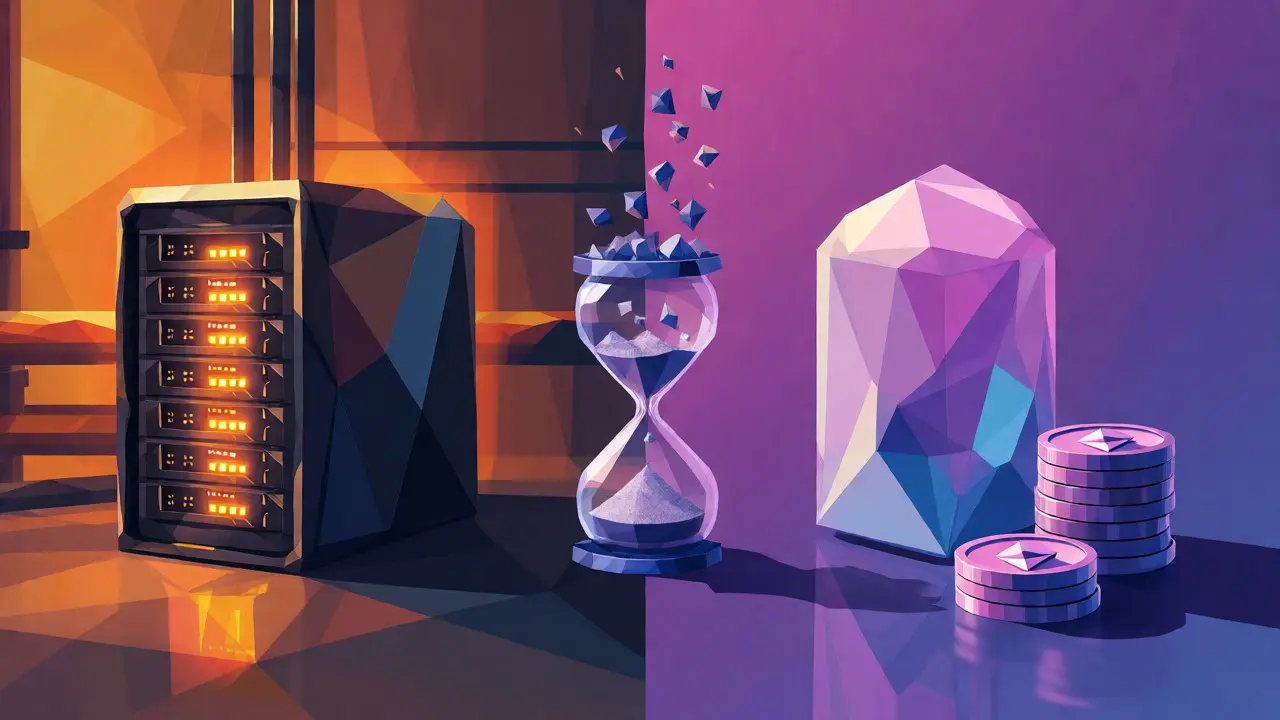
If Bitcoin is about hardware and electricity, Ethereum changed the game with Proof-of-Stake (PoS). Since "The Merge" in September 2022, Ethereum doesn’t use miners. Instead, it uses validators who lock up ETH to secure the network. Their rewards work differently.
Validators don’t get a fixed block reward. Their earnings depend on how much ETH is staked across the whole network. The formula is roughly proportional to the square root of the total stake. When more people stake, individual rewards go down slightly, but the network becomes more secure. Post-Merge, Ethereum reduced its annual issuance by about 90%. Plus, thanks to EIP-1559, some transaction fees are burned (destroyed), making ETH potentially deflationary if usage is high. This means validators earn less new ETH but benefit from a scarcer asset.
| Feature | Bitcoin (PoW) | Ethereum (PoS) | Litecoin (PoW) |
|---|---|---|---|
| Reward Type | Subsidy + Fees | Staking Rewards + Tips | Subsidy + Fees |
| Current Subsidy/Reward | 3.125 BTC | Dynamic (~0.5% annual issuance) | 6.25 LTC |
| Halving Event | Every 4 years | No Halving | Every 4 years |
| Total Supply Cap | 21 Million | No Hard Cap | 84 Million |
| Security Source | Electricity/Hardware | Locked Capital (ETH) | Electricity/Hardware |

Why Do We Need Block Rewards?
You might ask, why not just let anyone validate transactions for free? Because validation costs money. Miners spend billions on electricity and specialized hardware like Bitmain’s Antminer S21. Validators tie up thousands of dollars in locked ETH. These costs create a barrier to entry that keeps bad actors out.
Block rewards serve three main jobs:
- Incentivize Security: They pay for the energy and capital needed to protect the ledger from attacks.
- Distribute New Coins: They release new currency into circulation gradually, preventing sudden inflation shocks.
- Process Transactions: They ensure someone is always motivated to bundle user transactions into blocks.
Without these incentives, the network would grind to a halt. Imagine if your local coffee shop stopped charging for coffee but also stopped getting paid by suppliers. Eventually, they’d close. Crypto networks face similar economic realities.
The Future: What Happens When Rewards Run Out?
We’re already seeing signs of change. As block subsidies decrease, transaction fees must rise to compensate. Analysts predict that by 2030, fees could make up over 50% of miner revenue on major networks. For Bitcoin, this means the average fee per transaction might need to hit $15-$25 to maintain current security levels.
There’s also debate about centralization. As rewards shrink, only large, efficient operations can survive. Small solo miners often drop out, leading to mining pools dominating the hash rate. On Ethereum, the 32 ETH minimum stake creates a high barrier, favoring wealthy individuals or institutions. Regulators are watching closely. In the US, the IRS treats block rewards as ordinary income when received. In the EU, the MiCA framework classifies them similarly for tax purposes.
So, what should you take away? Block rewards are the heartbeat of crypto economics. They balance security, supply, and demand. Whether you’re mining Bitcoin or staking Ethereum, understanding these mechanics helps you gauge the health and sustainability of the network. It’s not just about price charts; it’s about whether the system can pay its bills long-term.
Do I get block rewards if I hold Bitcoin?
No. Holding Bitcoin does not generate block rewards. Block rewards are paid exclusively to miners (in Proof-of-Work chains) or validators (in Proof-of-Stake chains) who actively participate in creating new blocks. To earn them, you must either run mining hardware or stake your coins to become a validator.
How often do Bitcoin block rewards change?
Bitcoin block rewards change approximately every four years during an event called the 'halving.' Specifically, the reward is cut in half after every 210,000 blocks are mined. The most recent halving occurred in April 2024, reducing the reward from 6.25 BTC to 3.125 BTC per block.
Are block rewards taxable?
In many jurisdictions, yes. In the United States, the IRS considers block rewards as ordinary income at the time of receipt, based on the fair market value of the cryptocurrency then. You may also owe capital gains tax if you sell or spend the coins later at a different price. Always consult a tax professional for your specific situation.
What happens to block rewards when all coins are mined?
For Bitcoin, once all 21 million coins are mined (estimated around 2140), the block subsidy will reach zero. Miners will then rely entirely on transaction fees to cover their costs. If transaction volume remains high, fees should theoretically increase to sustain the network's security budget.
Is staking safer than mining?
'Safer' depends on your perspective. Mining requires significant upfront capital for hardware and ongoing electricity costs, with risk of equipment failure. Staking requires locking up capital (e.g., 32 ETH for Ethereum), which carries opportunity cost and slashing risks if the validator behaves poorly. However, staking generally has lower operational complexity and environmental impact.