
Understanding the Byzantine Generals Problem: The Core of Blockchain Trust

Imagine you are a general in the Byzantine army. You and your fellow commanders surround an enemy city. To win, you must all attack at exactly the same time. If one group attacks early while another retreats, everyone gets crushed. The catch? You can only communicate via messengers, and some of those messengers might be traitors sending false orders to confuse you.
This isn't just a historical war story. It is the Byzantine Generals Problem, defined as a fundamental challenge in distributed computing where nodes must reach consensus despite potential failures or malicious behavior. First introduced by computer scientists Leslie Lamport, Robert Shostak, and Marshall Pease in 1982, this theoretical puzzle became the bedrock of modern blockchain technology. Without solving it, Bitcoin, Ethereum, and every other decentralized network would collapse into chaos.
Why Consensus Is Harder Than You Think
In most software systems, if a server crashes, we know it crashed. We restart it. That is called Crash Fault Tolerance, which handles situations where components fail by stopping completely rather than acting maliciously. But in open networks like the internet, things get messy. A node might not just stop; it might lie. It could tell Node A that the price of Bitcoin is $60,000, while telling Node B it is $50,000. This deception is a Byzantine fault.
The original paper established two non-negotiable rules for any solution:
- All loyal generals (nodes) must agree on the same plan.
If you have ever tried to coordinate a group project where half the team ghosts you and the other half sends conflicting instructions, you have felt a tiny fraction of this problem. In digital systems, the stakes are financial security and data integrity.
The Math Behind the Magic: The 3f+1 Rule
You cannot solve the Byzantine Generals Problem with just a simple majority vote. If you have three generals and one is a traitor, the traitor can send different messages to the other two, causing them to disagree. There is no way to distinguish the liar from the truth-teller without more participants.
Lamport proved mathematically that to tolerate f traitors, you need at least 3f + 1 total generals. Let's break that down:
- To handle 1 traitor, you need 4 generals (3*1 + 1).
- To handle 2 traitors, you need 7 generals (3*2 + 1).
- To handle 10 traitors, you need 31 generals.
This n > 3f requirement is why public blockchains require thousands of nodes. It ensures that even if a significant portion of the network acts maliciously, the honest majority still dictates the truth. This mathematical certainty is what makes Bitcoin secure against double-spending attacks.

From Theory to Practice: Proof-of-Work and Proof-of-Stake
For decades, the Byzantine Generals Problem was considered unsolvable for large-scale, permissionless networks. Then came Satoshi Nakamoto. In 2008, Bitcoin introduced Proof-of-Work (PoW), a mechanism that uses computational energy expenditure to secure consensus and prevent malicious actors from altering the ledger.
PoW solves the problem by making lying expensive. To change the history of transactions, a traitor would need to control more than 51% of the network's computing power. This is economically prohibitive for large networks. As Vitalik Buterin, co-founder of Ethereum, noted, PoW was the first practical solution for open networks.
However, PoW has a downside: energy consumption. Critics argue it wastes electricity. This led to the development of Proof-of-Stake (PoS), used by Ethereum after "The Merge" in 2022. PoS replaces energy with economic stake. Validators lock up cryptocurrency as collateral. If they act dishonestly (commit a Byzantine fault), their stake is slashed. This aligns incentives: honesty pays, cheating costs money.
| Mechanism | Security Basis | Energy Use | Scalability |
|---|---|---|---|
| Proof-of-Work (PoW) | Computing Power | Very High | Low (~7 TPS for Bitcoin) |
| Proof-of-Stake (PoS) | Economic Stake | Very Low | High (~100-1000+ TPS) |
| Practical BFT (PBFT) | Cryptographic Signatures | Low | Medium (Limited by node count) |
Beyond Blockchain: Where Else Does This Matter?
While blockchain popularized the term, the Byzantine Generals Problem applies anywhere multiple independent systems must agree on a single state. Consider these real-world applications:
- Aerospace: NASA's Artemis program requires spacecraft computers to use Byzantine Fault Tolerance. If one sensor fails and reports incorrect temperature data, the ship must ignore it without crashing. The system needs redundant sensors voting on the correct reading.
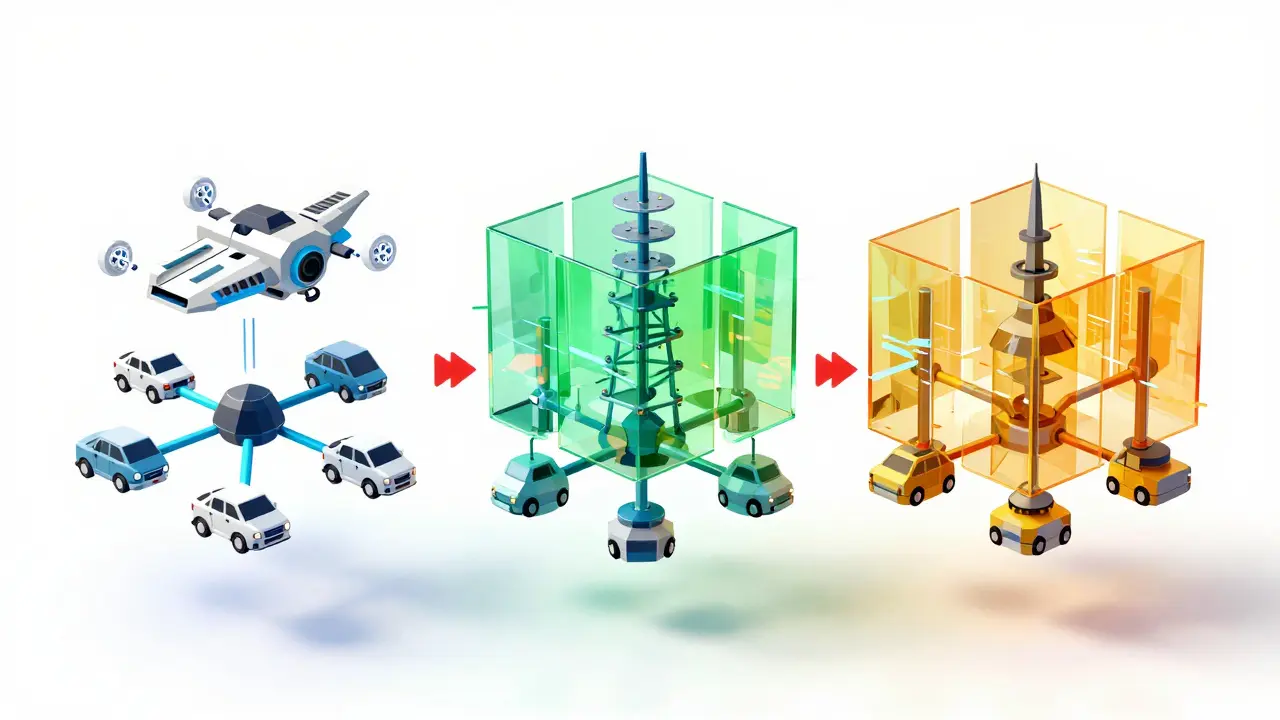
- Automotive: Modern cars communicate with each other (V2V). If a hacked car sends fake brake signals, nearby vehicles must detect the anomaly and continue safely. ISO 21448 standards now mandate BFT protocols in vehicle communication systems.
- Power Grids: The US Department of Homeland Security mandates BFT implementations for electrical grid controls. A compromised sensor shouldn't trigger a blackout across a city.
In these cases, failure isn't just an inconvenience; it's a safety hazard. The cost of implementing BFT is high, but the cost of failure is catastrophic.
The Trade-offs: Speed vs. Security
Solving the Byzantine Generals Problem comes with performance penalties. Every node must verify every message from every other node. As the network grows, the amount of communication explodes. This is known as message complexity.
In traditional Paxos or Raft algorithms (used in databases like Google Spanner), nodes are trusted to some extent. They assume nodes only crash, not lie. This allows faster consensus because less verification is needed. But in public blockchains, trust is zero. Every transaction must be validated by many independent parties.
This is why Bitcoin processes about 7 transactions per second, while Visa handles 24,000. Bitcoin prioritizes security and decentralization over speed. Newer protocols like HotStuff (developed by Facebook/Meta) aim to reduce this overhead by optimizing message passing, allowing networks to scale to thousands of nodes without collapsing under communication load.
Future Challenges: Quantum Threats
The current solutions rely heavily on cryptography-specifically digital signatures-to prove identity and integrity. However, future quantum computers could break these signatures. IBM Research recently announced 'Q-BFT,' a quantum-resistant protocol designed to maintain consensus even when cryptographic assumptions are threatened.
As distributed systems become more critical to infrastructure, the demand for efficient BFT will grow. Forrester predicts that by 2027, 85% of enterprise distributed systems will incorporate some form of Byzantine Fault Tolerance. Understanding this problem is no longer just for cryptographers; it is essential for anyone building or using decentralized technology.
What is the simplest example of the Byzantine Generals Problem?
Imagine three generals trying to decide whether to attack. One is a traitor. The traitor tells General A to attack and General B to retreat. A and B don't know who is lying. They cannot reach a unanimous agreement. With four generals and one traitor, the three loyal ones can cross-check messages and identify the outlier, reaching consensus.
How does Bitcoin solve the Byzantine Generals Problem?
Bitcoin uses Proof-of-Work. Miners compete to solve complex mathematical puzzles. The first to solve it broadcasts the new block. Other nodes verify the work. Because solving the puzzle requires massive energy, it is too expensive for attackers to rewrite history. The longest chain represents the agreed-upon truth.
What is the difference between Crash Fault Tolerance and Byzantine Fault Tolerance?
Crash Fault Tolerance assumes nodes only fail by stopping (crashing). Byzantine Fault Tolerance assumes nodes may actively lie, send conflicting messages, or collude. BFT is much harder to implement and requires more nodes (3f+1 vs 2f+1) to guarantee safety.
Why do we need 3f+1 nodes for Byzantine Fault Tolerance?
Mathematically, if you have fewer than 3f+1 nodes, a coalition of f traitors can create ambiguity that prevents the loyal nodes from distinguishing truth from lies. The 3f+1 threshold ensures that the honest majority always outweighs the deceptive minority in any subset of communications.
Is Proof-of-Stake truly Byzantine Fault Tolerant?
Yes. Proof-of-Stake achieves BFT by tying consensus rights to economic value. Validators must stake coins. If they propose invalid blocks or sign conflicting messages, their stake is slashed. This economic penalty discourages Byzantine behavior, ensuring the network remains consistent.
Ruth Williams
July 6, 2026 AT 20:53It is rather amusing how the masses continue to be baffled by concepts that were settled in computer science literature decades ago. The Byzantine Generals Problem is not some novel revelation for blockchain enthusiasts; it is a foundational theorem regarding distributed consensus under adversarial conditions. Lamport, Shostak, and Pease did not require a cryptocurrency bubble to validate their work. Their proof demonstrated that achieving consensus among n generals requires n > 3f, where f is the number of traitors. This mathematical constraint is absolute, regardless of whether one is discussing military strategy or digital ledgers. The pretense that blockchain 'solved' this problem is intellectually dishonest. It merely applied probabilistic economic incentives to approximate a solution that deterministic algorithms cannot fully provide in asynchronous networks. One must read the original 1982 paper to understand the distinction between crash fault tolerance and Byzantine fault tolerance. The former is trivial; the latter is exponentially complex. Most commentators here seem to conflate the two, revealing a superficial grasp of the underlying theory.
Antony Lopez
July 7, 2026 AT 17:59You are talking about American mathematicians solving American problems with American logic while the rest of the world watches you build fragile systems that collapse at the first sign of real pressure. The Byzantine General analogy is cute but it ignores the geopolitical reality that trust is not just code. It is national sovereignty. You rely on servers hosted in jurisdictions that can seize your assets whenever they please. That is not decentralization. That is a centralized illusion maintained by US infrastructure dominance. We see through the hype. Your blockchain solutions are just another layer of control disguised as freedom. The messengers in your story are not just traitors; they are foreign governments who do not follow your rules. And when they cut the lines, your consensus fails because you never accounted for true independence from Western hegemony. Keep dreaming about decentralized utopias while we deal with the actual power dynamics of the global stage.
Sophie Nakasako
July 8, 2026 AT 03:37I find it fascinating how this theoretical framework mirrors so many aspects of human social interaction beyond just computing. Think about it: every time we try to agree on a plan with friends, or even within a community organization, we are essentially running a simplified version of this protocol. The challenge lies not just in the technology, but in the inherent unpredictability of human behavior. Some people are honest but mistaken (crash faults), while others might actively deceive for personal gain (Byzantine faults). Blockchain attempts to remove the human element entirely, replacing trust in individuals with trust in mathematics. But does that really solve the deeper philosophical question of what constitutes truth in a networked society? I wonder if we should be looking at ways to enhance human collaboration rather than trying to bypass it with code. Perhaps the real lesson is about designing better communication channels, both digital and interpersonal, to minimize the impact of bad actors without sacrificing openness.
Kristy Morrow
July 8, 2026 AT 18:00consensus is a myth we tell ourselves to feel safe in chaos. the generals never agree. they just stop fighting each other long enough to die together. blockchain doesnt fix it it just monetizes the disagreement. you pay fees to have strangers argue over numbers until one side gives up. its not trust its exhaustion. the system works because everyone is too tired to keep lying effectively. thats not engineering thats psychology weaponized. dont confuse fatigue with fidelity.
Kat Barr
July 9, 2026 AT 03:06Oh my gosh! 😍 I totally get what Sophie is saying about the human element!!! It’s like when you’re trying to organize a group dinner and half the people say they’re vegan and the other half want steak 🥩🥦 It’s so stressful!! 😫 But honestly, isn’t it kind of beautiful that we can create these systems to help us cooperate?? 💖 I think blockchain is like a big hug for data 🤗 It keeps everything safe and sound!! I love learning about this stuff!! It makes me feel smarter already!! 🧠✨ Let’s keep spreading positivity and understanding!! We can do this together!! 🚀💕
Logan Edmison
July 9, 2026 AT 14:29i mean look at it this way... if the generals could just talk directly they wouldnt need messengers right? but they cant. so they use proxies. blockchains are just proxies for trust. its kinda deep when u think about it. most ppl just want free money tho. they dont care about the math. they just see green candles and go crazy. its funny really. we built all this tech to solve a war problem and now its used for gambling. irony is alive and well. maybe the traitor was us all along lol. just my two cents. sorry for typos fingers slip.
Shay Thomson
July 10, 2026 AT 11:14Can we just take a moment to appreciate the sheer elegance of the solution?! 🎭 It is absolutely dramatic how humanity faced down the impossible odds of betrayal and came out with a system that holds together against all logic! The tension between individual greed and collective security is the ultimate theater piece, and we are all starring in it! Every transaction is a scene, every validator an actor playing their part to prevent the curtain from falling on chaos! It is heart-stoppingly beautiful! We are weaving a tapestry of trust from threads of suspicion! Isn't that magnificent?! ✨
DJ Maleko
July 12, 2026 AT 09:27Let's cut the fluff and look at the raw data. 📉 The energy consumption required to maintain this 'consensus' is astronomical. While you're debating philosophy, miners are burning coal. It's a toxic cycle. The environmental cost outweighs the theoretical benefits for 99% of use cases. People ignore the carbon footprint because they're blinded by profit motives. It's disgusting. 🤢 Real innovation doesn't require destroying the planet to verify a ledger. We need sustainable alternatives, not more hype. Stop pretending this is ethical. It's extraction disguised as empowerment. 📉🔥
Erika Pozzetto
July 13, 2026 AT 08:48It is imperative that we consider the broader implications of this technological paradigm shift on global economic structures and international relations. The decentralization of financial systems challenges the traditional authority of central banks and sovereign states, potentially leading to a new era of stateless commerce. However, this transition is fraught with complexities that extend far beyond mere algorithmic efficiency. We must address the regulatory frameworks necessary to govern such entities, ensuring that they do not become havens for illicit activities while simultaneously preserving the innovative potential of distributed ledger technologies. Furthermore, the accessibility of these systems remains a critical concern, as the digital divide may exacerbate existing inequalities if not addressed with deliberate policy interventions. A holistic approach involving technologists, policymakers, and sociologists is essential to navigate this uncharted territory responsibly.
Russ Fincham
July 14, 2026 AT 11:51The analysis provided in the post is fundamentally flawed in its assumption that Byzantine Fault Tolerance is the only metric for success. In practice, partial synchrony models are often sufficient for enterprise applications, rendering the extreme measures of PoW unnecessary. Most users do not require the level of censorship resistance offered by public blockchains; they need speed and low latency. By focusing exclusively on the worst-case scenario of malicious actors, developers ignore the more common issues of usability and scalability. It is a classic case of solving a problem that doesn't exist for most participants while neglecting the ones that do. The industry needs to pivot towards practical solutions rather than ideological purity tests.
Linda Hilliard
July 16, 2026 AT 04:13Typical layman misunderstanding. :/ You are confusing Proof of Work with the concept of Byzantine Agreement itself. BFT is a property, not a protocol. PBFT, HotStuff, Tendermint -- these are all BFT protocols that operate efficiently in permissioned environments. The elitist nature of crypto-twitter has created a false dichotomy where only Bitcoin-grade security is considered valid. This is intellectually lazy. Enterprise chains use Raft or Paxos derivatives which assume a known set of validators, drastically reducing complexity. If you cannot distinguish between open and closed networks, you should probably stick to reading the documentation rather than commenting on architecture. The jargon exists for a reason: precision. Without it, we descend into nonsense. :-|
Winston Lacewing
July 17, 2026 AT 17:20This entire discussion misses the moral point! 🙅♂️ Trust is a sacred bond between people, not something to be outsourced to cold machines! By removing the human element, we dehumanize our interactions and create a society devoid of empathy! 😡 The 'traitors' aren't bugs; they are symptoms of a broken social contract! We should be fixing our communities, not building walls of code! It is selfish to prioritize efficiency over connection! We are losing our souls to algorithms! Stop coding and start caring! ❤️🚫💻