
The Future of Decentralized Finance: DeFi Trends and Predictions for 2026

Imagine a world where your local coffee shop doesn't lose a chunk of every latte sale to credit card processing fees, and you can send money across the globe in minutes without a bank taking a cut or holding your funds for a week. This isn't a sci-fi movie; it's the reality of Decentralized Finance is a blockchain-based financial ecosystem that removes intermediaries like banks and brokers, allowing peer-to-peer transactions via smart contracts. Also known as DeFi, this movement has shifted from a niche experiment for crypto enthusiasts to a serious contender for the future of global money.
The Core Engine: How DeFi Actually Works
At its heart, DeFi replaces the bank manager with code. Instead of a human approving your loan or a central server verifying your balance, DeFi relies on Smart Contracts. These are self-executing contracts with the terms written directly into the code. If condition A happens, action B is triggered automatically. No paperwork, no waiting rooms, and no bias.
This architecture enables a variety of tools that were once the exclusive domain of Wall Street. We now have decentralized lending platforms where you can earn interest on your assets, and automated market makers that allow for trading without a centralized exchange. The transparency is a huge win; because everything sits on a Blockchain, anyone can verify that the funds exist and the rules are being followed, eliminating the "black box" nature of traditional banking.
Why Now? The Push Toward Mainstream Adoption
For years, DeFi was too scary for the average person. Who wants to manage a 24-word recovery phrase just to buy a sandwich? But as we've hit 2026, the barriers are falling. We're seeing a massive shift in user experience. DeFi Wallets have evolved from simple storage tools into full-service financial hubs. Modern wallets now integrate biometric authentication and multi-chain support, making the process feel more like using a standard banking app and less like hacking into a mainframe.
Beyond the tech, the economic incentive is becoming impossible to ignore. Consider the cost of doing business. Traditional credit card processors often charge around 30 cents per transaction plus a percentage fee. For a small business, like a corner store or a boutique, those pennies add up to thousands of dollars a year. DeFi transactions, by contrast, often cost a tiny fraction of that. When you combine these savings with the fact that cross-border payments settle in minutes rather than the typical 3-7 business days, the value proposition is clear.
| Feature | Traditional Finance (TradFi) | Decentralized Finance (DeFi) |
|---|---|---|
| Intermediaries | Banks, Brokers, Clearinghouses | Smart Contracts, P2P Networks |
| Settlement Speed | Hours to Days (especially international) | Minutes or Seconds |
| Access | KYC, Credit Scores, Geographic limits | Permissionless (Internet access only) |
| Cost Structure | High processing fees, monthly maintenance | Network gas fees (often much lower) |
| Consumer Protection | Chargebacks, FDIC insurance | Code-based security (No one to call for a refund) |

The New Frontier: Tokenization and Real-World Assets
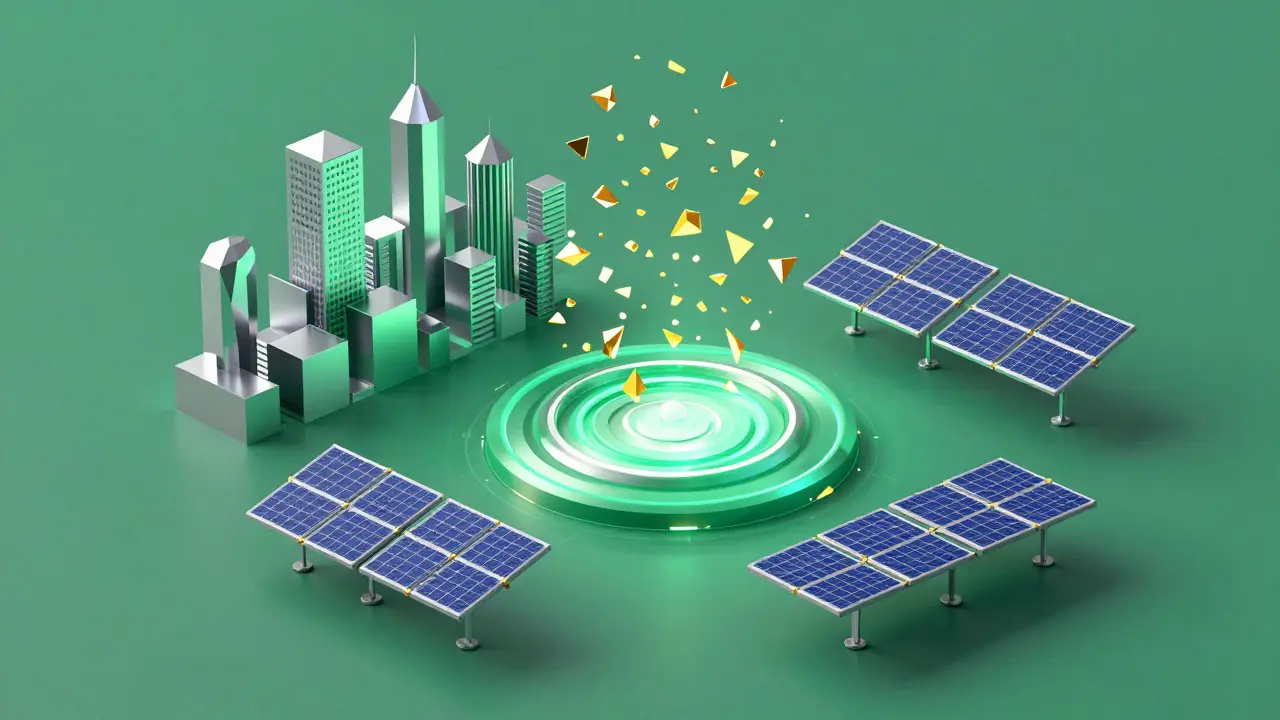
The most exciting part of the DeFi trajectory isn't just "better banking," but the Tokenization of everything. We're moving past trading digital coins to tokenizing physical assets. Imagine owning a fractional share of a solar farm or a piece of commercial real estate through a digital token. This allows for liquidity in assets that were previously "stuck" and impossible to trade quickly.
We are also seeing the rise of Stablecoins as a bridge. Large corporations are starting to use these to bypass traditional payment providers and reclaim the 2% transaction fees they currently lose. Furthermore, the development of government-backed digital assets, or CBDCs (Central Bank Digital Currencies), is creating a hybrid environment. While some fear the surveillance aspect of CBDCs, their integration with DeFi protocols could provide the institutional-grade stability that big enterprises need to fully commit to the ecosystem.
The Growing Pains: Risks and Reality Checks
It's not all sunshine and rainbows. The "be your own bank" philosophy is a double-edged sword. In the traditional world, if you lose your password, you call the bank. In DeFi, if you lose your private keys, your money is gone forever. There is no "forgot password" button on the blockchain. This irreversibility is a major psychological barrier for most people.
Then there's the learning curve. Even with better wallets, understanding concepts like "liquidity pools" or "impermanent loss" can take a newcomer weeks to grasp. Security is another hot topic; while the blockchain itself is secure, the smart contracts written by humans can have bugs. We've seen protocols drained by exploits, which underscores the need for rigorous auditing and insurance layers within the DeFi space.
Where We Go From Here: The 2026-2030 Outlook
Looking ahead, DeFi won't simply delete traditional banks. Instead, we'll likely see a parallel system. Traditional banking will keep its grip on areas requiring heavy consumer protection and regulatory oversight, while DeFi will dominate high-efficiency use cases like instant global settlements and automated asset management.
The next few years will be defined by the "invisible' transition. You won't need to know how a smart contract works to use it, just like you don't need to know how TCP/IP works to browse the web. The complexity will be hidden behind intuitive interfaces, and the backend will be powered by a blend of decentralized protocols and government-regulated digital assets. For the small business owner, this means a world where payment processing is a negligible cost rather than a monthly headache.
Is DeFi safe for a regular person to use?
It depends on your risk tolerance. While the technology is robust, you are responsible for your own security. If you use a reputable wallet and avoid un-audited protocols, it is generally safe, but there is no central authority to recover funds if you make a mistake or lose your keys.
How does DeFi lower costs for small businesses?
By removing the middleman. Traditional payment processors charge fees for every single transaction to cover their infrastructure and profit. DeFi uses peer-to-peer networks and smart contracts to handle the transaction, reducing the cost to just the network fee (gas), which is often significantly lower.
What is the difference between a CBDC and a Stablecoin?
A Stablecoin is typically issued by a private company and pegged to an asset like the US Dollar. A CBDC (Central Bank Digital Currency) is digital money issued and regulated directly by a nation's central bank. One is a private tool, the other is official government tender in digital form.
How long does it take to learn how to use DeFi?
For basic tasks like sending and receiving funds via a wallet, most people can get proficient in 2-4 weeks. However, advanced strategies like yield farming, providing liquidity, and managing complex portfolios usually require 2-3 months of study and practice.
Will DeFi eventually replace all banks?
Unlikely. Banks provide services like fraud protection, legal recourse, and physical identity verification that are hard to replicate in a fully decentralized system. DeFi will likely exist alongside traditional finance, offering a faster, cheaper alternative for specific financial operations.
Alex Mazonowicz
April 27, 2026 AT 17:30This is such an exciting time to be alive!!! I really believe we are on the cusp of a financial revolution that helps everyone!!!
Andrew Todd
April 29, 2026 AT 14:42Whatever. US banks are the best in the world and we dont need some weird code to replace them. Most of this is just fake money for people who dont have real jobs.
Felix Eduardo Velasquez
May 1, 2026 AT 12:40The shift toward tokenization represents a fundamental change in how we perceive ownership. By decoupling the asset from its physical location and converting it into a digital ledger entry, we are essentially redefining the concept of liquidity. This is not merely a technical upgrade but a philosophical pivot. In a world where everything is tokenized, the friction of trade disappears, but we must consider if the loss of tangible ownership affects our psychological connection to value. If I own a fraction of a forest via a token, do I still feel the stewardship that a traditional landowner feels? The efficiency is undeniable, but the ontological impact on wealth is something we are only beginning to grasp. We are moving toward a state of pure financial abstraction where the medium is the message.
Rain Richardsson
May 3, 2026 AT 11:42I agree with the point on UX. It needs to be seamless.
Jimmy vasquez
May 3, 2026 AT 14:39Just a tip for anyone starting out: look into hardware wallets like Ledger or Trezor. They keep your keys offline, which is the best way to avoid those smart contract exploits mentioned. It's a small investment for a lot of peace of mind!
Emily A
May 4, 2026 AT 12:03The author completely glosses over the systemic risk of oracle failure. If the data feed providing the price of an asset is manipulated, the entire smart contract executes based on a lie, regardless of how "secure" the blockchain is. It is frankly naive to present DeFi as a safer alternative without emphasizing that the protocol is only as reliable as its weakest external data dependency.
Kristi Swartz
May 4, 2026 AT 18:30it is obvious that the ethics of this are missing here because people just want money and do not care about the environment or the poor people who cannot use computers
Iestyn Lloyd
May 5, 2026 AT 16:20From a UK perspective, the regulatory approach has been quite measured. We are seeing a slow but steady integration of these protocols into the legal framework, which usually helps with institutional confidence.
Gabby Puche
May 7, 2026 AT 07:19Love the vibe of the future! 🚀 Just keep learning and stay curious everyone!! 💎🙌
Lynne Teperman
May 7, 2026 AT 23:57wild west energy for sure but those fees are a total vibe killer
AP Fisher
May 9, 2026 AT 15:51I wonder if this will eventually help people in countries with crazy inflation. It seems like a way to save money without needing a government that works.