
SushiSwap on Celo Review: How to Trade, Fees, and Risks in 2026

Imagine wanting to trade crypto without handing your keys over to a corporation. That is the promise of decentralized exchanges (DEXs). But when you look at SushiSwap specifically on the Celoa mobile-first blockchain platform focused on financial inclusion and stablecoin transactions network, things get a bit tricky. Many users search for this specific combination because they want low fees and fast transactions associated with Celo, paired with the liquidity depth of SushiSwap. Here is the hard truth right out of the gate: as of mid-2026, SushiSwap does not have a native, direct deployment on the Celo blockchain in the same way it operates on Ethereum or Polygon.
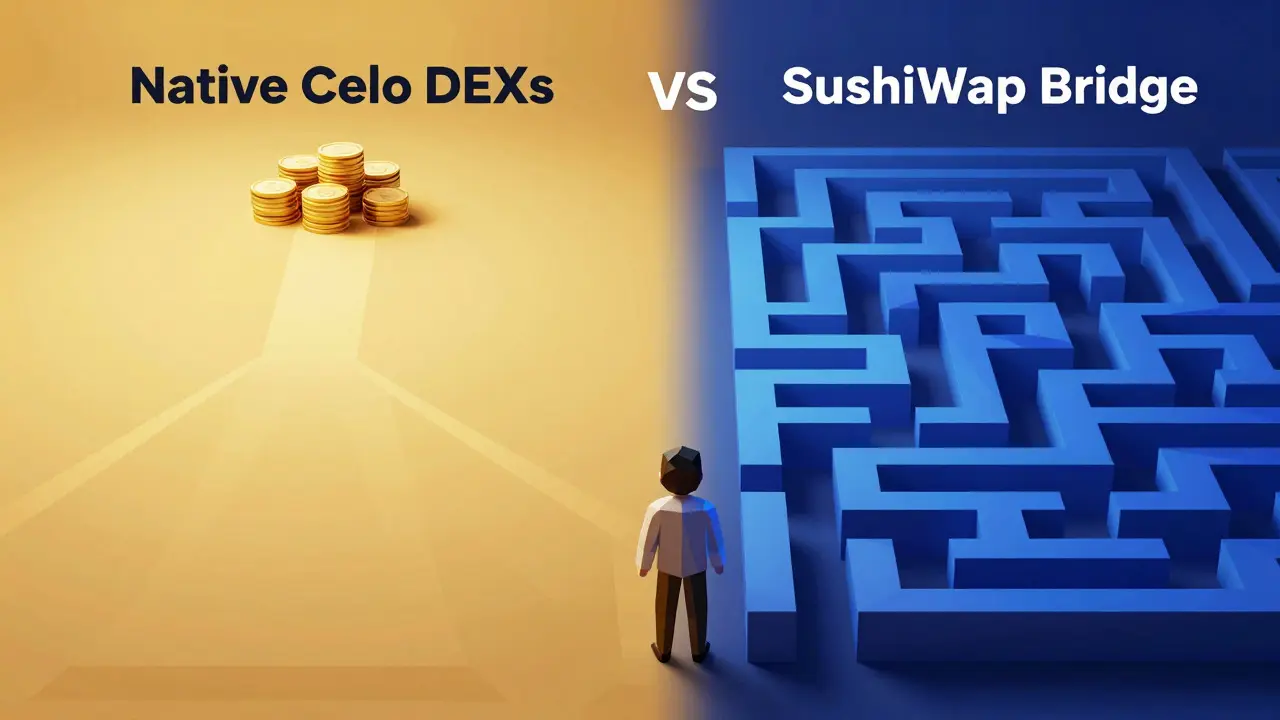
This doesn't mean you are stuck. It means you need to understand how cross-chain bridges work if you want to use SushiSwap while holding assets on Celo. This review breaks down exactly how that works, the costs involved, and whether it makes sense for your portfolio compared to native Celo DEXs.
What Is SushiSwap and Why Does Chain Matter?
SushiSwapa decentralized exchange protocol that allows users to swap tokens directly from their wallets using automated market maker pools started as a fork of Uniswap in 2020. Its main selling point was community governance and rewarding liquidity providers with its native SUSHI tokenthe governance and utility token of the SushiSwap ecosystem used for voting and staking rewards. Over time, it became a multi-chain giant. You can find it on Ethereum, Arbitrum, Optimism, Polygon, and BNB Chain.
Why does the chain matter? Because each blockchain has different speeds and costs. Ethereum Mainnet is secure but expensive during peak hours. Polygon is cheap and fast. Celo is designed for mobile payments and stability, often featuring lower gas fees than Ethereum but higher than some Layer 2 solutions. If SushiSwap isn't natively on Celo, every trade involves moving data across chains, which adds time and potential risk.
| Feature | SushiSwap (via Bridge) | Ubeswap (Native Celo) | Centralized Exchange (CEX) |
|---|---|---|---|
| Asset Control | You hold keys (Non-custodial) | You hold keys (Non-custodial) | Exchange holds keys (Custodial) |
| Transaction Speed | Slow (Bridge + Swap) | Fast (Native) | Instant |
| Fees | High (Bridge fee + Gas + Swap fee) | Low (Gas only) | Variable (Trading fee + Withdrawal) |
| KYC Required | No | No | Yes |
The Reality of Using SushiSwap with Celo Assets
If you hold CELO or cUSD (Celo Dollar) and want to trade on SushiSwap, you cannot just connect your wallet and click "swap." You must first bridge your assets. This process usually involves converting your Celo assets into a wrapped version on a chain where SushiSwap lives, like Ethereum or Polygon.
Here is the step-by-step reality of this workflow:
- Choose a Bridge: You will likely use a bridge service like Connext, Synapse, or Hop Protocol. These services lock your tokens on Celo and mint equivalent tokens on the destination chain.
- Pay Bridge Fees: Bridges charge a fee for their service. This can range from 0.1% to 0.5% depending on congestion.
- Connect Wallet: Once your assets arrive on, say, Polygon, you connect MetaMask or WalletConnect to SushiSwap.
- Execute Trade: You perform your swap on SushiSwap. You pay the standard 0.3% trading fee unless you provide liquidity.
- Bridge Back (Optional): If you want your profits back on Celo, you repeat the bridging process in reverse.
Notice the friction? Two bridges plus a swap means three separate transactions, each with its own gas fee and security consideration. For small trades, these fees might eat up more profit than the trade itself generates. This is why many Celo users prefer native DEXs for daily activities.

Alternatives: Native Celo DEXs
Before you go through the hassle of bridging, consider if you actually need SushiSwap. The Celo ecosystem has robust native decentralized exchanges. Ubeswapa leading decentralized exchange built specifically on the Celo blockchain offering low-fee token swaps is the most prominent example. It offers deep liquidity for major pairs like CELO/cUSD and CELO/ETH.
Another option is Moola Marketa decentralized lending and borrowing protocol on Celo that also facilitates asset swapping, which integrates well with other DeFi apps. If your goal is simply to swap tokens quickly and cheaply within the Celo ecosystem, Ubeswap is almost always the better choice. It avoids bridge risks entirely.
However, there is one scenario where SushiSwap wins: Exotic Pairs. If you are looking for a niche token that exists on Ethereum but hasn't been listed on Celo's native DEXs yet, SushiSwap might be your only non-custodial option. In this case, the bridge cost is the price of access to a wider market.
Security Risks: Bridging vs. Native Trading
Security is the biggest concern when leaving the Celo chain. When you trade natively on Celo, your risk is limited to smart contract bugs within that specific environment. When you bridge to use SushiSwap, you introduce bridge risk.
Bridges are historically the weakest link in DeFi security. They hold massive amounts of value and are frequent targets for hackers. While reputable bridges use multi-signature wallets and audited code, no system is perfect. By bridging your assets off Celo, you expose them to the security posture of the bridge provider and the destination chain.
Additionally, SushiSwap itself relies on Automated Market Makers (AMMs)algorithmic systems that replace traditional order books by using liquidity pools to determine token prices. This means you face Impermanent Loss if you provide liquidity. If you are just swapping, you face Slippage. On less liquid pairs, slippage can be high, meaning you get fewer tokens than expected. Always check the "Price Impact" warning before confirming any transaction on SushiSwap.
How to Minimize Costs and Risk
If you decide the exotic pair on SushiSwap is worth the effort, follow these tips to protect your capital:
- Batch Your Transactions: Instead of bridging $100 today and $100 tomorrow, wait until you have a larger amount to move. Bridge fees are often fixed or percentage-based with minimums, so larger batches reduce the relative cost.
- Use Aggregators: Tools like 1inch or Matcha can sometimes find cheaper routing paths for swaps on SushiSwap, reducing slippage.
- Check Gas Prices: Avoid bridging or swapping during peak hours on Ethereum or Polygon. Use sites like Etherscan Gas Tracker to find quiet periods.
- Verify Contract Addresses: Never click links from social media. Bookmark the official SushiSwap URL. Phishing sites are common in the DEX space.
Who Should Use SushiSwap on Celo?
This setup is not for everyone. It is best suited for:
- DeFi Degens: Traders hunting for alpha on new tokens listed on Ethereum but not yet on Celo.
- Liquidity Providers: Users who want to earn SUSHI rewards by providing liquidity on major chains, then occasionally rebalancing from Celo holdings.
- Privacy Advocates: Those who refuse to use centralized exchanges (CEXs) and need access to broader markets without KYC.
For the average user who just wants to swap CELO for USDC or buy a few tokens, stick to native Celo DEXs like Ubeswap. Save the bridge fees and avoid the complexity.
Is SushiSwap officially available on the Celo blockchain?
As of 2026, SushiSwap does not have a native, direct deployment on the Celo blockchain. To use SushiSwap with Celo assets, you must bridge your tokens to a supported chain like Ethereum, Polygon, or Arbitrum first.
What is the cheapest way to trade on Celo?
The cheapest way is to use native Celo DEXs like Ubeswap. These platforms operate directly on the Celo network, avoiding expensive cross-chain bridge fees and high gas costs associated with Ethereum.
Do I need to verify my identity (KYC) to use SushiSwap?
No. SushiSwap is a decentralized exchange (DEX), which means it is non-custodial and permissionless. You only need a compatible crypto wallet like MetaMask or WalletConnect. No personal information or ID is required.
What are the risks of bridging assets from Celo to SushiSwap?
The primary risks are bridge hacks and smart contract vulnerabilities. Bridges hold significant value and are frequent targets for attackers. Additionally, you face impermanent loss if providing liquidity and slippage when swapping large amounts on illiquid pairs.
Can I earn SUSHI tokens by providing liquidity on Celo?
Not directly on Celo, since SushiSwap isn't natively deployed there. However, you can bridge your Celo assets to Polygon or Ethereum, provide liquidity on SushiSwap, and earn SUSHI rewards. Just remember to factor in the bridge costs when calculating your potential profit.