
SushiSwap (Haqq) Crypto Exchange Review: How It Works, Fees, and Why It Stands Out

When you think of decentralized exchanges, Uniswap usually comes to mind first. But there’s another player that’s been quietly building a loyal following: SushiSwap. Not just another fork of Uniswap - it’s a community-driven platform with real rewards, multi-chain support, and a governance model that actually pays you for participating. If you’ve ever swapped tokens on Ethereum and gotten burned by gas fees, or if you’re looking for better yields than what centralized exchanges offer, SushiSwap deserves your attention.
What Is SushiSwap?
SushiSwap is a decentralized exchange (DEX) that lets you trade cryptocurrencies without a middleman. Unlike centralized platforms like Binance or Coinbase, there’s no account, no KYC, and no company holding your funds. Instead, trades happen directly between wallets using smart contracts on the blockchain. It launched in September 2020 as a fork of Uniswap, but quickly added features Uniswap didn’t have - especially around rewards and governance.
The native token, SUSHI, isn’t just for trading. It’s the backbone of the whole system. When you stake SUSHI in the SushiBar, you get xSUSHI, which gives you a cut of every trade made on the platform. That’s 0.05% of all trading fees - on top of the standard 0.25% that liquidity providers earn. This dual-reward structure is rare in DeFi and one of the main reasons users stick around.
How SushiSwap Works
At its core, SushiSwap uses an Automated Market Maker (AMM) model. That means there are no order books. Instead, trades happen against liquidity pools - pairs of tokens locked in smart contracts. For example, if you want to swap ETH for USDC, you’re trading against a pool that already has both tokens in it. The price adjusts automatically based on supply and demand using the formula x*y=k.
Every trade costs 0.3%. Out of that:
- 0.25% goes to liquidity providers (LPs)
- 0.05% goes to xSUSHI holders
You don’t need to be a whale to participate. Even small traders can add liquidity to pools like ETH/USDC or SUSHI/DAI and earn fees. But here’s the catch: you need to deposit equal value of both tokens. If you want to add $100 worth of ETH, you also need $100 worth of USDC. The platform doesn’t let you deposit just one.
Multi-Chain Power: More Than Just Ethereum
When SushiSwap started, it was stuck on Ethereum. High gas fees and slow transactions made it frustrating for everyday users. But by late 2025, it had expanded to over 30 blockchains - including Polygon, Binance Smart Chain, Avalanche, Fantom, and now Haqq. That’s huge.
Haqq Network, an Ethereum-compatible blockchain built for Islamic finance, became a major integration target in 2025. SushiSwap’s presence on Haqq means users in Southeast Asia and the Middle East can now trade crypto with lower fees and faster confirmations. Haqq’s average transaction cost is under $0.01, compared to Ethereum’s $1.50-$5.00. For small traders, this is a game-changer.
According to DeFi Llama’s October 2025 data:
- Ethereum: 62% of SushiSwap’s total value locked (TVL)
- Binance Smart Chain: 23%
- Polygon: 9%
- Haqq and other chains: 6%
This multi-chain strategy isn’t just for show. It lets users avoid Ethereum congestion entirely. If gas spikes, you just switch to Haqq or Polygon. That flexibility is why SushiSwap’s daily trading volume hit $470 million in October 2025 - despite Uniswap’s dominance.
Fees, Slippage, and Real-World Costs
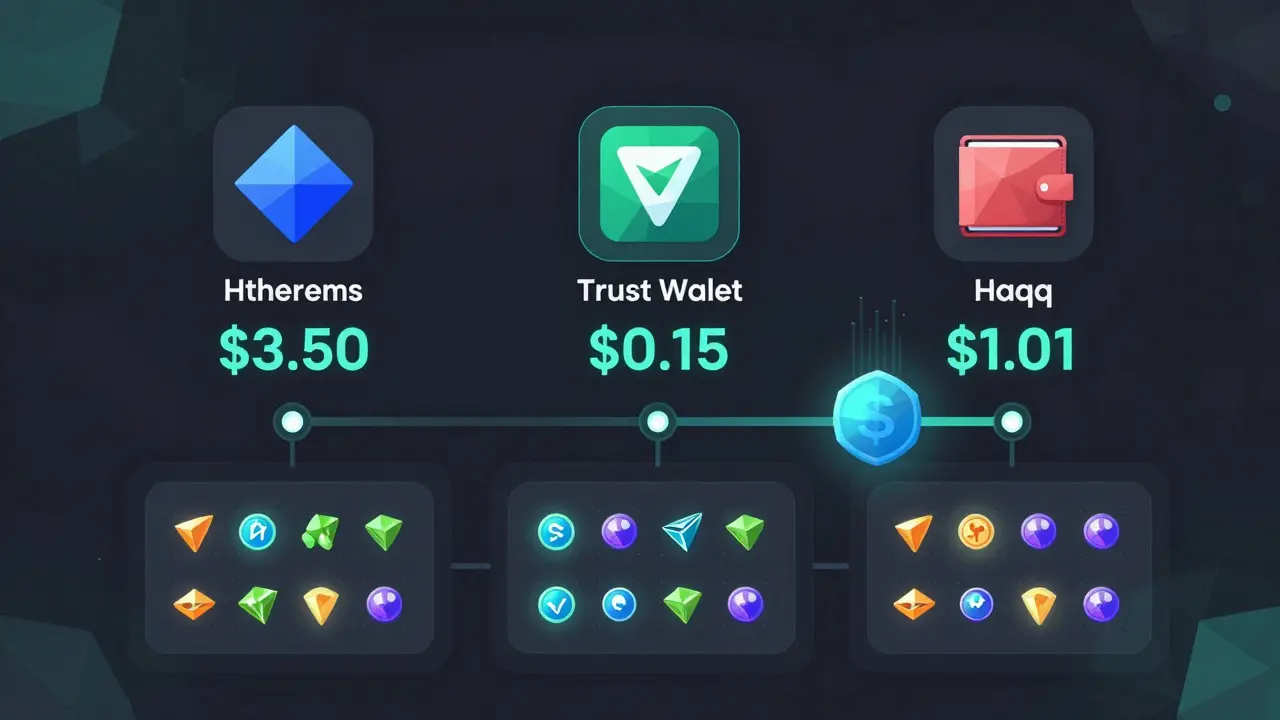
Let’s be honest: fees are where SushiSwap hurts. On Ethereum, a simple swap of $200 in ETH to USDC can cost $38 in gas during peak times. That’s more than 18% of your trade value. Users on Reddit and Trustpilot have called this “unacceptable.”
But here’s the workaround: use a different chain. On Haqq, that same swap costs $0.02. On Polygon, it’s $0.15. SushiSwap’s interface lets you pick your chain before you trade. Many experienced users now only use Ethereum for large, infrequent swaps and rely on Layer 2s or sidechains for daily trading.
Slippage - the difference between the price you see and what you get - is another concern. For $10,000 trades, SushiSwap averages 0.85% slippage. Uniswap? 0.62%. Why? Liquidity. Uniswap has more money in its pools. SushiSwap’s pools are smaller, especially for obscure tokens. According to DeFi Prime’s September 2025 report, 63% of SushiSwap pools have less than $1 million in liquidity. That means illiquid pairs can have wild price swings.
Pro tip: Always use the “Price Impact” slider in SushiSwap’s interface. If it shows over 2%, consider splitting your trade or waiting for better liquidity.
Security and Audits
SushiSwap’s smart contracts have been audited multiple times. The latest audit, done by PeckShield in September 2025, found zero critical vulnerabilities. That’s good. But audits don’t make you immune. The biggest risk isn’t the code - it’s you.
YouTube creators like CryptoCasey warn that new users often approve unlimited token access. That means if a malicious site tricks you into signing a transaction, they can drain your entire wallet. Always check the approval amount. Never approve “unlimited.” Set it to the exact amount you’re trading.
Also, never share your seed phrase. SushiSwap has no customer support team to call. If you lose access, you’re out of luck. The platform is designed to be self-custodial - which is great for freedom, but dangerous if you’re careless.
Community and Governance
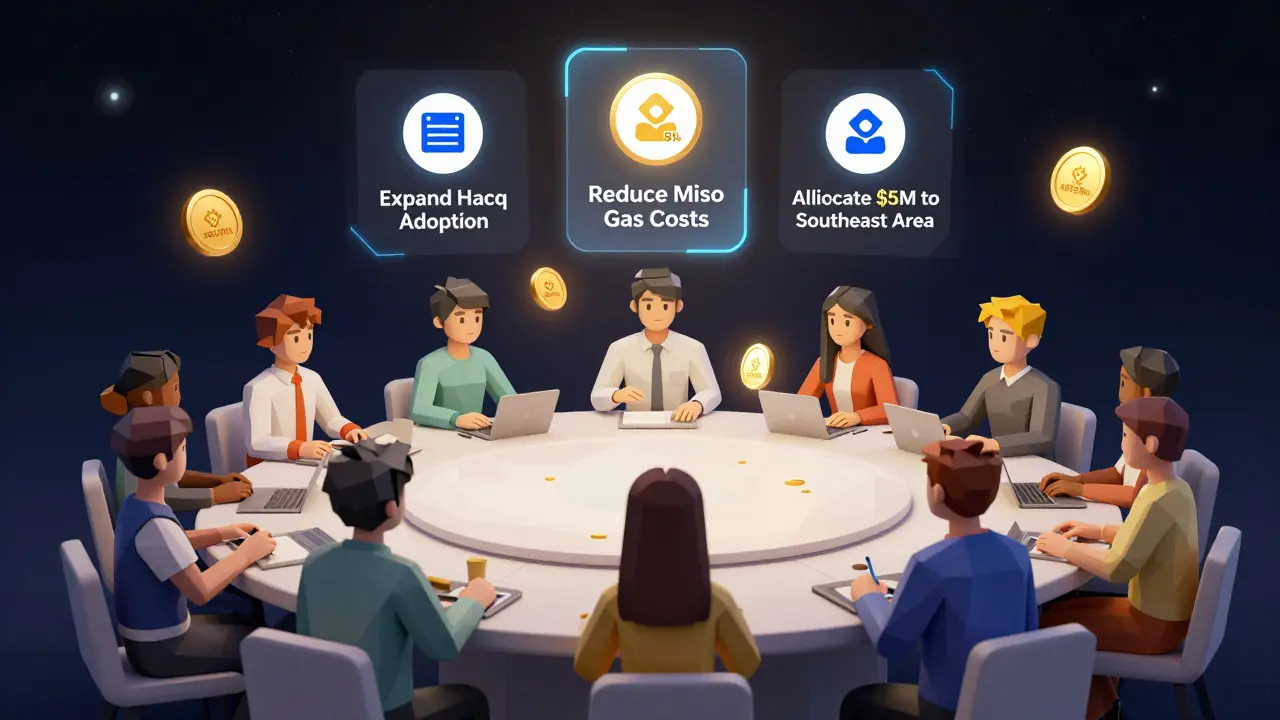
SushiSwap isn’t run by a CEO. It’s governed by its users. Every xSUSHI holder gets one vote on proposals. Recent votes include:
- Allocating $5 million to expand adoption in Southeast Asia (passed with 92.3% approval)
- Reducing gas costs on the Miso launchpad by 47%
- Adding support for Haqq Network
The community is active. Discord has over 142,000 members. GitHub shows 87 active contributors. And the team responds to bugs in under two weeks. This level of transparency is rare in crypto. Most projects hide behind anonymous founders. SushiSwap? They post their weekly updates, roadmap, and treasury spending publicly.
Staking and Earning Rewards
Want to earn passive income? SushiSwap’s Onsen program is one of the best in DeFi. It offers extra SUSHI rewards to liquidity providers on select pools. For example, the ETH/USDC pool on Haqq was offering 14.7% APY in late 2025. That’s far better than any centralized exchange.
Here’s how it works:
- Deposit ETH and USDC into the SushiSwap pool
- Receive LP tokens
- Stake those LP tokens in the Onsen program
- Earn both trading fees and bonus SUSHI
One Reddit user documented earning $1,200 in SUSHI rewards over six months on a $5,000 stake. That’s not guaranteed - yields drop as more people join - but it shows the potential.
SushiSwap vs Uniswap: The Real Difference
Uniswap is bigger. It has more liquidity, more volume, and more brand recognition. But SushiSwap has something Uniswap doesn’t: direct fee sharing.
Here’s the breakdown:
| Feature | SushiSwap | Uniswap |
|---|---|---|
| Trading Fee | 0.3% | 0.3% |
| Liquidity Provider Cut | 0.25% | 0.25% |
| Token Holder Fee Share | 0.05% to xSUSHI holders | None |
| Number of Chains | 30+ | 12 (mostly Ethereum + L2s) |
| TVL (Oct 2025) | $1.52B | $4.8B |
| Daily Volume | $470M | $3.2B |
| Governance Rewards | Yes - voting earns fees | Only voting - no fee share |
If you care about earning from trading fees, SushiSwap wins. If you just want to swap ETH for USDC with the lowest slippage, Uniswap is safer. But if you’re serious about DeFi, you should be using both.
Who Is SushiSwap For?
SushiSwap isn’t for everyone. If you’re new to crypto and want a simple app like Coinbase - skip it. But if you:
- Want to earn rewards from trading fees
- Use multiple blockchains
- Believe in community-owned platforms
- Are comfortable with wallet management
Then SushiSwap is one of the best tools in DeFi. Its integration with Haqq makes it especially valuable for users in emerging markets. The platform is evolving, not stagnating. With zkSync integration and Kashi lending protocol expansion planned for Q2 2026, it’s still growing.
Final Thoughts
SushiSwap isn’t perfect. Gas fees on Ethereum are still a nightmare. Liquidity for small tokens is thin. And yes, the early days were rocky - with the founder cashing out his tokens. But that’s not the platform anymore. Today, it’s a decentralized, community-run ecosystem with real utility.
It’s not trying to be Uniswap. It’s trying to be better. And in many ways, it already is.
Is SushiSwap safe to use?
Yes, but only if you manage your own security. The smart contracts have been audited and show no critical flaws. However, the biggest risk comes from user error - like approving unlimited token access or losing your private key. Always use a trusted wallet like MetaMask, never share your seed phrase, and double-check transaction details before confirming.
Can I trade SUSHI on Haqq Network?
Yes. SushiSwap officially launched on Haqq Network in early 2025. You can now swap SUSHI for other tokens like USDC, ETH, or HAQQ with gas fees under $0.02. This makes it one of the most cost-effective ways to trade SUSHI for users in Asia and the Middle East.
How do I earn rewards on SushiSwap?
There are two ways: First, provide liquidity to a trading pair (like ETH/USDC) and earn 0.25% of all trades in that pool. Second, stake your SUSHI tokens in the SushiBar to get xSUSHI, which earns you 0.05% of all trading fees across the platform. You can also join the Onsen program to earn bonus SUSHI tokens on select pools.
What’s the difference between SUSHI and xSUSHI?
SUSHI is the native token you can buy and trade. xSUSHI is what you get when you stake SUSHI in the SushiBar. xSUSHI represents your staked position and gives you voting rights and a share of trading fees. You can’t trade xSUSHI directly - you must unstake it to get SUSHI back.
Why does SushiSwap have higher slippage than Uniswap?
Slippage happens when there’s not enough liquidity in a trading pair. Uniswap has over $4.8 billion in total value locked, while SushiSwap has $1.52 billion. For popular pairs like ETH/USDC, the difference is small. But for lesser-known tokens, SushiSwap’s pools are thinner, so large trades cause bigger price shifts.
Start small. Use Haqq or Polygon to avoid Ethereum fees. Stake your SUSHI. Watch the governance votes. And remember - in DeFi, you’re not just a user. You’re a stakeholder.
Maggie House
February 23, 2026 AT 19:03Dana Sikand
February 24, 2026 AT 05:16bella gonzales
February 24, 2026 AT 11:07Paul Reinhart
February 24, 2026 AT 19:42Cameron Pearce Macfarlane
February 25, 2026 AT 17:10Robert Kromberg
February 26, 2026 AT 22:10Elizabeth Smith
February 28, 2026 AT 05:00Carl Gaard
March 1, 2026 AT 17:52Nicki Casey
March 2, 2026 AT 19:17Jessica Carvajal montiel
March 4, 2026 AT 12:03Samantha Stultz
March 4, 2026 AT 13:18Sean Logue
March 5, 2026 AT 14:58Vishakha Singh
March 7, 2026 AT 04:14Daisy Boliaan
March 7, 2026 AT 06:09