
stETH vs rETH: A Complete Guide to Liquid Staking Tokens

Imagine locking your savings in a bank account that pays interest but won't let you withdraw the cash for five years. That was the reality of early Ethereum staking. You had to lock up your ETH, and while it earned rewards, you couldn't use it anywhere else. Then came liquid staking tokens, changing everything.
Tokens like stETH (from Lido) and rETH (from Rocket Pool) solve this problem. They give you a receipt for your staked ETH that you can trade, spend, or use in other apps while your original money keeps earning rewards. It’s like getting an interest-bearing deposit certificate that also works as credit card cash.
What Are Liquid Staking Tokens?
To understand why these tokens matter, you first need to know how traditional staking works. When Ethereum switched to Proof-of-Stake, users could help secure the network by locking up ETH. In return, they got paid rewards. But there was a catch: you needed at least 32 ETH to run your own validator node, and your funds were illiquid.
Liquid staking tokens (LSTs) fix both issues. You deposit any amount of ETH into a protocol. The protocol pools everyone's money together to run validators. In exchange, you get an ERC-20 token back. This token represents your share of the pool plus the rewards being earned.
The magic happens because these tokens are liquid. You don't have to wait to unlock your ETH. You can sell the token on an exchange, use it as collateral to borrow stablecoins, or provide liquidity in a decentralized finance (DeFi) pool. Your capital works twice as hard.
How stETH Works: The Lido Model
Lido is currently the biggest player in this space. When you stake ETH with them, you receive stETH. Here is the simple breakdown of how it functions:
- Deposit: You send ETH to the Lido smart contract.
- Minting: Lido mints stETH tokens and sends them to your wallet. Initially, 1 ETH equals 1 stETH.
- Rebasing: This is the key feature. As Lido’s validators earn rewards from the Ethereum network, the total supply of stETH increases slightly every day. If you hold stETH in your wallet, your balance automatically goes up. You don’t need to do anything.
- Redemption: You can swap stETH back for ETH on exchanges or through Lido’s withdrawal queue when you want your original principal back.
Lido has grown massively fast. Recent data shows that about 23% of all ETH is staked, and roughly 32% of that staked amount flows through Lido. That means stETH represents about 7% of the entire ETH supply. This dominance makes it highly liquid, meaning you can easily buy or sell it without moving the price too much.
How rETH Works: The Rocket Pool Difference
Rocket Pool offers a different approach with its token, rETH. While the goal is the same-staking ETH while keeping liquidity-the mechanics differ significantly.
Rocket Pool focuses on decentralization. Unlike Lido, which uses a curated list of professional validators chosen by a DAO, Rocket Pool allows anyone to become a "Node Operator" if they stake 16 ETH. Smaller stakers (called "Stakers") can deposit as little as 0.01 ETH. The Node Operator provides the remaining ETH and runs the hardware.
Here is how rETH handles rewards differently than stETH:
- No Rebasing: Your rETH balance stays exactly the same number forever. You will not see your wallet balance change daily.
- Exchange Rate Appreciation: Instead of getting more tokens, each rETH token becomes worth more ETH over time. For example, today 1 rETH might equal 1.1 ETH. Next year, it might equal 1.2 ETH.
- Smaller Minimums: Because of the split between Node Operators and Stakers, the barrier to entry for running the infrastructure is lower (16 ETH vs 32 ETH), though individual stakers can still enter with tiny amounts.
This design appeals to people who worry about centralization. Rocket Pool has many more independent operators running nodes compared to Lido, which relies heavily on large professional firms.
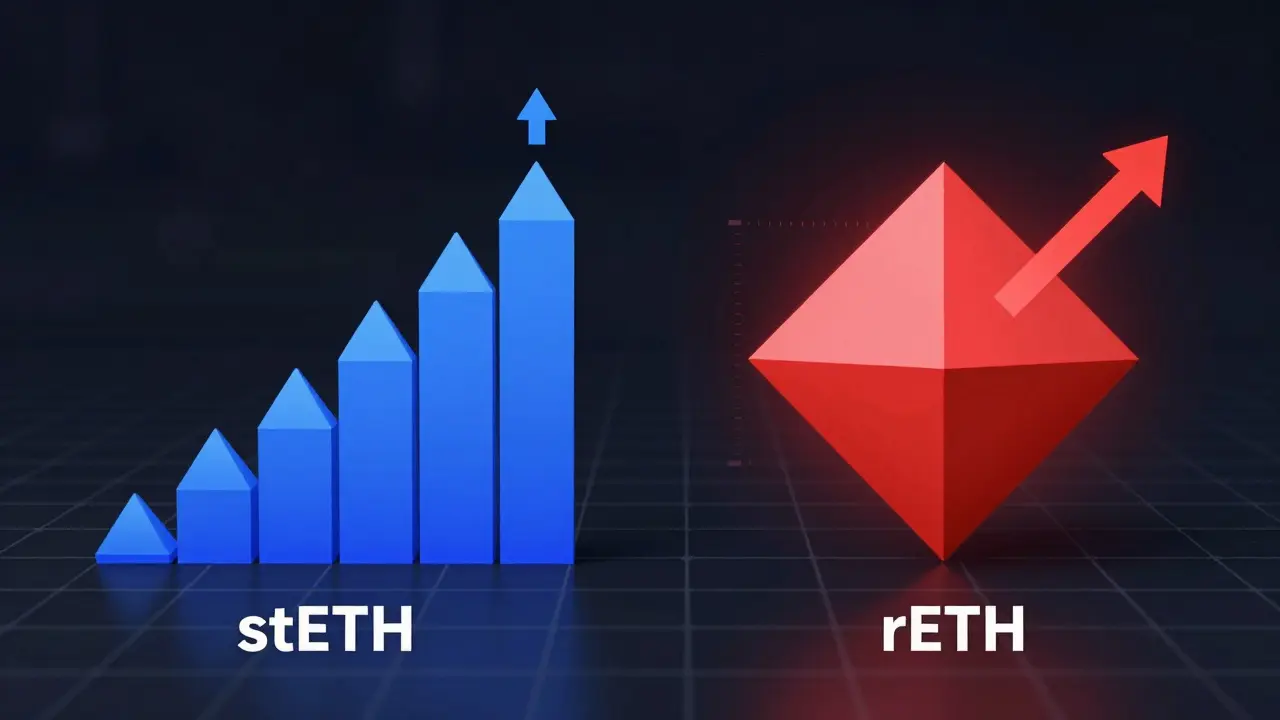
Key Differences: stETH vs rETH
Choosing between these two depends on what you value more: ease of use and market depth, or decentralization and specific token mechanics. Let’s look at the side-by-side comparison.
| Feature | stETH (Lido) | rETH (Rocket Pool) |
|---|---|---|
| Reward Mechanism | Rebasing (Balance grows) | Accruing Value (Exchange rate rises) |
| Minimum Stake | None (any amount) | None for Stakers (any amount) |
| Validator Structure | Curated professional validators | Distributed Node Operators |
| Market Share | Dominant (~32% of staked ETH) | Smaller but growing |
| DeFi Integration | Extremely high | High, but less than stETH |
| Centralization Risk | Higher concern due to size | Lower due to distribution |
Why Does This Matter? Capital Efficiency
The real power of these tokens isn't just the staking yield (which is usually around 3-4% APY). It’s what you can do with the token afterward. This concept is called capital efficiency.
Let’s say you have 10 ETH. If you stake it natively, you earn ~3.5% per year. Total return: 3.5%.
If you use stETH, here is a common strategy:
- You deposit 10 ETH and get 10 stETH.
- You lend those 10 stETH on a platform like Aave to earn another 2% interest.
- You borrow 5 USDC against that collateral.
- You use the USDC to buy more assets or provide liquidity elsewhere.
Now you are earning staking rewards + lending yield + potential trading profits. You’ve turned one asset into multiple income streams. This is why DeFi protocols love LSTs. They act as super-collateral.

Risks You Need to Know
Nothing in crypto is free money. Liquid staking introduces new risks that don't exist with native staking.
Smart Contract Risk
When you use native staking, you only trust the Ethereum code. With Lido or Rocket Pool, you are trusting their smart contracts too. If there is a bug in the Lido contract, your stETH could be drained. Both protocols undergo regular audits, but bugs can still slip through.
De-pegging Risk
stETH is supposed to always equal 1 ETH. But in panic situations, or if liquidity dries up, it might trade at $0.98 ETH or $0.95 ETH. If you need to sell quickly during a crash, you might lose value. rETH doesn't have a "peg" in the same way, but its exchange rate can also fluctuate based on market sentiment.
Centralization Concerns
Because Lido controls such a huge chunk of the staked ETH, some developers worry about censorship. If Lido decides to censor certain transactions (highly unlikely but theoretically possible), it affects the whole network. Rocket Pool argues its distributed model prevents this single point of failure.
Which One Should You Choose?
There is no single right answer. It depends on your goals.
Choose stETH if:
- You want the easiest experience with the most tutorials and support.
- You plan to use the token in various DeFi apps, as stETH is accepted almost everywhere.
- You prefer seeing your balance grow visually every day (rebasing).
Choose rETH if:
- You care deeply about decentralization and want to avoid relying on one giant protocol.
- You dislike rebasing tokens because they can break some older DeFi interfaces (non-rebasing tokens are often easier for developers to integrate).
- You believe in the long-term value of a more distributed Ethereum validator set.
Getting Started
Starting is straightforward. You don't need to be a developer.
For stETH:
- Connect your wallet (like MetaMask) to the Lido website.
- Select "Stake" and approve the transaction to send your ETH.
- Receive stETH in your wallet immediately.
For rETH:
- Connect your wallet to the Rocket Pool dashboard.
- Click "Stake" and select the amount of ETH.
- Confirm the transaction. You will receive rETH shortly after.
Always double-check the URL to avoid phishing sites. And remember, never invest more than you can afford to lose, especially when dealing with complex DeFi strategies.
Is stETH safe to hold?
stETH is considered relatively safe because it is backed 1:1 by staked ETH and managed by a well-audited protocol. However, it carries smart contract risk and de-pegging risk. It is safer than holding volatile altcoins but riskier than holding plain ETH in a cold wallet.
Can I convert stETH to rETH?
You cannot directly swap them on the Lido or Rocket Pool platforms. To convert, you must sell your stETH for ETH (or WETH) on a decentralized exchange like Uniswap, then deposit that ETH into Rocket Pool to mint rETH. Be aware of gas fees and slippage during the swap.
Why does my stETH balance change every day?
This is due to the "rebasing" mechanism. As Lido's validators earn rewards from the Ethereum network, the protocol distributes these rewards by increasing the total supply of stETH. Since you own a percentage of that supply, your specific token count increases slightly to reflect your share of the new rewards.
What happens if Lido goes bankrupt?
Lido itself doesn't hold the ETH; the Ethereum blockchain does. Even if the Lido company dissolved, the stETH smart contracts would remain active. Users could still redeem their stETH for underlying ETH, although the process might become slower or more expensive without active management. The primary risk is a hack of the smart contracts, not corporate bankruptcy.
Do I pay taxes on staking rewards?
In many jurisdictions, including New Zealand and the US, staking rewards are considered taxable income at the fair market value when received. For rebasing tokens like stETH, this can be complex since your balance changes daily. Consult a local tax professional for accurate advice tailored to your location.
Jay Sharma
June 28, 2026 AT 18:52the whole point of decentralization is being bypassed by these giant centralized pools. lido controls too much voting power and it's just a matter of time before they censor transactions or get regulated into oblivion. rocket pool is the only honest way to do this because the node operators are actual humans with skin in the game not faceless corporations running servers in virginia.
John Curry
June 29, 2026 AT 07:52it is fascinating how we have created financial instruments that mimic traditional banking but strip away the safety nets while adding layers of cryptographic complexity. the rebasing mechanism feels like a psychological trick to make users feel productive when they are simply watching numbers go up on a screen.
Trent Erman1
June 29, 2026 AT 21:28Great breakdown! I really appreciate the clarity on the difference between rebasing and accruing value. For those new to DeFi, rETH might be less confusing at first glance since your balance stays static, but stETH has so much more liquidity depth right now. It’s all about what fits your strategy best!
Fiona Ellis
June 30, 2026 AT 19:13I must interject here because the section on risks was woefully inadequate. You cannot simply gloss over the smart contract risk as if audits guarantee safety. The history of DeFi is littered with audited protocols that got drained within hours of launch. Furthermore, the centralization of Lido poses an existential threat to Ethereum’s censorship resistance which many casual investors seem entirely oblivious to. One does not simply 'trust' a DAO without understanding the political dynamics within its governance token holders.
Maurice Flynn
July 1, 2026 AT 22:21just chill out guys. both work fine for most people. i use steth because it is everywhere and i dont want to deal with slippage when i try to move large amounts. rocket pool is cool for ideology but idk if i care enough about validator distribution to sacrifice ease of use.
Rebecca Shoniker
July 2, 2026 AT 09:53Let us be absolutely clear: the notion that one can achieve 'capital efficiency' through these leveraged strategies is fundamentally flawed for the average retail participant. The yield you earn from lending stETH is often negated by the impermanent loss incurred in liquidity pools, not to mention the tax implications of daily rebasing events which create taxable income every single day regardless of whether you realize gains. It is a trap designed to keep you engaged in a high-risk environment under the guise of passive income. Do not fall for it.
Melissa L
July 3, 2026 AT 10:06i just want my eth to grow lol. steth seems easier bc i see the number go up everyday. thats satisfying. rEth looks boring even tho i know it works same.
ross harris
July 5, 2026 AT 09:33look at these sheep flocking to lido like moths to a flame. they think they are securing the network but they are just feeding the beast. the exchange rate appreciation of rETH is the only sane way to handle accruals because rebasing tokens break composability in subtle ways that will haunt developers for years. it is a technical debt bomb waiting to explode.
nancy jarecki
July 6, 2026 AT 23:29The entire premise of liquid staking is derivative and redundant. True believers should stake natively. If you cannot afford 32 ETH or run a node, you do not deserve exposure to the layer one consensus mechanism. Using LSTs is essentially renting out your sovereignty to a third party protocol that introduces unnecessary attack vectors. It is intellectually lazy.
Jon Milton
July 7, 2026 AT 15:20You are missing the bigger picture here. This is not just about yields; it is about the geopolitical distribution of computing power. When Lido dominates, it concentrates influence among a few large entities. Rocket Pool allows for a more distributed validator set which aligns better with the ethos of open networks. We need to support protocols that prioritize decentralization over sheer market cap dominance.
Mélanie Boulay
July 8, 2026 AT 16:28I have been holding rETH for quite some time now, and I find the experience to be significantly more stable in terms of portfolio tracking because I do not have to account for the daily fluctuations in token count which can sometimes complicate things when trying to calculate cost basis for tax purposes, especially since the exchange rate increases gradually and predictably over time rather than spiking daily which makes it easier to understand exactly how much underlying ETH you actually own at any given moment without needing complex calculators.
Robert Hundley
July 10, 2026 AT 04:03Hey everyone! Just wanted to say that both options are solid. I started with stETH because of the liquidity but recently moved some to rETH to diversify. The community around Rocket Pool is super helpful too. Keep learning and stay safe out there! :)
Rob Morton
July 10, 2026 AT 20:18This is a really thoughtful analysis of the trade-offs. I am curious about the long-term sustainability of the rewards structure for both protocols. As Ethereum fees fluctuate, how do you think the APY for stakers will adjust compared to native staking? Is there a risk that protocol fees eat into the returns too much?
Routh Middaugh
July 11, 2026 AT 02:47It is interesting to note that the choice often comes down to personal preference regarding user interface and mental accounting. Some people prefer seeing their balance grow (stETH) while others prefer seeing the value of each unit increase (rETH). Both mechanisms ultimately deliver the same economic outcome over time, assuming no de-pegging events occur. The key is to understand which model fits your workflow better.
Ryan Peters
July 12, 2026 AT 03:11Typical crypto bro nonsense. You guys talk about decentralization but you are using US-based exchanges to swap these tokens anyway. The regulatory risk is real and Lido is already under scrutiny. Smart money knows that holding plain ETH in cold storage is the only play that doesn't involve trusting some random smart contract written by anonymous devs. Stop chasing yield and start securing your assets.
ELNORA JEFFERSON
July 13, 2026 AT 03:14Ugh. Another guide telling me what to do. I lost money on stETH during the flash crash last year and I am still bitter about it. The de-pegging risk is not theoretical; it happened. I am sticking to native staking now because at least I know where my keys are. These liquid tokens are just another way for protocols to extract value from users who don't read the whitepapers.
Carol @minaszilda
July 13, 2026 AT 03:17Don't let the risks scare you off completely. Education is key. Start small with an amount you can afford to lose. Experiment with both to see which interface you prefer. The benefits of liquidity are significant if used correctly.
Nicole Woessner
July 14, 2026 AT 01:41From a cultural perspective, the adoption of LSTs represents a shift towards financial accessibility. In emerging markets where access to traditional banking is limited, the ability to stake small amounts of ETH and use the receipt token in DeFi applications provides a level of financial inclusion that was previously impossible. This technological democratization is profound.
Abby Martin
July 15, 2026 AT 17:27Let me tell you something. Most of you are walking around blindfolded. The centralization of Lido is a ticking time bomb. When regulators come knocking, they will go after the biggest target first. Rocket Pool is decentralized by design which means there is no single entity to shut down. It is not just a preference; it is a survival strategy. Wake up.
Sajjad Ghorbani Moghaddam
July 17, 2026 AT 07:13If anyone is looking to get started, I recommend checking out the official documentation for both protocols. They have detailed guides on how to connect wallets and execute transactions safely. Always verify URLs to avoid phishing sites. Happy staking!