
Sidechain Use Cases and Benefits: How They Solve Blockchain Scalability Without Compromising Innovation

Sidechain Cost Calculator
Compare transaction costs between Ethereum mainnet and sidechain networks. Based on real-world data from Polygon and Ethereum.
Example: 1000 transactions
Ethereum Mainnet
Current Cost
$0.00
At peak transaction fees ($10 per transaction)
Sidechain (Polygon)
Current Cost
$0.00
At $0.0001 per transaction
You save $0.00
Savings represent 100% reduction in transaction costs
Important note: Sidechains offer speed and cost benefits but have different security trade-offs than Ethereum mainnet. Always consider security requirements for your use case.
Most people think blockchain scalability means just making transactions faster. But the real problem isn’t speed-it’s flexibility. If you want to build a game that handles 10,000 NFT trades per second, or a corporate supply chain that logs thousands of shipments daily, Ethereum’s base layer can’t handle it. And you don’t want to overload the main chain with every experimental feature. That’s where sidechains come in.
What Exactly Is a Sidechain?
A sidechain is a separate blockchain that runs parallel to a main blockchain-like Bitcoin or Ethereum-and connects to it through a two-way peg. This peg lets users move assets back and forth securely. Think of it like a toll bridge: your Bitcoin or ETH gets locked on the main chain, and an equivalent amount is released on the sidechain. When you want to go back, the sidechain tokens are burned, and the original ones are unlocked. This isn’t theoretical. Liquid Network, launched in 2017, was the first real-world sidechain built for Bitcoin. It’s used by exchanges like Bitfinex and Kraken to settle large trades in seconds instead of waiting 10+ minutes for Bitcoin confirmations. Polygon PoS, launched in 2020, became the go-to sidechain for Ethereum-based dApps because it slashed fees to pennies and cut finality time to under 3 seconds. Sidechains aren’t just faster. They’re customizable. While Bitcoin uses Proof-of-Work and Ethereum uses Proof-of-Stake, sidechains can pick their own rules. Liquid uses a federated model with 15 trusted nodes. Polygon uses a modified PoS system with hundreds of validators. This freedom lets developers build exactly what they need-whether it’s high-speed trading, private transactions, or specialized smart contracts.Why Use a Sidechain? Key Benefits
- Massive speed boost: Polygon PoS processes 7,000+ transactions per second. Ethereum’s mainnet? Around 15-30. That’s a 200x improvement.
- Near-zero fees: On Polygon, a typical transaction costs $0.0001. On Ethereum during peak times, it can hit $10 or more.
- Custom consensus: Need faster finality? Use a PoS sidechain. Need privacy? Build one with zero-knowledge proofs. You’re not stuck with the main chain’s rules.
- Reduced main chain congestion: By moving gaming, DeFi, and enterprise apps off the main chain, you keep Bitcoin and Ethereum stable and secure for high-value transfers.
- Faster innovation: Want to test a new token standard or smart contract feature? Deploy it on a sidechain. If it fails, the main chain stays untouched.
Real-World Use Cases That Actually Work
1. Gaming and NFTs
Immutable X, a sidechain built for gaming, handles 9,000 transactions per second. That’s why games like Gods Unchained and Illuvium run smoothly. Players mint, trade, and move NFTs without waiting or paying $50 in gas fees. The sidechain handles all the heavy lifting, while the main Ethereum chain only records the final ownership proofs when users cash out.2. Enterprise Supply Chains
Fortune 500 companies like Walmart and Maersk use sidechains to track goods. In one case, a pharmaceutical company moved its cold-chain logistics to a private sidechain connected to Ethereum. Each temperature sensor reading, warehouse scan, and customs clearance was recorded on-chain. The sidechain allowed them to control who could view or edit data-something impossible on a public chain. Transaction volume? Over 120,000 per day. Cost? Less than $100/month in fees.3. Digital Identity and Credentials
Adobe’s Content Credentials system uses a sidechain to verify the origin and edits of digital files. Photographers, journalists, and designers can prove their work hasn’t been altered. The sidechain stores hashes of edits, not the files themselves, keeping data lightweight and private. Over 2 million files have been verified this way since 2023.4. High-Frequency Trading and Settlement
Liquid Network lets crypto exchanges settle millions in Bitcoin trades within 2 minutes-instead of waiting 60+ minutes on the main chain. It’s not just faster. It’s safer. By using a federated model, Liquid avoids the risk of 51% attacks that could plague a smaller PoW chain. The 15 functionaries are all well-known, regulated entities.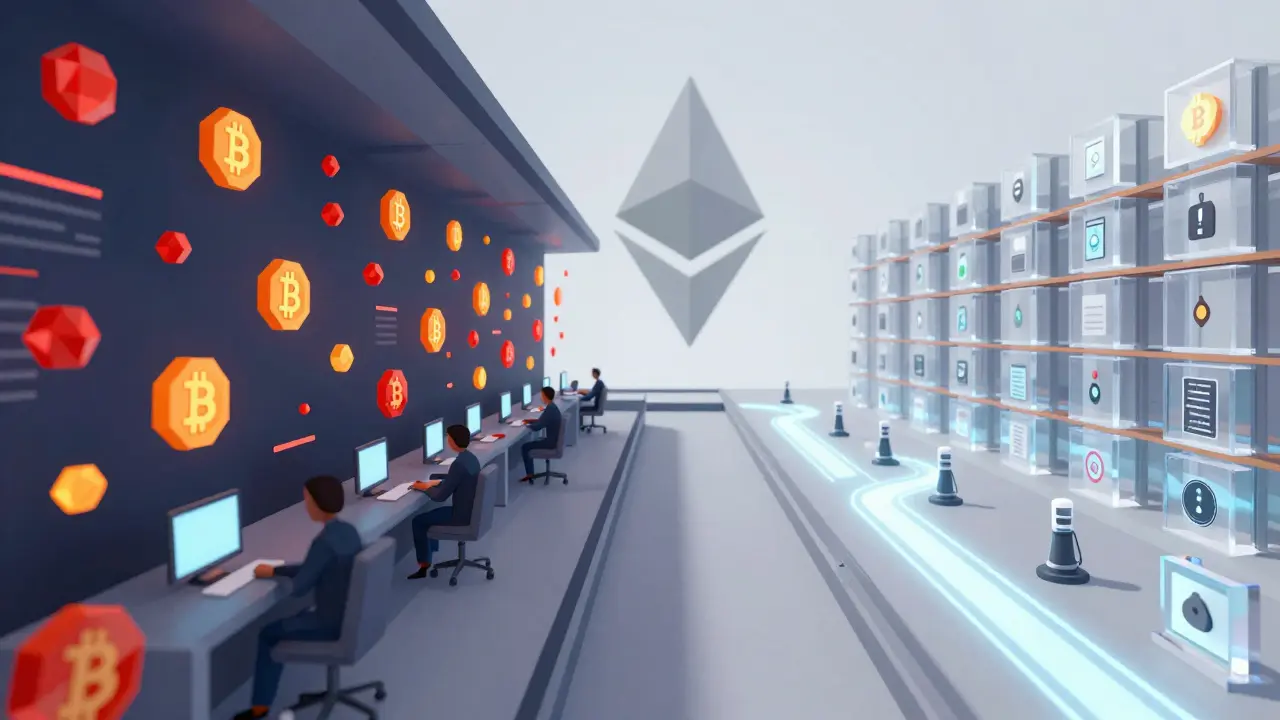
The Trade-Off: Security Isn’t Free
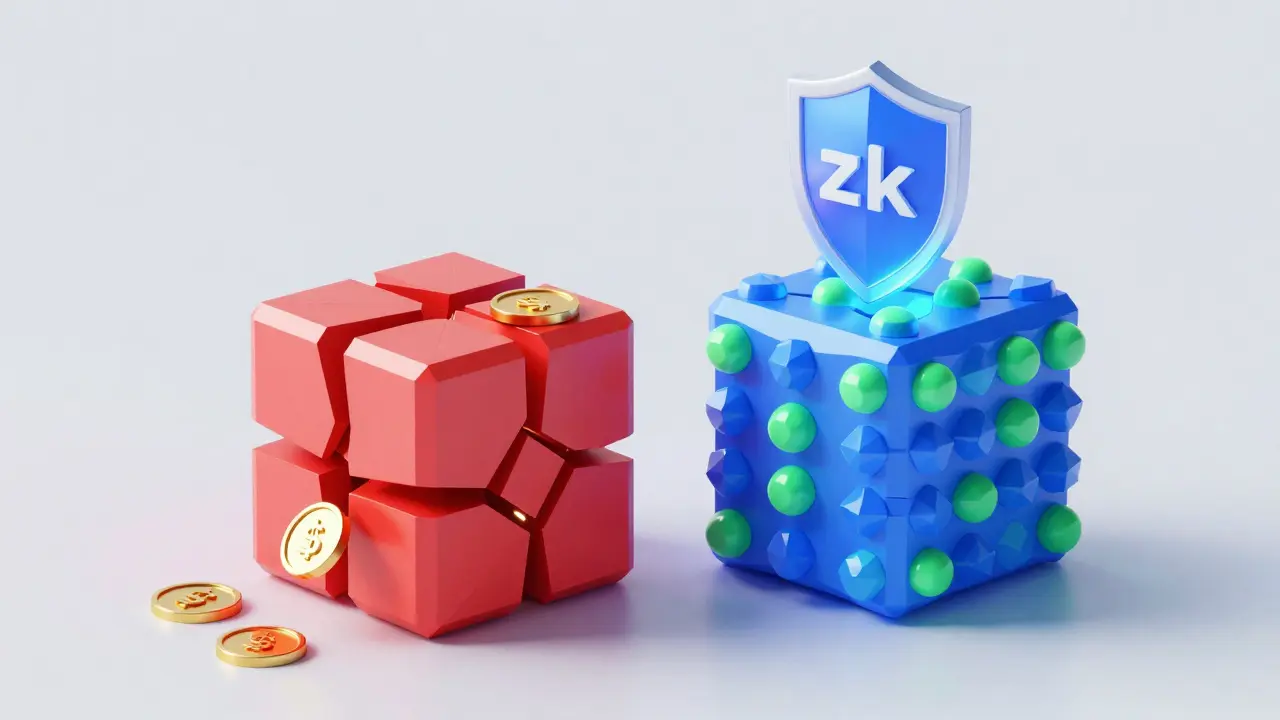
Sidechains aren’t perfect. The biggest downside? They don’t inherit the main chain’s security. Ethereum’s Layer-2 solutions like zk-Rollups are anchored directly to Ethereum’s security. If Ethereum is attacked, so are they. Sidechains? They’re on their own. Polygon PoS has around 65-70% of Ethereum’s security. That’s still strong-but not absolute. The Ronin Network hack in March 2022 proved the risk. Axie Infinity’s sidechain had only 5-of-9 validators. Hackers compromised 4 of them and stole $625 million. That’s not a flaw in the tech-it’s a flaw in the validator setup. Sidechains need strong, decentralized validator networks. If you rely on a handful of trusted nodes, you’re just building a private database with a blockchain label. Vitalik Buterin put it bluntly: sidechains are useful for specific apps, but they can’t match Layer-2 security. That’s why Polygon announced in late 2023 it was moving toward zk-Rollups. They’re keeping their sidechain for speed but adding a security layer on top.Sidechains vs. Layer-2: What’s the Difference?
People mix up sidechains and Layer-2s. They’re not the same.- Sidechains: Independent blockchains with their own validators and consensus. They use a two-way peg. Security is optional.
- Layer-2s (like Optimism, zkSync): Built on top of Ethereum. They bundle transactions and submit proofs back to Ethereum. They inherit Ethereum’s security.
What’s Changing in 2025?
The sidechain landscape is evolving fast.- Shared security models: Cosmos’ IBC protocol lets 32 sidechains share validator sets. This cuts individual security risks by 60% and makes cross-chain swaps smoother.
- Improved bridging: Ethereum’s Shanghai upgrade in 2023 made it cheaper and faster to move assets between chains. Bridging costs dropped 40%.
- Enterprise adoption: 72 Fortune 500 companies now use sidechains, mostly for supply chain and identity. That number is growing 34% a year, according to Gartner.
- Regulation catching up: The EU’s MiCA framework now treats sidechains as separate financial entities. That means they need licenses, audits, and compliance checks-just like banks.
Challenges You’ll Face When Using Sidechains
If you’re thinking about building on a sidechain, here’s what you need to know:- Bridging is tricky: Setting up a secure two-way peg requires deep crypto knowledge. Most projects get hacked not because of smart contracts-but because of weak bridge logic.
- Validator incentives: 68% of sidechain projects struggle to keep validators active. If no one’s running nodes, the chain dies. You need token rewards, staking, or enterprise partnerships.
- Developer tools vary: Polygon has excellent docs and SDKs (rated 4.3/5). Lesser-known sidechains? Some have documentation scores under 3/5. You’ll waste weeks just figuring out how to deploy a contract.
- Interoperability: Moving assets between sidechains isn’t seamless. You need third-party bridges, which add another point of failure.
Who Should Use Sidechains?
Sidechains aren’t for everyone. But they’re perfect if:- You’re building a game, social app, or NFT platform that needs high throughput.
- You’re a company needing private, permissioned blockchain for internal records.
- You want to test new features without risking the main chain.
- You’re okay with slightly lower security in exchange for speed and control.
Mark Stoehr
December 4, 2025 AT 15:40Shari Heglin
December 5, 2025 AT 04:21Murray Dejarnette
December 5, 2025 AT 12:50Maggie Harrison
December 6, 2025 AT 12:23alex bolduin
December 7, 2025 AT 10:05Althea Gwen
December 8, 2025 AT 21:22Sarah Roberge
December 9, 2025 AT 03:50Steve Savage
December 10, 2025 AT 00:45Layla Hu
December 10, 2025 AT 09:15Nora Colombie
December 11, 2025 AT 14:21Bhoomika Agarwal
December 12, 2025 AT 22:02Katherine Alva
December 13, 2025 AT 16:00Nelia Mcquiston
December 15, 2025 AT 04:33Philip Mirchin
December 16, 2025 AT 07:35Britney Power
December 17, 2025 AT 13:07ashi chopra
December 19, 2025 AT 11:34Akash Kumar Yadav
December 20, 2025 AT 23:07Marsha Enright
December 22, 2025 AT 18:33Andrew Brady
December 23, 2025 AT 15:10