
Removing Middlemen with Blockchain: A Practical Guide to Disintermediation
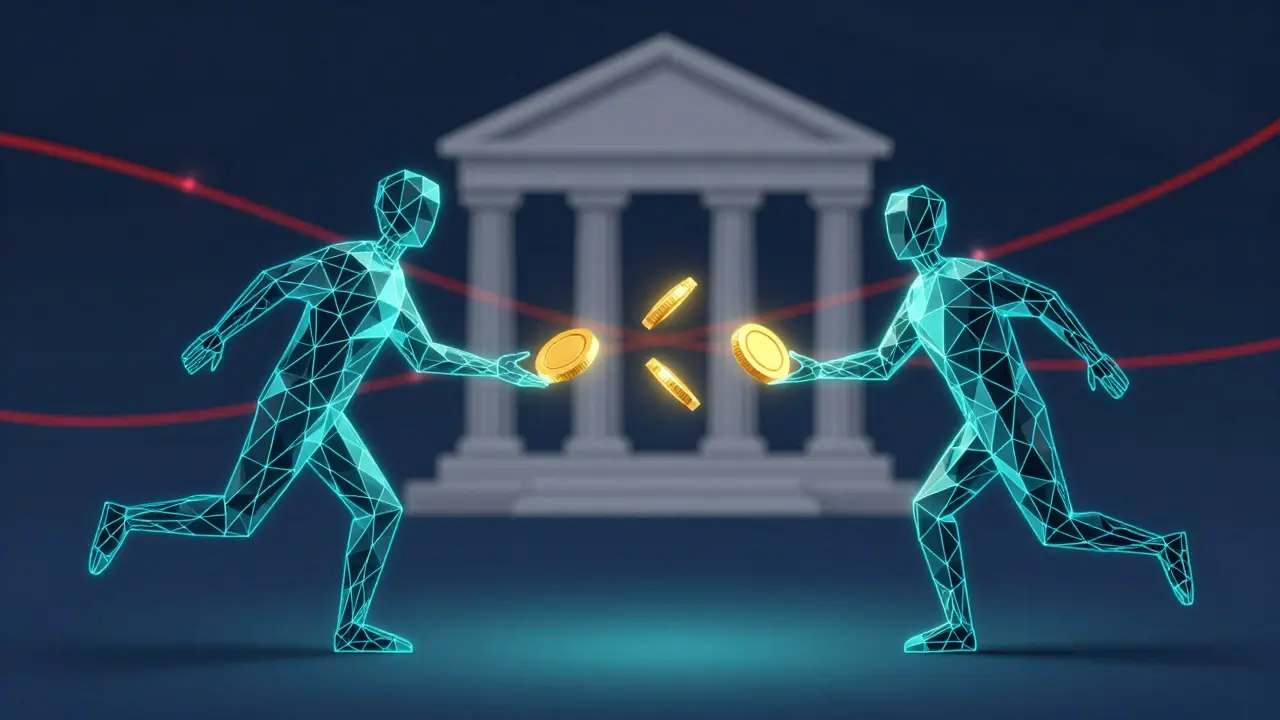
Imagine sending $5,000 to a family member overseas. In the traditional banking system, that money hits three or four banks before arriving. You wait days, pay fees totaling 6% or more, and trust strangers along the way. Now picture doing the same transaction directly with your phone, settling in minutes with under 1% in fees. That shift isn't science fiction; it is the core promise of Blockchaina distributed ledger technology that enables peer-to-peer transactions without trusted third parties. Also known as Distributed Ledger Technology (DLT), it was first implemented with Bitcoin in 2009.
This technology fundamentally changes how we handle trust. For decades, we have relied on intermediaries-banks, lawyers, brokers-to verify agreements and record ownership. They add safety, yes, but they also add cost and delay. The goal of disintermediation is cutting out those layers while keeping the security. By 2026, this concept has moved from theory to reality in specific sectors. We are seeing real savings in cross-border payments and transparent royalty distribution for artists.
What Exactly Is Disintermediation?
You hear the term often in tech circles, but simply put, it means removing the middleman between two parties. In a standard trade, you buy from a seller, and a bank handles the payment while ensuring neither party cheats. That bank is the middleman. With blockchain, the network itself acts as the validator.
When Satoshi Nakamoto launched Bitcoin, the vision was peer-to-peer electronic cash. The key innovation was creating a "trustless" environment. Instead of trusting a bank manager, you trust the mathematical proof and code running on thousands of computers. This reduces the friction of verifying identities or assets manually. For businesses, this translates to lower operational costs. McKinsey estimated annual savings potential of $1.5 trillion across finance and supply chains by 2027 due to these efficiencies.
However, being "middleman-free" doesn't mean chaos. The network relies on consensus mechanisms. In Bitcoin's case, miners validate transactions through Proof-of-Work. Ethereum uses validators with Proof-of-Stake. These systems ensure everyone agrees on the state of the ledger without a central boss telling them what to do.
How Smart Contracts Automate Trust
The real engine behind modern disintermediation is the smart contract. Launched via Ethereuma decentralized computing platform that enables self-executing contracts with terms written directly into code. Founded by Vitalik Buterin in 2015, Ethereum expanded blockchain utility beyond simple currency., this feature changed everything.
A smart contract is code that automatically executes when conditions are met. Imagine an escrow service. Normally, a lawyer holds your deposit until the house deed transfers. On-chain, the funds are locked in a digital wallet. When the deed transfer signal arrives, the code releases the funds instantly. No lawyer sits there signing papers. This automation eliminates the need for brokers and legal intermediaries in many routine transactions.
In the advertising industry, platforms like Google or Facebook take 30% to 35% of ad spend as fees for connecting advertisers to audiences. Blockchain-based ad exchanges can route ads directly to publishers, potentially boosting ROI by 30%. Tools like Unstoppable Ads allow publishers to receive payment immediately upon view confirmation, cutting out the ad agency layer entirely.
| Feature | Traditional System | Blockchain System |
|---|---|---|
| Intermediaries | 3-5 Banks/Brokers | 0 (Peer-to-Peer) |
| Cost | 6.5% of Value | <1% of Value |
| Speed | 24-48 Hours | Seconds to Minutes |
| Security | Centralized Authority | Cryptographic Verification |
| Accessibility | Bank Account Required | Internet Access Only |
Real-World Examples of Cutting Costs
It is easy to get lost in the technical jargon, so let's look at where this actually works today. Supply chain management is a massive area where transparency helps immensely. Companies like Walmart and Maersk use blockchains to track goods.
Suppose a retailer buys produce from a farm. Traditionally, paper invoices move slowly through customs, distributors, and warehouses. Documentation processing time drops by 35-50% using blockchain procurement systems. If a contamination issue arises, investigators can pinpoint the exact batch in seconds rather than weeks.
MUSIC royalties provide another stark example. Before blockchain, artists waited 18 months for streaming payouts after navigating labels, distributors, and collection societies. Platforms like Tunecore or newer decentralized alternatives allow near-instant distribution. One independent artist reported earning $2,300 from streams in March 2023 compared to $800 through traditional Spotify aggregation within the same period, largely because they kept the bulk of the fee share.
However, it is not all smooth sailing. High-throughput public chains still face bottlenecks. Bitcoin handles 7 transactions per second. Ethereum capped at around 30 pre-upgrade. New Layer-2 solutions like Polygon achieve 7,000 TPS, making them viable for mass consumer apps. Without these scaling tools, removing the middleman creates a traffic jam instead of a highway.
The Risks of Self-Custody
Here is the flip side. When you remove the bank, you become the bank. In a traditional setup, if you lose your password, customer support resets it. On a public blockchain, losing your private key means losing access to your assets forever. Approximately 3.7 million ETH remains locked away because users forgot passwords or misplaced hardware wallets.
This introduces a steep learning curve. ConsenSys Academy noted in 2023 that business professionals typically need 80-120 hours of training to interact safely with decentralized applications. Mistakes are irreversible. If you send funds to the wrong address, there is no fraud department to call. This responsibility shift scares off non-technical users.
We also face the "middleman paradox." While we kill the old agents, new ones emerge to manage complexity. Oracle networks like Chainlink now act as bridges between external data and blockchain smart contracts. So, instead of a banker, you trust the oracle provider. We haven't removed intermediaries; we have just reconfigured them into software protocols.

Current Adoption and Reintermediation
Big institutions aren't just watching; they are adapting. JPMorgan created its own coin, JPM Coin, processing $1 billion daily in institutional payments. This demonstrates "reintermediation," where traditional players adopt the tech to stay relevant rather than die out. They offer the benefits of speed but keep the compliance wrapper customers expect.
As of 2023, 68% of financial institutions implement blockchain for specific functions. Yet, Gartner predicts that through 2026, 80% of supply chain initiatives will fail to scale. Why? Overestimating disintermediation benefits while underestimating coordination costs. Getting everyone on the network is harder than writing the code.
Regulatory frameworks are finally catching up. The EU's MiCA regulation provides comprehensive guidelines effective 2024. In contrast, the US maintains an agency-by-agency approach, creating confusion for global businesses. Compliance remains the biggest hurdle for total removal of middlemen in heavily regulated industries like banking.
Getting Started with Decentralization
If you want to try this yourself, start small. Create a non-custodial wallet like MetaMask. Connect it to a testnet to practice interacting with smart contracts. Be aware of gas fees, which average around $0.42 per Ethereum transaction as of mid-2023, though prices fluctuate wildly with network congestion.
For businesses, integration requires APIs connecting to legacy systems. Developers use Web3.js libraries for JavaScript or Web3.py for Python. Support varies significantly between enterprise platforms offering 24/7 service and community-driven projects relying on forums. Always evaluate who is behind the tool.
The technology promises a world where trust is built into the protocol, not the person. As we move through 2026, the expectation is not that middlemen disappear completely, but that they transform into validators and service aggregators. By 2027, 10% of global GDP could sit on blockchain ledgers according to the World Economic Forum. The shift is inevitable, even if the path is messy.
Does blockchain eliminate all middlemen completely?
Not entirely. While it removes traditional financial intermediaries, new technical intermediaries like node providers, wallet services, and oracle networks emerge to manage infrastructure and data inputs. The role shifts from controlling funds to validating data.
Is it safer to store assets without a bank?
It offers control over your funds, but increases risk. If you lose your private keys, you lose access permanently. Banks offer recovery options, whereas blockchain enforces absolute responsibility on the user.
How fast are blockchain transactions compared to banks?
Public blockchains settle in seconds to minutes. Traditional cross-border banking transfers often take 24 to 48 hours depending on time zones and intermediary clearinghouses.
Can regular people use blockchain without coding skills?
Yes, user-friendly interfaces and dApps allow basic usage, but deep interaction with smart contracts usually requires understanding of wallets, gas fees, and security hygiene.
Why are some blockchain projects failing?
Many fail due to poor adoption rates among partners. Success depends less on the tech and more on getting all parties in a supply chain or agreement to use the same network effectively.
Justin Credible
March 26, 2026 AT 10:15its crazy how much banks charge u really. i tried sending money to my cousin last week and almost half vanished before it arrived. blockchain sounds like a lifter situation for people like us who just want to move cash quick without paying the toll tax. hopefully more apps make it easier soon because dealing with seed phrases sucks sometimes lol.
Abhishek Thakur
March 27, 2026 AT 20:40the consensus mechanism dictates the throughput capabilities significantly when we consider sharding implementation across layer two protocols. gas optimization strategies are crucial for minimizing slippage during high volatility periods within the decentralized exchange environment. regulatory frameworks like MiCA impose compliance overhead that may hinder true decentralization efforts in the near term horizon. oracle integration points introduce centralized failure vectors that require rigorous audit trails to mitigate risk exposure. scalability solutions such as rollups demonstrate potential for enterprise adoption rates exceeding current benchmarks. interoperability standards remain fragmented which limits cross chain communication efficiency between heterogeneous networks. security audits must verify smart contract logic before deployment to prevent exploitation of vulnerability classes identified in previous incidents. developer tooling has matured sufficiently to support complex financial primitives without manual intervention layers. transaction finality depends on confirmation depths which vary by network configuration parameters. liquidity provision incentives drive market depth stability in automated market maker structures. governance tokens often concentrate power among early adopters rather than distributing control evenly. legacy system integration requires extensive API development to bridge centralized ledgers with distributed state machines. privacy concerns persist regarding transaction traceability on public chains versus permissioned alternatives. institutional players are building internal rails while retail users struggle with interface complexity barriers. educational resources lack standardization leading to confusion around self custody responsibilities. ultimately the technology offers value proposition beyond mere speculation or asset price appreciation trends. long term viability hinges on solving the trilemma of security scalability and decentralization balance.
Anna Lee
March 28, 2026 AT 09:16this is soo helpful thks for explaining all that stuff clearly! i was confused bout the gas fees thing but now i get why it spikes. its great when u know exactly how the code works behind the scenes. keep sharing these tips plz they help newbies alot!! :)
Jackie Crusenberry
March 28, 2026 AT 12:23This whole idea is too complicated for normal people to understand safely.
Shelley Dunbrook
March 29, 2026 AT 10:49The narrative suggests technological utopia yet ignores inherent human error probabilities entirely. Regulatory capture remains inevitable regardless of cryptographic assurances offered by protocol design.
Shana Brown
March 31, 2026 AT 10:22You make valid points but there is room for growth here 😊 we just need better tools tbh. Dont lose hope over the issues though! 💪 Everyone makes mistakes but progress is happening slowly.
Aman Kulshreshtha
April 1, 2026 AT 02:26Been following this tech since early days honestly. Seeing it come into mainstream finally feels exciting for sure. Supply chain tracking is where i see real utility outside crypto trading mostly. People focus too much on price action instead of actual function usually.
Neil MacLeod
April 2, 2026 AT 13:43The monolithic promise of decentralization obscures the fragile reality of key management practices observed today. Security theater replaces actual safety nets when traditional custodial protections vanish overnight. We construct digital cathedrals upon foundations of sand when private keys go astray into oblivion.
Domenic Dawson
April 2, 2026 AT 21:08We acknowledge risks but also recognize empowerment potential for underserved populations globally. Technology democratizes access even if execution requires learning curve initially. Focus on education helps mitigate threats described effectively.
Marie Mapilar
April 4, 2026 AT 11:57I totally feel what ur saying about the riks involved. But thinkin about all the peple who need banking access is important. Custody models are indeed hard to grasp for non techies definitely. Yet social recovery wallets offer a new paradigm shift soon. Multisig setups reduce single point failures significantly in practice. Smart contract audits need to be mandatory for large projects always. Gas prices fluctuate wildly based on network congestion levels currently. Layer two scaling might fix throughput bottlenecks eventually yes. Interoperability bridges still hold centralization risks unfortunately. User experience design must prioritize intuitive interfaces more. Onboarding processes confuse many potential early adopters sadly. We see high abandonment rates due to lost credentials frequently. Biometric authentication could ease security burdens substantially. Privacy preserving technologies like ZK proofs are promising too. Community support forums play huge role in retention stats. We must balance innovation with consumer protection regulations now.