
Public Key Cryptography in Bitcoin: How Your Coins Stay Secure

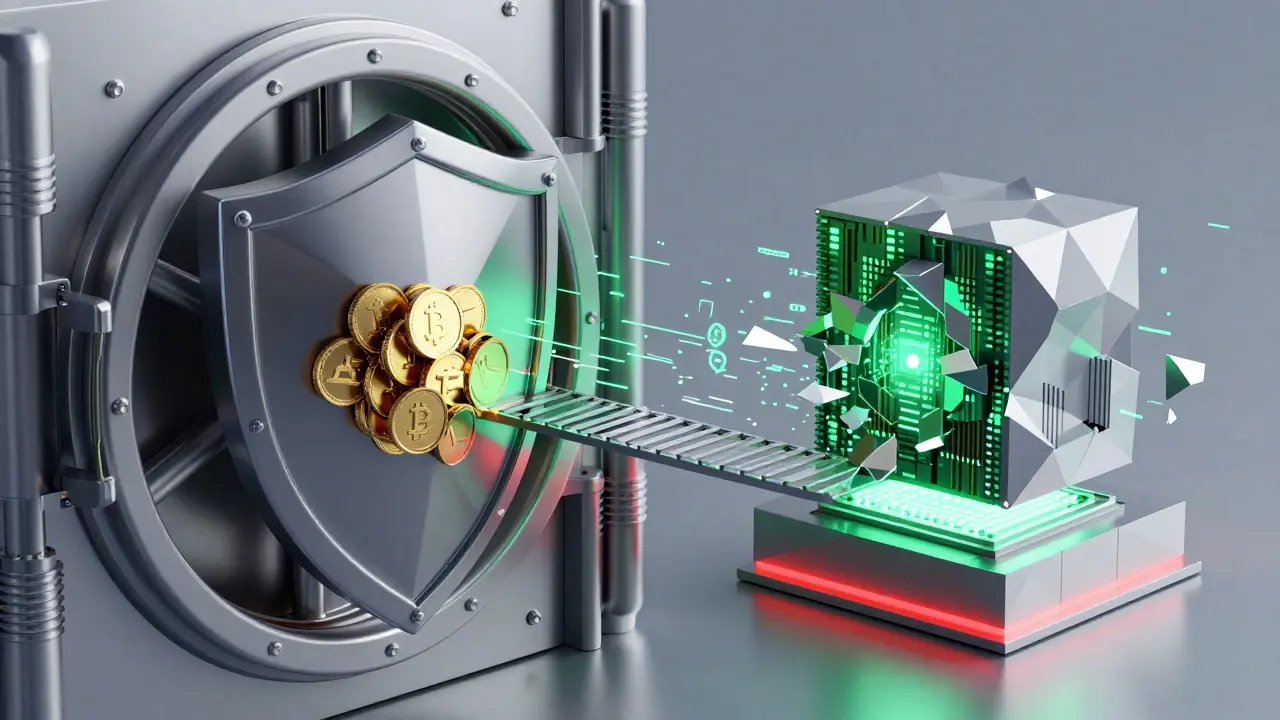
Imagine having a safe that anyone in the world can see and drop money into, but only you-and absolutely only you-can open. That is essentially how Bitcoin works. Many people think of Bitcoin as just a digital coin, but at its heart, it is a masterclass in Public Key Cryptography. This isn't about hiding data in a secret code; it is about proving you own something without ever giving away the secret that proves it.
If you have ever heard the phrase "not your keys, not your coins," you are dealing with the practical side of asymmetric cryptography. In a world where there is no bank to reset your password, the math is the only thing protecting your funds from being stolen. Let's break down the machinery that keeps your wallet secure.
The Secret Sauce: Asymmetric Cryptography
Traditional security usually relies on symmetric encryption-like a house key. You and your friend both have a copy of the same key to get in. But in a global network like Bitcoin, you can't exactly email your secret key to every single node in the world just to verify a transaction. That would be a security nightmare.
Bitcoin uses Asymmetric Cryptography is a cryptographic system that uses pairs of keys: public keys which may be shared, and private keys which are kept secret. . Think of the public key as your email address-anyone can see it and send things to it. The private key is like the password to that email account; it's the only way to actually access and move the contents.
The magic here is that the public key is mathematically derived from the private key, but it is virtually impossible to do the reverse. You can give the world your public key, and they can be certain it belongs to you, but they can't use it to figure out your private key. This one-way street is what allows Bitcoin to exist without a central authority.
The Math Behind the Curtain: secp256k1
Bitcoin doesn't just use any random math; it uses secp256k1 is a specific elliptic curve used to generate the public and private keys in the Bitcoin network. . This curve is defined by the equation y² = x³ + 7. While that looks like high school algebra, the way it's applied over a finite field makes it incredibly secure.
A private key is simply a massive random number between 1 and roughly 2^256. To get the public key, the network performs a process called elliptic curve multiplication. It takes the private key and multiplies it by a fixed starting point on the curve (called the base point G). The resulting coordinate on the curve is your public key.
Why this specific curve? Because it offers a great balance of speed and security. To crack a 256-bit key using current tech, you'd need roughly 2^128 operations. To put that in perspective, even if you had a supercomputer that could check billions of keys per second, the sun would likely burn out before you found the right one. This is the "discrete logarithm problem"-the mathematical wall that prevents thieves from guessing your keys.
| Feature | ECC (Bitcoin) | RSA (Traditional) |
|---|---|---|
| Key Size for 128-bit Security | 256 bits | 3072 bits |
| Efficiency | Very High (Smaller keys) | Lower (Larger overhead) |
| Computational Load | Lower per bit | Higher for decryption |
| Primary Use Case | Digital Signatures / Blockchain | Data Encryption / Web SSL |

Signing the Deal: How ECDSA Works
Having a key is one thing; using it to spend money is another. Bitcoin uses the ECDSA is the Elliptic Curve Digital Signature Algorithm used to ensure that a transaction was authorized by the owner of the private key. .
Here is how it works in plain English: when you want to send Bitcoin, you don't "send" the coins. Instead, you create a message that says, "I am moving X amount from Address A to Address B." You then "sign" this message using your private key. This signature is a piece of mathematical proof that says, "The person who knows the private key for Address A approved this move."
The rest of the network (the miners) doesn't need your private key to verify this. They use your public key to check if the signature matches the message. If the math checks out, the transaction is valid. The beauty of this is that your private key never leaves your wallet. It never travels across the internet; only the resulting signature does.
The Evolution: From ECDSA to Schnorr Signatures
For years, ECDSA was the only game in town. But it had a few quirks, like "malleability," where a third party could slightly tweak a signature without making it invalid, which caused headaches for developers building second-layer tools like the Lightning Network.
Enter Schnorr Signatures is a more efficient signature scheme implemented in Bitcoin via the Taproot upgrade in 2021. . Schnorr signatures are a game-changer because they allow for signature aggregation. Imagine a multisig wallet where three people must sign a transaction. With ECDSA, you had to list all three signatures, making the transaction bulky and expensive. With Schnorr, those three signatures can be compressed into one single signature that looks just like a normal transaction.
This doesn't just save space; it boosts privacy. An outside observer can't tell if a transaction was signed by one person or a complex group of ten people. It makes the blockchain leaner and the users more private.
Practical Pitfalls and Key Management
The math is perfect, but humans are not. This is where most "hacks" actually happen. Most people never have their cryptography "broken"; they just lose their keys or get tricked into giving them away.
- Compressed vs. Uncompressed Keys: Early Bitcoin used 65-byte uncompressed keys. Since 2012, 33-byte compressed keys have been the standard. If you're using ancient recovery tools, mixing these up can make your funds seem invisible.
- The Address Misconception: Your Bitcoin address isn't actually your public key. It's a double-hashed version of it (using SHA-256 and RIPEMD-160). This adds an extra layer of security; even if someone has your address, they don't actually have your public key until you make your first transaction.
- WIF and Hex: You'll see private keys in different formats. Some are 64-character hex strings, while others use the Wallet Import Format (WIF). Using the wrong one in a wallet import is a common cause of "missing" funds.
To avoid these headaches, most people use BIP39 is the standard for mnemonic seed phrases, allowing users to back up their private keys as a list of 12 to 24 easy-to-write words. . This abstracts the scary math into a simple list of words, but remember: those words are your private key. Anyone who has them has your money.
The Quantum Boogeyman: Is Bitcoin at Risk?
You might have read that quantum computers will one day crack all encryption. It's true that Shor's Algorithm is a quantum algorithm capable of solving the discrete logarithm problem, which would allow a quantum computer to derive a private key from a public key. can theoretically break ECDSA.
Should you panic? Not yet. We currently lack the "error-corrected" quantum computers needed to pull this off. Furthermore, Bitcoin can evolve. Through a "soft fork," the network could migrate to quantum-resistant algorithms (like lattice-based cryptography) before the threat becomes real. The community is already researching how to transition addresses to these new standards without losing funds.
Can someone find my private key if they have my public key?
Mathematically, yes, but computationally, no. Using the secp256k1 curve, it would take trillions of years for current computers to reverse-engineer a private key from a public key. It is effectively impossible unless a powerful quantum computer is developed.
What is the difference between a public key and a Bitcoin address?
Your public key is a point on the elliptic curve. Your address is a hashed version of that public key. Hashing it protects you because your full public key isn't revealed to the network until you spend funds from that address, adding a layer of protection against potential future quantum attacks.
Do I need to worry about compressed vs uncompressed keys today?
For 99% of users, no. Modern wallets handle this automatically. However, if you are recovering a wallet from 2010-2012, you might need to specify the format to see your balance.
How does a seed phrase relate to public key cryptography?
A seed phrase (BIP39) is a human-readable way to store the "master private key." From this one master key, your wallet can mathematically derive an infinite number of child private keys and their corresponding public keys/addresses.
Is a hardware wallet more secure than a software wallet?
Yes, because the private key is generated and stored inside a secure chip and never touches the internet. The "signing" process happens on the device, so your private key is never exposed to a potentially infected computer.
Felix Eduardo Velasquez
April 30, 2026 AT 23:53The distinction between the public key and the address is a crucial point that many beginners overlook. By hashing the public key, Bitcoin creates a layer of protection that prevents the actual key from being exposed on the blockchain until a spending transaction is broadcasted. This effectively mitigates several attack vectors and provides a buffer against premature quantum vulnerability.
Robert Smith
May 2, 2026 AT 09:09Safe and sound! 🚀🔒
Emily A
May 3, 2026 AT 22:22It is quite fascinating how the author describes the 'mathematical wall' as a high school algebra problem. In reality, the complexity of the discrete logarithm problem over elliptic curves is far more sophisticated than simple quadratic equations. Precision in terminology is essential when discussing cryptographic standards like secp256k1 to avoid misleading novices.
Carli Bates
May 3, 2026 AT 23:43oh wow a magic math curve that saves my money from the boogeyman... truly revolutionary stuff here
Rain Richardsson
May 4, 2026 AT 18:17That's really helpful. I never knew about the hashing part.
Lloyd I
May 5, 2026 AT 15:05I love how this breaks everything down! It makes the whole concept of self-custody feel much more approachable for everyone getting started. Keep this energy going!
Jan Conrad
May 7, 2026 AT 14:34The mention of Schnorr signatures is a great addition. The ability to aggregate signatures doesn't just reduce the data footprint on the blockchain, it fundamentally changes how complex smart contracts and multisig setups can be implemented. It's a massive leap in efficiency for the network's scalability.
Aaron Zeiler
May 7, 2026 AT 16:01hardware wallets are basically a must these days since you dont have to worry about keyloggers or malware sniffing your seed phrase while you sign stuff
Rushell Perry
May 9, 2026 AT 07:57bip39 is a lifesaver honestly. just imagine trying to write down a 64 character hex string without making a single typo that would lock you out of your funds forever
its me
May 9, 2026 AT 13:09One must wonder if the obsession with mathematical purity is simply a mask for the moral vacuum of decentralized finance. We trust a curve because we fear human nature, yet we forget that the humans who write the code are just as flawed as the banks we're replacing. It's a circular tragedy of trust.
Ipsita Seal
May 11, 2026 AT 12:17Too much reading. Just tell me if I'm going to lose my money or not.
Abhishek Verma
May 12, 2026 AT 10:40Oh look, another 'guide' telling us that math will save us. I'm sure the 'quantum boogeyman' will be very impressed by your optimism while he's emptying your wallet.
Kathleen Warren
May 13, 2026 AT 12:41It's a bit scary to think that one list of words is all that stands between you and your savings. If you're new to this, please just be really careful about where you write those words down!
Barbara Jones
May 14, 2026 AT 09:47i always forgeted the differnce between the public key and the adress... thx for clarifying that!
Gabrielle Danis
May 15, 2026 AT 17:34To expand on the RSA comparison, the primary advantage of ECC is that it achieves the same security level as RSA with significantly smaller key sizes. This reduction in size leads to lower power consumption and faster computation, which is vital for a peer-to-peer network where thousands of nodes must verify transactions simultaneously. Without ECC, the Bitcoin blockchain would have grown to an unmanageable size much faster than it already has. The efficiency of the secp256k1 curve is specifically optimized for these types of operations. It allows for a lightweight signature process that doesn't sacrifice the integrity of the fund ownership. The transition to Schnorr signatures further optimizes this by reducing the size of the signature itself. This means more transactions can fit into a single block, effectively increasing the throughput of the network. It also enhances the privacy of the users by masking the nature of multisig transactions. Ultimately, the mathematical foundation of Bitcoin is designed for maximum efficiency and security in a trustless environment. This is why the choice of curve was so critical during the inception of the protocol. The resilience against classical brute-force attacks is simply staggering given the key size.
Gabby Puche
May 15, 2026 AT 19:45Love the way this is explained! 🌟 It's so empowering to understand how the tech actually works! ✨
Amanda Macy
May 17, 2026 AT 14:38The tension between absolute mathematical certainty and the fragility of human memory is the true core of this discussion.