
Privacy-Preserving Smart Contracts: A Guide to Confidential Blockchain Agreements
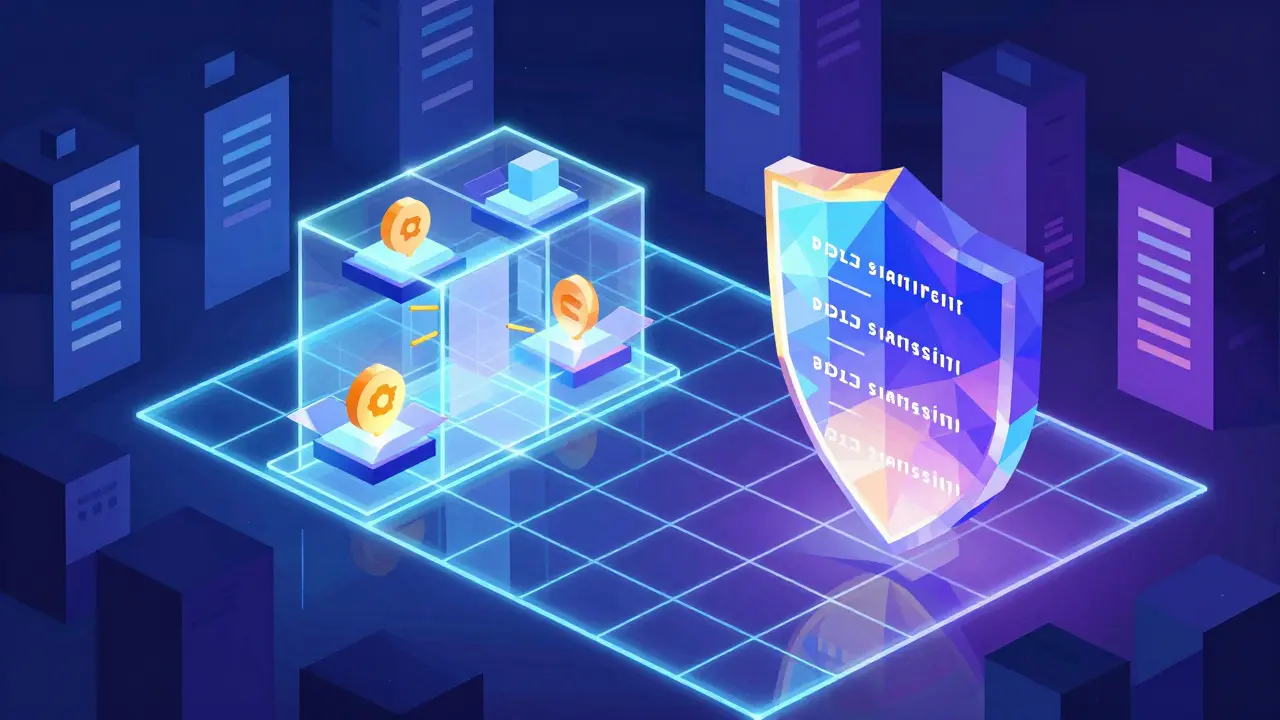
You don't have to choose between trustless verification and secrecy. By using advanced math, these contracts allow the network to verify that a transaction is valid without ever seeing the actual data inside it. It's like proving you have enough money for a house without showing your bank statement to the entire neighborhood.
The Core Problem: Transparency vs. Confidentiality
Standard blockchains, like Ethereum or Solana, are essentially global spreadsheets where everyone has a copy. If you send 10 ETH to a contractor, that event is etched into the ledger forever. While this prevents fraud, it's a disaster for healthcare records or corporate payroll. The tension lies in the "Verification Paradox": how do you prove something happened correctly if no one is allowed to see what happened?
To solve this, developers have moved away from simple transparency toward a hybrid model. This involves a public state for general verification and a private state for sensitive data. In this setup, private functions update encrypted data and use "nullifiers"-unique markers that prove a piece of data has been spent-to prevent double-spending without revealing which specific account was used.
How the Magic Works: Cryptographic Techniques
The heavy lifting in these contracts is done by Zero-Knowledge Proofs (ZKPs), a cryptographic method that allows one party to prove to another that a statement is true without revealing any information beyond the validity of the statement itself. ZKPs are the gold standard here because they maintain the blockchain's integrity while shielding the user.
One of the earliest breakthroughs was the Hawk framework, which used non-interactive zero-knowledge proofs (NIZKs). Hawk made it possible for programmers who aren't PhDs in cryptography to write private contracts by using a compiler that generates the complex math automatically. Beyond ZKPs, other methods include Trusted Execution Environments (TEEs), like those found in Intel SGX, which create a secure "black box" inside a computer's processor where data is processed privately.
| Technology | How it Works | Main Advantage | Trade-off |
|---|---|---|---|
| ZK-Proofs (Aztec, Aleo) | Mathematical proofs of validity | Strongest privacy guarantees | High computational overhead |
| TEEs (Oasis Network) | Hardware-level isolation | Faster performance | Reliance on hardware vendors |
| MPC (Enigma) | Splitting data across nodes | Collaborative computation | High network latency |
Real-World Use Cases: From Health to Finance
Where does this actually get used? Look at healthcare. A 2021 pilot by the Mayo Clinic showed that patient identifiers could remain encrypted while authorized doctors could still verify that a treatment plan was followed. This satisfies the need for medical privacy while maintaining a verifiable audit trail.
In the financial world, the stakes are even higher. JPMorgan's Quorum platform used these contracts for interbank settlements. Banks can settle huge sums of money without alerting competitors to their liquidity levels or counterparty identities. They use "selective disclosure," which means they can hide data from the public but reveal it to a regulator if an audit is required. This balance is key to surviving the strict requirements of the Financial Action Task Force (FATF).
The Developer's Struggle: Performance and Pain
If this is so great, why isn't every contract private? Because it's incredibly hard to build. Developing a privacy-preserving contract takes significantly longer than writing a standard Solidity script. ConsenSys Academy found that developers need about 8 to 12 weeks of study to get proficient, compared to just 2 to 4 weeks for traditional development.
There is also a "performance tax." ZKP-based contracts often have a 20-40x computational overhead. For example, generating a proof can take 1.5 to 3.5 seconds on standard hardware. While that doesn't sound like much, in the world of high-frequency trading or mass-market apps, it's an eternity. Furthermore, debugging is a nightmare. You can't just "print" your variables to the console when those variables are encrypted strings of gibberish.

Risks, Vulnerabilities, and the Road Ahead
Privacy isn't a silver bullet; sometimes it creates new holes. A security audit by the Electric Coin Company found that several frameworks suffered from "timing side-channel leaks," where an attacker could guess private data based on how long the computer took to generate a proof. Even more concerning, 63% of early implementations had flaws in their selective disclosure mechanisms, meaning they accidentally leaked data they were supposed to hide.
Looking forward, things are improving. Ethereum's EIP-4844 (proto-danksharding) is set to slash data costs for ZK-rollups by roughly 90%, making these contracts cheaper to run. Projects like Aztec Protocol are introducing "programmable privacy," letting you pick exactly which parts of a function are public and which are private. By 2027, analysts suggest that 40-50% of all new enterprise blockchain deployments will use these tools.
Do privacy-preserving contracts make blockchains illegal for regulators?
Not necessarily. Most enterprise solutions use selective disclosure. This allows the user to keep data private from the public while providing a "view key" or specific proof to regulators to comply with Anti-Money Laundering (AML) and KYC laws.
What is a nullifier in a private contract?
A nullifier is a unique identifier derived from a private piece of data (like a coin or a note). When the data is spent, the nullifier is published on-chain. The network can see that *some* coin was spent, but not *which* one, and the nullifier prevents the same coin from being spent twice.
Can I use Solidity to write these contracts?
Generally, no. Most privacy-preserving contracts require specialized languages that can handle ZK-circuit logic. For example, Aztec uses Noir, and Aleo uses Leo. These languages are designed to manage the constraints required for generating cryptographic proofs.
Are ZK-proofs slower than regular transactions?
Yes. Because the computer has to generate a complex mathematical proof, there is a significant computational overhead. Proof generation can take a few seconds, and the gas costs on networks like Ethereum are typically 15-25% higher than transparent contracts.
Which industry is adopting this technology the fastest?
Financial services are leading the way, accounting for about 45% of implementations. They are followed by healthcare (28%) and supply chain management (19%), as these sectors have the strongest need for data confidentiality.
Next Steps for Implementation
If you're a developer looking to get started, don't jump straight into the code. Start by studying the basics of R1CS (Rank-1 Constraint Systems), as this is the foundation for languages like Noir. If you're an enterprise leader, evaluate your data needs: do you need absolute privacy, or is selective disclosure enough? The latter is much easier to implement and far more likely to pass a regulatory audit.
Yuhan Mo
April 19, 2026 AT 04:23The trade-off between computational overhead and privacy is the real bottleneck here. Implementing R1CS circuits is basically a nightmare for anyone not steeped in cryptography, and that 20-40x performance tax is a tough pill to swallow for any real-time application.
Still, the movement toward programmable privacy is the only way we're getting actual institutional adoption.
Michelle Stanish
April 20, 2026 AT 08:56Not sure about all this. Seems like just another way to hide things.
Trudy Morse
April 20, 2026 AT 11:26Privacy is just a social construct we use to feel safe in a digital void. We're basically just rearranging the furniture of our secrets while the blockchain remains the eternal observer of our existence. It's a beautiful paradox, really.
Luke George
April 22, 2026 AT 08:21Of course they say it's for "privacy," but any real patriot knows this is just a backdoor for the globalist elites to scrub their tracks while keeping us under a microscope. The hardware-level isolation in TEEs is exactly where they'll hide the real control switches. I've seen this pattern before and it always ends with total surveillance under the guise of "security." They want us using these encrypted black boxes so we can't even see who's pulling the strings anymore. Just wait until the "view keys" are mandatory for every single citizen to access basic services. It's a trap designed to consolidate power into a few invisible hands while we celebrate the "math" behind it. The more complex they make the cryptography, the easier it is to hide the vulnerabilities they intend to exploit later. This isn't about business secrets; it's about creating a shadow ledger for the people who actually run the world. Wake up people, the transparency was the only thing keeping them honest, and now they're taking that away.
John and Lauren Busch
April 22, 2026 AT 17:24Whatever floats your boat, I guess. As long as it doesn't break the internet.
Saurav Bhattarai
April 24, 2026 AT 15:17Imagine thinking the West is leading this. My country will outpace these clumsy attempts at privacy in a heartbeat. This "developer struggle" is just a sign of their inefficiency. Truly pathetic.
Michael Harms
April 26, 2026 AT 06:35This is such a cool breakdown! It's definitely a steep learning curve, but for anyone wanting to get into the space, the effort is totally worth it. Just take it one step at a time!
Kevin Lư
April 27, 2026 AT 09:16Honestly, if you're hiding money from the government, you're basically a criminal anyway. Why do we even need these "private" contracts when honesty is the only way to a better society? Just be open about your business and maybe you wouldn't need a PhD in math to pay your bills.
Sean Mitchell
April 29, 2026 AT 00:20The sheer audacity of suggesting that a few weeks of study could make one proficient in ZK-circuits is simply laughable. It is a tragedy of the highest order that we are entrustring our financial futures to code that is, by its very nature, an opaque labyrinth of gibberish!
Karen Mogollon Gutierrez
April 29, 2026 AT 15:14I am utterly appalled by the notion that my personal financial data could be broadcast to the entire world! It is an absolute travesty that we have lived in such a state of vulnerability. This guide provides a glimmer of hope, yet the "performance tax" mentioned is simply an insult to any serious business owner! How dare they expect us to wait seconds for a transaction in a fast-paced global economy!
Chintu Parikh
April 29, 2026 AT 21:34I truly believe this technology will bridge the gap between corporate needs and decentralized trust. It is an honor to witness such innovation, and I am certain that the community will find a way to optimize those computational overheads together. Let's all support the developers working on Noir and Leo!
Jeff Barlett
May 1, 2026 AT 16:52Actually, the whole concept of a "private" blockchain is a contradiction in terms. You're just moving the trust from the ledger to the person who wrote the ZK-proof. It's a joke.
Thomas Jewett
May 3, 2026 AT 01:41This whole thing is just a way for the globalists to hide their thievery while we Americans are told to follow the rules and pay our taxes on every cent. its laughable how the govt lets this slide while they track evrything we do with our phones. we need a system that only serves the people of this country and not some fancy math project from a lab in europe or wherever. the fact that 63 percent of these things leak data just shows they dont know what they are doing and its a disaster waiting to happen for anyone with actual values.
Anna Grealis
May 3, 2026 AT 14:38Typo in the ZKP section... and also the whole thing feels like a setup for a massive data breach. The math is just a cover for the backdoors they're building in.