
Portugal Crypto Tax Guide: How to Get Tax-Free Long-Term Gains
Imagine living in a place where your Bitcoin or Ethereum gains don't get eaten away by the government once you've held them for a year. For a long time, Portugal was the "Wild West" of crypto taxes-basically a free-for-all. But things changed in 2023. While the government finally stepped in to tax active traders, they left a massive loophole for the patient investor: the 365-day rule. If you can hold your assets for a year, you can still walk away with your profits completely tax-free.
The Golden Rule: 365 Days to Tax Freedom
The core of the Portugal crypto tax system is simple: time is money. If you hold a cryptocurrency asset for more than 365 days, any gains you make when selling it for fiat currency (like Euros) are tax-exempt. This isn't a complex deduction or a credit; it's a straightforward exemption. If you bought Solana in January 2025 and sold it in February 2026, you owe zero in capital gains tax on that profit.
However, if you're a "degenerate" trader or just someone who can't stop checking the charts and selling every dip, you'll hit a different wall. Profits from assets held for less than a year are slapped with a flat 28% tax. This creates a very clear incentive: stop day trading and start HODLing if you want to keep your money.
Understanding the Three Tax Categories
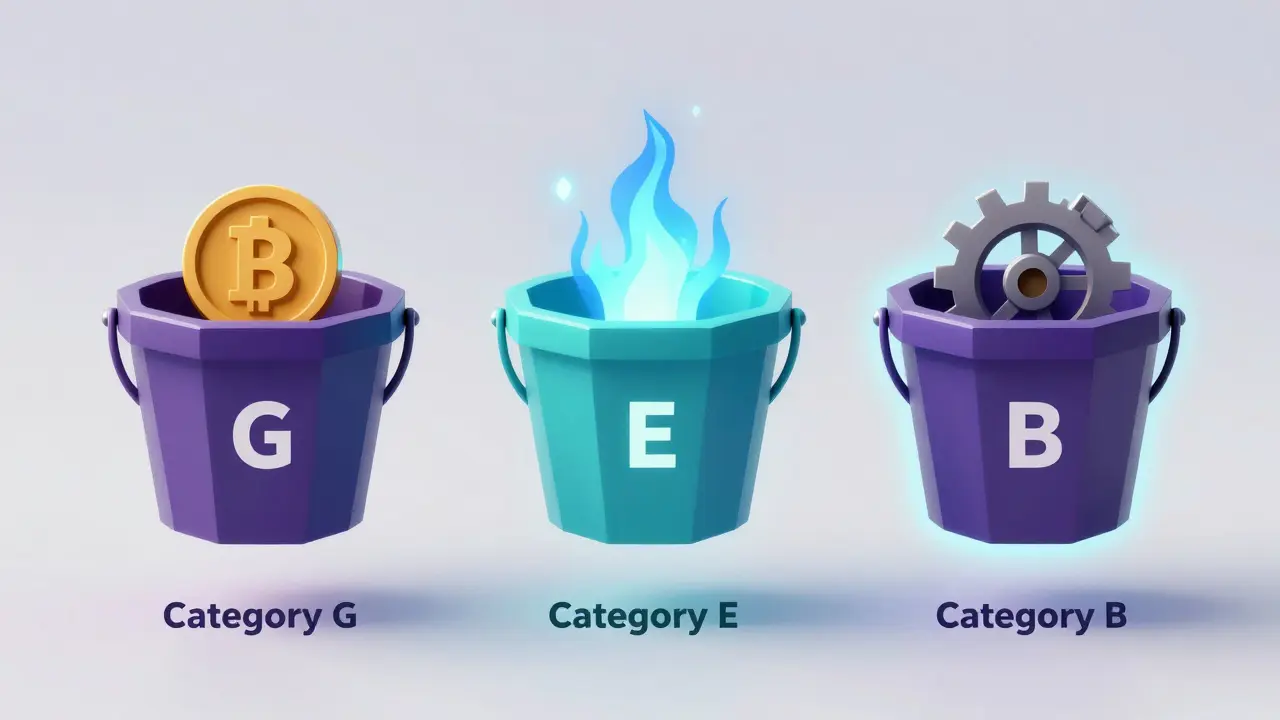
To navigate the Portuguese system, you need to know which "bucket" your income falls into. The Personal Income Tax Code (PIT Code) divides crypto activity into three distinct categories:
- Category G (Capital Gains): This is where most casual investors live. It covers the sale of crypto assets. As mentioned, if the holding period is >365 days, it's tax-free. If it's <365 days, it's taxed at 28%.
- Category E (Capital Income): This is for passive earnings. Think staking or lending your coins to earn interest. This income is generally taxed at a flat rate of 28%, regardless of how long you've held the original assets.
- Category B (Self-Employment): This is for the pros. If you run a mining farm, work as a professional trader, or validate transactions for a living, the government views this as a business. You'll be taxed progressively, with rates climbing from 14.5% up to 53% depending on your total earnings.
| Category | Activity Type | Tax Rate | Key Condition |
|---|---|---|---|
| Category G | Selling Assets | 0% or 28% | Tax-free after 365 days |
| Category E | Staking/Lending | 28% | Flat rate on passive income |
| Category B | Professional Trading/Mining | 14.5% - 53% | Progressive based on income |
Crypto-to-Crypto: The Hidden Advantage
One of the best parts of the Portuguese regime is how it handles swaps. In many countries, swapping BTC for ETH is a taxable event. In Portugal, crypto-to-crypto trades are currently exempt from taxation. You only trigger a tax event when you "exit" the crypto ecosystem by converting your assets into fiat currency or using them to buy a physical product.
This is a huge win for portfolio rebalancing. You can move your funds across different protocols or coins without worrying about a tax bill every time you make a move. Just remember: the clock for your 365-day holding period usually resets or requires careful tracking when you swap assets, so keep your logs tight.
Portugal vs. The Rest of Europe
If you're deciding where to base your operations, Portugal is a powerhouse compared to its neighbors. While France takes a flat 30% cut of your profits and Spain uses progressive rates that can hit 47% for staking, Portugal remains one of the few places where a long-term strategy is actually rewarded with zero tax.
The only real competitor in the EU is Germany, which also offers exemptions for assets held over a year. However, many digital nomads find Portugal's framework more straightforward to implement and the lifestyle more appealing. When you combine the tax perks with the MiCA (Markets in Crypto-Assets) regulation providing legal clarity across the EU, Portugal becomes a top-tier destination for wealth preservation.
How to Stay Compliant (And Avoid Audits)
"Tax-free" doesn't mean "ignore it." The Portuguese tax authority still wants to know where your money came from. To prove that your gains are exempt, the burden of proof is on you. You cannot simply show a bank statement with 100,000 Euros and say "it was Bitcoin."
- Track every trade: Use software like CoinTracking or a detailed spreadsheet. You need the exact date of acquisition and the price paid.
- Export your CSVs: Download every single trade history file from your exchanges (Binance, Kraken, Coinbase, etc.) immediately. Exchanges sometimes purge old data or change their export formats.
- Document the "Exit": Keep a record of the transaction where you converted crypto to fiat. This is the moment the 365-day clock is verified.
- Separate your activities: If you do a bit of everything, keep your staking rewards (Category E) separate from your long-term holds (Category G) to avoid confusion during filing.
A pro tip for those with lower overall incomes: you can actually choose to aggregate your short-term gains into your general income rather than paying the flat 28%. If your total yearly income is low enough to put you in a lower tax bracket, this "aggregation" can save you a significant amount of money.

Potential Pitfalls to Watch Out For
It's not all sunshine and surf. There are a few traps that can trip you up. First, the 365-day rule applies to standard crypto assets. If your tokens are classified as securities, the rules might change. Similarly, keeping your assets in jurisdictions outside the European Economic Area (EEA) can sometimes complicate the reporting process.
Additionally, while NFTs (Non-Fungible Tokens) are often treated differently than standard fungible tokens, the laws here are still evolving. If you're flipping high-value digital art, don't assume it falls under the long-term exemption without checking with a local specialist.
Do I have to report my crypto in Portugal if it's tax-free?
Yes. Even if your gains are exempt because you held them for over a year, you still need to declare the sale of those assets in your annual tax return. Failure to report can lead to penalties, even if the tax owed is zero.
What happens if I swap BTC for ETH and then hold ETH for a year?
Because crypto-to-crypto trades are not taxable events in Portugal, the "exit" only happens when you move to fiat. However, you must keep meticulous records to prove the total chain of ownership and ensure the assets were effectively held for the required period.
Is staking income always taxed at 28%?
Generally, yes. Staking and lending are considered passive income (Category E) and are subject to a flat 28% tax, regardless of how long you intend to hold the coins.
Does the 365-day rule apply to all coins?
It applies to most standard cryptocurrencies. However, if the asset is legally classified as a security or is held in specific non-EEA structures, the tax treatment may differ. Always verify the classification of your tokens.
What is the risk of being classified under Category B?
If the tax authority decides your trading volume and frequency look like a full-time job rather than a personal investment, they can move you to Category B. This means you pay progressive income tax (up to 53%) instead of the flat 28% or 0% rates.
Next Steps for Crypto Residents
If you're planning to move to Portugal or already live there, your first move should be a "data audit." Gather every trade you've ever made. If you're missing data from an exchange that went bust, start looking for blockchain explorers to reconstruct your history.
For those with substantial portfolios, don't DIY your first year of filing. The Portuguese system is friendly, but the bureaucracy can be rigid. A local tax accountant who understands the difference between Category G and Category E is worth every cent to ensure you don't accidentally trigger a professional trading audit.
Joshua Aldrich
April 5, 2026 AT 12:28Always check the local laws first because things change fast in the EU. I've seen a few people trip up on the Category B stuff just because they traded too much on dapps and didn't realize the gov could see it. Pro tip: get a real accountant who specilize in crypto, dont try to wing it with a generic tax guy who doesnt even know what a seed phrase is. The 365 day rule is a lifesaver though, just gotta be patient and keep those CSVs organized or you're gonna have a bad time during an audit. its basically the only way to keep your gains without the state taking a massive bite out of your portfolio. just be careful with the staking part since that 28% hits regardless of how long you hold the underlying asset. honestly, most people ignore the reporting part until they get a letter in the mail, which is a huge mistake. just log everything from day one and you'll be golden. definitely worth the move if you're a long term believer in the tech anyway. just keep your records tight and stay humble.
Hugo Lopez
April 7, 2026 AT 06:04This is such a helpful breakdown! 🌟 Living in the US, we really don't have anything this friendly for long-term holders. 🇵🇹✨
Earnest Mudzengi
April 7, 2026 AT 08:03Typical government trap. They lure you in with the 365-day rule just to get your KYC data on file. Once you're in their database, they'll find a way to reclassify you as Category B and seize your assets under some vague 'security' law. This is all part of the larger MiCA surveillance state to kill the anonymity of the blockchain. If you're not using a non-custodial wallet and a VPN, you're just asking to be audited. Don't trust the 'tax-free' bait.
Diana Martín Prieto
April 8, 2026 AT 19:19I've helped a few clients transition to Portugal and the most important thing is the paper trail. If you're using multiple exchanges, I highly recommend Koinly or CoinTracking to automate the process. It saves hours of manual work and ensures you don't miss a single transaction when filing for those Category G exemptions.
Carmelita Gonzales
April 9, 2026 AT 21:02sounds like a great way to live a slower life and keep your money
Deepak Prusty
April 9, 2026 AT 23:03The comparison to Germany is slightly misleading. While Germany also has a one-year holding period, the administrative burden of proving residency and tax nexus in Portugal is often perceived as easier for non-EU citizens entering through specific visa programs.
sekhar reddy
April 10, 2026 AT 10:23OMG the 28% tax for short term is absolutely BRUTAL!! 😱 Literally a crime to stop people from trading! I cant even imagine the stress of accidentally selling at 364 days lol!
Trish Swanson
April 11, 2026 AT 18:05The 365-day reset on swaps is a huge detail!!! People need to be way more careful with that...!!!
Suzanne Robitaille
April 12, 2026 AT 07:42It is truly poetic how patience is rewarded in such a tangible way here. It turns the volatile nature of crypto into a lesson in mindfulness and discipline!
Nicholas Whooley
April 12, 2026 AT 15:05It is most encouraging to see such clear guidelines provided for the community. I believe that with a structured approach to record-keeping, any investor can successfully navigate these regulations.
Susan Wright
April 12, 2026 AT 19:44Just a heads up on the aggregation tip-that only works if your total income is really low. For most people, the flat 28% is actually simpler to handle and keeps the tax office from digging too deep into other income streams.
alex rodea
April 14, 2026 AT 06:26good info man
Susan Payne
April 14, 2026 AT 07:36One finds it utterly quaint that individuals still believe a simple spreadsheet will suffice for a government audit. The lack of professional oversight in these 'digital nomad' circles is truly appalling.
Siddharth Bhandari
April 15, 2026 AT 11:07For those interested in the Category B risk, the authority usually looks at the frequency of trades per month. If you are trading daily, you are almost certainly a professional in their eyes.
akash temgire
April 16, 2026 AT 16:44The distinction between securities and tokens is vague. Clarification is required.
Brooke Herold
April 18, 2026 AT 13:34I prefer the quiet life in the Algarve anyway, the tax is just a nice bonus.