
P2P Crypto Trading in Bangladesh: How to Use Peer-to-Peer Methods Safely
Imagine trying to send money home from Dubai, only to watch nearly half of it vanish into banking fees and unfavorable exchange rates. Now imagine doing the same thing with a fraction of that cost, in minutes, using your phone. This is the reality for millions in Bangladesh, where P2P crypto trading has become the lifeline for cross-border payments despite being technically illegal. You are not alone if you feel confused or worried about this contradiction. The government says "no," but the people say "yes." So, how do you navigate this grey zone without losing your money or running into legal trouble?
This guide cuts through the noise. We will look at exactly how peer-to-peer (P2P) methods work in Bangladesh, which platforms are actually safe to use, and how to protect yourself from scams. We will also break down the current legal landscape as of mid-2026, so you know what risks you are taking.
The Legal Reality: De Facto Ban vs. Daily Practice
To trade safely, you first need to understand the rules-or lack thereof. In Bangladesh, cryptocurrency exists in a complex legal grey zone. Since 2014, Bangladesh Bank has issued warnings stating that cryptocurrency trading violates Section 33 of the Foreign Exchange Regulation Act 1947. The central bank’s stance is clear: converting Taka (BDT) into foreign currency without prior approval is illegal. Circular No. 13 from 2017 reinforced this, explicitly banning transactions involving digital assets.
Yet, on the ground, the story is different. According to Chainalysis’ 2024 Global Crypto Adoption Index, Bangladesh ranks 35th globally, with approximately 3.5 million users. That is 2.1% of the population actively trading. Why? Because the demand is real. Bangladesh received $21.5 billion in official remittances in 2022. Traditional channels charge 3-8% in fees. Crypto offers 0.5-2%. For a family relying on those funds, the savings are life-changing.
The risk is real, though. In 2022, 17 traders in Dhaka were arrested under Section 411 of the Penal Code for 'possessing stolen property'-a charge applied to their crypto holdings. As Dr. Ahsan H. Mansur from the Policy Research Institute noted in March 2024, users have "zero recourse if scammed" because they operate outside the law. However, enforcement has been inconsistent. While raids happen, the sheer volume of daily transactions makes total suppression impossible. Currently, the government is focusing more on monitoring large suspicious transfers rather than arresting every small-time trader.
How P2P Crypto Trading Works in Bangladesh
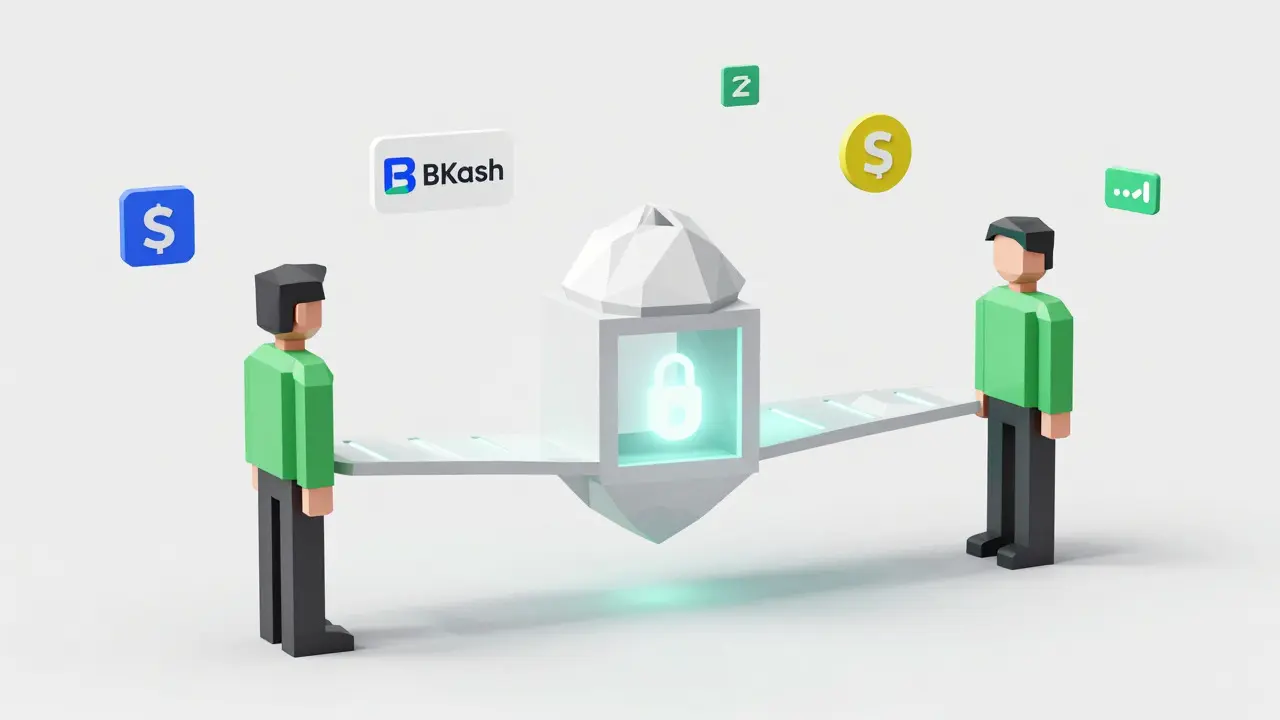
Peer-to-peer (P2P) trading allows you to buy and sell cryptocurrencies directly with other people, using a platform as an intermediary. Unlike buying from an exchange directly (where you pay the exchange), P2P means you pay another user, and the exchange holds the crypto in escrow until both parties confirm the deal.
In Bangladesh, this process relies heavily on mobile financial services (MFS). Here is the typical workflow:
- Choose a Platform: Most users sign up on international exchanges like Binance, Bybit, or KuCoin. These sites are accessible via browsers or apps, even though the Bangladesh Telecommunication Regulatory Commission (BTRC) attempted to block them in 2018.
- Select a Payment Method: You choose between bKash, Nagad, or bank transfer. bKash is the most popular, used in 61% of transactions due to its widespread adoption (72.5 million active users).
- Match with a Merchant: You find a seller offering a good rate. Sellers often set prices slightly above market value to cover risk and fees.
- Escrow Protection: The seller locks the crypto (usually USDT or BTC) into the platform’s escrow system. It is safe here; neither party can touch it yet.
- Transfer Funds: You send BDT to the seller’s bKash/Nagad account via QR code or number. Crucially, you must keep screenshots of the transaction.
- Release Crypto: Once the seller confirms receipt, they release the crypto from escrow to your wallet. The average completion time is 8.2 minutes during peak hours.
This system works because it bypasses traditional banks, which monitor foreign exchange closely. Instead, it uses the informal economy of mobile money, which is harder to track comprehensively.
Top Platforms for Bangladeshi Traders
Not all platforms are created equal. Your choice depends on whether you prioritize security, speed, or anonymity. Here is a breakdown of the main options available in 2026.
| Platform | Market Share | Key Feature | Average Spread | Best For |
|---|---|---|---|---|
| Binance | 61% | Robust Escrow & Bengali Support | 1.2-3.5% | Beginners & Large Remittances |
| Bybit | 19% | High Leverage & Margin Trading | 2-4% | Advanced Traders |
| KuCoin | 11% | Wide Altcoin Selection (700+) | 2-5% | Diversified Portfolios |
| DEX (e.g., PancakeSwap) | 8% | No KYC Required | 0.8% + Gas Fees | Tech-Savvy Users Seeking Anonymity |
Binance dominates the market for a reason. It processes 1.2 million monthly P2P trades from Bangladesh with a 99.98% success rate. In January 2025, they introduced dedicated BDT liquidity pools and Bangla language support, making it much easier for local users. Their dispute resolution team responds within 12 hours on average.
Bybit is gaining traction among experienced traders who want to use leverage. If you are looking to trade volatile assets with borrowed capital, Bybit offers up to 50x leverage. However, this comes with higher risk.
Decentralized Exchanges (DEX) like PancakeSwap offer near-anonymity. You connect a wallet like MetaMask and swap tokens directly. There is no middleman, so no one can freeze your funds. But, you need to pay gas fees in BNB (averaging $0.15 per transaction) and handle technical setup yourself. Only 8% of Bangladeshi traders use DEXs due to the steep learning curve.
Payment Methods: bKash, Nagad, and Bank Transfers
Your payment method is the bridge between your fiat money and crypto. In Bangladesh, this bridge is built on mobile financial services.
- bKash: The undisputed king. With 72.5 million users, it is the default choice. Transactions are fast, and most merchants accept it. However, be careful with transaction limits. Anti-fraud algorithms may flag transfers above ৳50,000, leading to delays or rejections. Always use the "Send Money" function, not "Cash In," when paying a merchant, as the latter can sometimes trigger stricter verification.
- Nagad: The second-largest player with 45 million users. It is a solid alternative if bKash is down or if you get better rates from Nagad-specific merchants. About 29% of P2P transactions use Nagad.
- Bank Transfers: Used by only 10% of traders. Banks are slower and more likely to question large incoming/outgoing transfers related to crypto. They are best for very large amounts where you have a trusted relationship with the merchant, but they carry higher regulatory risk.
A common issue reported by 41% of users is Nagad transaction failures for amounts over ৳50,000. To mitigate this, split larger orders into smaller chunks or stick to bKash for smoother processing.
Safety First: Avoiding Scams and Legal Pitfalls
Since you are operating in a legal grey zone, protection falls largely on your shoulders. Scams are the biggest threat. In 2023, Bangladesh Bank reported 214 fraud cases totaling ৳1.2 billion ($11 million). Here is how to stay safe:
- Stick to Verified Merchants: On Binance, look for merchants with high completion rates (95%+) and thousands of orders. New accounts with low history are risky.
- Never Pay Outside the App: If a seller asks you to send money to a different account number than the one listed in the order, it is almost certainly a scam. Keep all communication within the platform’s chat.
- Keep Evidence: Take screenshots of every step: the order details, the payment confirmation from bKash/Nagad, and the chat logs. If a dispute arises, these are your only proof.
- Enable 2FA: Two-factor authentication is enabled by 98% of smart users. Use an authenticator app, not just SMS, as SIM swapping is a common attack vector.
- Use Community Resources: Join Telegram groups like 'Crypto BD Guide' (47,300 members). They maintain blacklists of fraudulent agents. In 2023 alone, they helped blacklist 217 bad actors.
Legally, keep your trades modest. Large, frequent transfers attract attention from Bangladesh Bank’s Financial Compliance Unit, which froze 1,842 accounts in Q4 2024. For now, the strategy is "don't get caught," which means avoiding flashy spending and keeping records private.
The Future: Will Crypto Be Legalized?
The landscape is shifting. In February 2025, the government formed a 12-member Crypto Asset Task Force, chaired by Deputy Governor Kazi Abdul Muktadir. Their goal is to submit regulatory recommendations by December 2025. Industry analysts predict a "dual-track" approach: embracing blockchain technology for business while restricting speculative trading.
Additionally, Bangladesh Bank is piloting a Central Bank Digital Currency (CBDC) across 12 districts with 500,000 users. Results expected in Q3 2025 could determine the future of crypto. If the CBDC succeeds, it might legitimize digital asset infrastructure. If it fails, crackdowns could intensify. For now, P2P trading remains the primary way Bangladeshis access global finance, growing at a 42% compound annual growth rate.
Frequently Asked Questions
Is P2P crypto trading legal in Bangladesh?
Technically, no. Bangladesh Bank considers it a violation of the Foreign Exchange Regulation Act 1947. However, it is widely practiced by millions, and enforcement is currently focused on large-scale operators rather than individual retail traders. You operate at your own legal risk.
Which exchange is best for beginners in Bangladesh?
Binance is the best option for beginners. It has the highest liquidity, robust escrow protection, Bengali language support, and a responsive customer service team. Its P2P interface is user-friendly and integrates seamlessly with bKash and Nagad.
Can I use my bank account for P2P crypto trading?
You can, but it is not recommended for small transactions. Banks monitor foreign exchange flows closely and may freeze accounts involved in suspicious crypto-related transfers. Mobile financial services like bKash and Nagad are less scrutinized and faster for P2P trades.
What happens if a P2P seller scams me?
If you use a major exchange like Binance, open a dispute immediately. Provide screenshots of your payment and chat logs. The platform’s mediation team will review the evidence and often release the crypto back to you if the seller failed to deliver. Always trade within the platform’s chat to ensure this protection applies.
Are there any taxes on crypto profits in Bangladesh?
Currently, there is no specific tax framework for cryptocurrency gains because crypto is not legally recognized. However, if you convert crypto back to Taka and deposit it into a bank, the source of funds may be questioned. It is advisable to keep records of all transactions in case of future regulatory changes.
Why is USDT the most popular coin for P2P in Bangladesh?
USDT (Tether) is a stablecoin pegged to the US Dollar. It offers stability against the fluctuating Bangladeshi Taka and Bitcoin's volatility. 72% of P2P transactions involve USDT because users want to preserve value during transfers and remittances without exposure to market swings.
How do I avoid bKash transaction failures during Eid?
During holidays like Eid, mobile banking systems overload, causing delays. To avoid this, trade during off-peak hours (early morning or late night) or use Nagad as a backup. Also, ensure your bKash app is updated and try splitting large transactions into smaller ones to bypass anti-fraud triggers.