
Norway Crypto Mining Tax Changes 2026: Incentives Removed or Just Misunderstood?

There is a lot of noise in the crypto community right now. Rumors are spreading that Norway has removed tax incentives for crypto mining, making it an unprofitable place to run rigs. If you are looking at setting up operations in Scandinavia, this sounds like bad news. But before you pack up your GPUs and ASICs, we need to separate fact from fiction.
The short answer? There were never specific "tax incentives" for mining in Norway to begin with. The confusion comes from a misunderstanding of how the Norwegian Tax Administration (Skatteetaten) handles digital assets. The rules haven't changed overnight; they have been consistent, strict, and transparent for years. What feels like a "removal" of benefits is actually just the standard application of income tax laws to a high-energy industry.
The Myth of the "Removed" Incentive
To understand why people think something was taken away, you have to look at what they expected. Many miners come from countries where mining was treated as a hobby, taxed lightly, or ignored entirely until the coins were sold. In those places, the lack of immediate taxation felt like an incentive.
In Norway, the approach is different. The government views mining not as a passive investment, but as active work. When your computer verifies transactions on the blockchain, you are providing a service. Therefore, the reward you receive is considered income, not capital gain.
This distinction is crucial. It means you pay tax on the value of the coin the moment it hits your wallet, even if you haven't sold it yet. For some, this feels punitive. For others, it's just fair business logic. The "incentive" that was supposedly removed was likely the hope that miners could defer taxes until later. That hope was never legally valid in Norway.
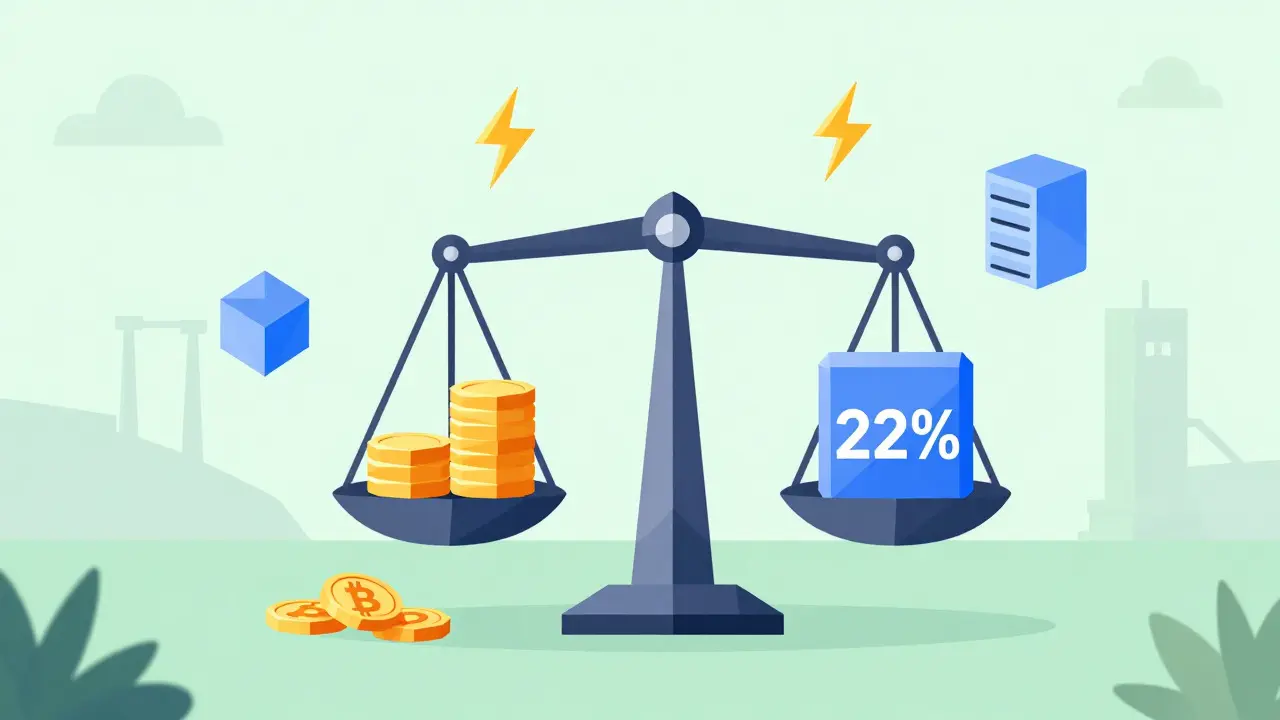
How the 22% Flat Tax Works
Let’s get into the numbers, because that’s what matters most. Currently, all income derived from cryptocurrency mining in Norway is subject to a flat tax rate of NOK 22%. This applies whether you are mining Bitcoin, Ethereum (post-merge staking rewards), or any other Proof-of-Work asset.
Here is how the calculation works in practice:
- Valuation Timing: You must declare the Norwegian Kroner (NOK) value of your mining earnings at the exact time of token receipt.
- Fair Market Value (FMV): You use the market price of the cryptocurrency on the day you mined it. If you mine 1 BTC when it is worth NOK 500,000, you report NOK 500,000 as income, regardless of what it is worth six months later.
- Consistency: This rule applies equally to mining rewards, staking rewards, and other blockchain-based income generation activities.
This system removes ambiguity. You don't have to guess which exchange rate to use later. You lock in the value today, pay the 22%, and move on. While 22% might seem high compared to zero-tax jurisdictions, it is relatively low compared to top marginal income tax rates in many European countries, which can exceed 40-50%.
Deductions: Your Real "Incentive"
If there are no special breaks, how do miners stay profitable? The answer lies in deductions. Norway allows you to offset your taxable income by claiming legitimate business expenses. This is the closest thing to an "incentive" structure available.
You can deduct costs related to:
- Equipment: The cost of ASICs, GPUs, and servers.
- Electricity: One of the biggest factors in mining profitability.
- Software: Mining pool fees and management software subscriptions.
- Depreciation: You can apply an annual depreciation rate of 30% on your equipment.
For example, if you earn NOK 100,000 in mined coins but spend NOK 40,000 on electricity and depreciate NOK 10,000 of your hardware, your taxable income drops to NOK 50,000. You only pay the 22% tax on that remaining amount. This structure encourages efficient operations. If you are wasting energy or using outdated gear, your deductions won't save you. If you are running a lean, modern operation, the tax burden becomes manageable.
For cooperative mining operations-where multiple people share resources-the rules are strict. Deductions must be distributed equally among all participants based on their contribution. This prevents one partner from claiming all the losses while another claims all the profits.
Capital Gains vs. Income Tax: A Critical Distinction
Confusion often arises because Norway treats holding cryptocurrency differently than earning it through mining. Digital assets held in your wallet are classified as capital assets, not currency.
When you sell or swap these assets, you trigger a capital gains event. This is also taxed at 22%. However, the key difference is timing. With mining income, you pay when you receive the coin. With capital gains, you pay when you sell the coin.
This creates a unique scenario. Imagine you mine coins worth NOK 10,000. You pay NOK 2,200 in tax immediately. Later, the price doubles, and you sell them for NOK 20,000. You then pay capital gains tax on the profit (NOK 10,000 - NOK 10,000 original value = NOK 0 gain? No, wait. The cost basis is established at the time of receipt). Actually, since you already paid income tax on the full value, your cost basis for capital gains purposes is effectively the same as the sale price if sold immediately, resulting in no further tax. If you hold and the price rises, you pay capital gains on the appreciation above the initial FMV.
Wait, let's simplify. The initial receipt is income. Subsequent sales are capital events. If the price goes down after you pay the income tax, you have a loss. Norway allows you to carry forward capital losses to offset future gains. This safety net helps mitigate the risk of paying tax on coins that subsequently crash in value.
Energy Consumption and Regulatory Pressure
Why does Norway care about mining taxes? It’s not just about revenue. It’s about energy. Norway is a hydroelectric powerhouse, exporting massive amounts of renewable energy. However, the grid isn't infinite.
As of 2025, the crypto mining industry consumes approximately 1% of Norway’s total energy output. While this seems small, it contributes roughly 0.5% to the national GDP. The government wants to ensure that this energy usage is balanced against residential needs and industrial exports.
The regulatory environment includes a FinTech sandbox established by the Financial Supervisory Authority (FSA). While crypto mining hasn't been a major participant in this sandbox, its existence shows Norway prefers innovation within rules rather than outright bans. The current tax framework is designed to keep mining legal but accountable. By taxing mining as income, the state ensures that miners contribute fairly to the society whose infrastructure they rely on.

Reporting Requirements: Don't Get Caught Off Guard
Compliance is non-negotiable in Norway. The Skatteetaten requires detailed reporting. Here is what you need to do:
- Track Every Block: Maintain records of the market value for each token received at the time of mining.
- Year-End Balances: Report your total cryptocurrency holdings as of December 31st of each tax year.
- Filing Deadline: Submit your returns by April 30th of the following year.
For the 2025 tax return, taxpayers must provide balances of all cryptocurrency holdings as of December 31, 2024. Failure to report can lead to audits, penalties, and back-taxes. Given the transparency of blockchains, hiding mining income is nearly impossible if the authorities decide to investigate.
| Activity | Tax Type | Rate | Trigger Event |
|---|---|---|---|
| Mining Rewards | Income Tax | 22% | Receipt of Token |
| Staking Rewards | Income Tax | 22% | Receipt of Reward |
| Selling Crypto | Capital Gains Tax | 22% | Sale/Swap Transaction |
| Holding Crypto | Wealth Tax* | Variable | Annual Assessment |
*Note: Wealth tax applies to total net assets exceeding a certain threshold, including crypto holdings.
Is Mining Still Profitable in Norway?
So, did the removal of incentives kill the industry? Not necessarily. Norway still offers some of the cheapest and greenest electricity in Europe. If you can secure long-term contracts for hydro power at competitive rates, the 22% tax is a cost of doing business, not a dealbreaker.
The key is efficiency. Miners who treat their operation as a serious business-tracking every kWh, optimizing cooling, and maximizing uptime-can thrive. Those who expect a loophole or a special break will find Norway’s system rigid. But rigidity brings predictability, which is valuable for long-term planning.
Did Norway recently remove tax incentives for crypto mining?
No, there were no specific tax incentives for crypto mining to remove. The confusion stems from the standard treatment of mining rewards as taxable income at a 22% rate, which has been consistent for years. The perception of "removal" often comes from comparing Norway to countries with lighter or deferred taxation.
What is the tax rate for crypto mining in Norway?
The tax rate for crypto mining income in Norway is a flat 22%. This applies to the fair market value of the cryptocurrency at the time it is received.
Can I deduct electricity costs from my mining income?
Yes, you can deduct legitimate business expenses including electricity, equipment costs, and software fees. Equipment also qualifies for a 30% annual depreciation rate.
When do I have to report my crypto mining income?
You must report your mining income as part of your annual tax return, which is due by April 30th of the following year. You should track the value of mined coins at the time of receipt throughout the year.
Is crypto mining legal in Norway?
Yes, crypto mining is legal in Norway. It is regulated by the Norwegian Tax Administration (Skatteetaten) and overseen within the broader financial regulatory framework.
Prudence Flemming
August 11, 2026 AT 21:26the epistemological framework here is flawed. you treat tax as a static variable when it is clearly dynamic within the socio-economic matrix. the notion of 'incentive' is a construct designed to pacify the proletariat while the hegemony extracts value through energy consumption metrics. we are not discussing profitability but rather the ontological status of digital labor in a post-scarcity illusion.
Lance Jantz
August 13, 2026 AT 18:16Ah, the quaint delusion of the uninitiated! You speak of 'misunderstanding' as if clarity were a commodity freely traded in this marketplace of ideas. Let us be brutally honest: Norway is not removing incentives; they are simply enforcing the natural order upon those who mistake code for currency. It is a tragic spectacle, really, watching the masses scramble for crumbs of perceived benefit while ignoring the grand architecture of fiscal reality. One must have a certain... sophistication... to appreciate that taxation is merely the toll fee for existing in a civilized society. Do try to keep up, darling.
Don Fizy
August 14, 2026 AT 20:43Hey there! Great read on this topic :). Just wanted to add that many people forget about the depreciation angle. If you're running older rigs, that 30% write-off can actually save you a ton in the long run. Don't stress too much about the 22% flat rate because when you factor in electricity costs (which are low in Norway), it still makes sense for serious miners. Keep tracking your logs and you'll be golden! :)
Dominic Greco
August 15, 2026 AT 19:23They want to track every block 🚨👀. This isn't about taxes. It's about control. The grid isn't infinite? Please. They're manufacturing scarcity to justify surveillance. Skatteetaten has your wallet addresses linked to your social security number before you even hit 'send'. Wake up sheeple. The 22% is just the entry fee for their database. Soon they'll tax the air you breathe to cool your GPUs. Stay hidden. Use cash. Trust no one. 🕵️♂️💸
Ryan Robinson
August 17, 2026 AT 13:22i mean look at it from both sides tho. sure its strict but its predictable. i dont see why everyone is freaking out. maybe just accept the rules and move on? no need for drama. hydro power is cheap so its still viable if u do the math right. lets just chill and mine.
amy miranda
August 18, 2026 AT 09:56The moral bankruptcy of treating environmental stewardship as a mere line item in a profit-and-loss statement is staggering. To suggest that the 'rigidity' of the system is a virtue ignores the fundamental ethical obligation of industry to contribute equitably to the public good. It is not punitive; it is corrective. Those who whine about the 22% rate are likely the same individuals who ignored the carbon footprint of their operations until the bill arrived. Precision in reporting is not an inconvenience; it is a civic duty. Fail to comply, and face the consequences with dignity, or lack thereof.
Rodmun Tarnowski
August 20, 2026 AT 05:42Indeed! This article provides a remarkably clear perspective on a often-misunderstood subject. It is heartening to see such transparency regarding the tax implications. One should always remember that compliance fosters stability! Furthermore, the distinction between income and capital gains is crucial for accurate financial planning. Let us embrace these regulations with open arms! After all, predictability is the bedrock of prosperity! Well said!
Matthew Smith
August 20, 2026 AT 10:04the moral imperative dictates that one pays their fair share. yet the philosophical underpinning of 'income' vs 'capital' is arbitrary. we assign value based on consensus which is fragile. norway treats it as work because it requires effort. this is logical. however the rigidity suggests a lack of faith in individual discretion. perhaps the state fears what it cannot quantify. the 22% is a compromise between chaos and order. accept it or leave. simple ethics.
Carl Michaud
August 21, 2026 AT 02:02The semantic drift in this discourse is indicative of a broader cognitive decline. You posit 'incentives' where none exist, revealing a fundamental misunderstanding of fiscal policy mechanisms. The Norwegian model is not a punishment; it is a calibrated extraction algorithm designed to maximize state utility from decentralized networks. Your outrage is misplaced. The real conspiracy is the illusion of privacy itself. Blockchains are public ledgers; anonymity is a myth perpetuated by tech-bros selling FUD. The state sees all. Adapt or perish.
Matt Kay
August 22, 2026 AT 10:48boring. tax is tax. doesnt matter how u slice it. u pay money to gov. end of story. stop overthinking it. my rig runs fine regardless of ur feelings.
Dave Kjendal
August 22, 2026 AT 22:06Most people miss the point entirely. Its not about the money. Its about the principle. But honestly, who cares? The system works for those who know how to play it. If you cant handle a flat tax you probably werent going to make it anyway. Simple truth. No need for fancy words. Just do the math and move on. Life goes on.
Candice Cornett
August 24, 2026 AT 06:03everyone says its fair but its not. the burden falls hardest on small operators. big corps have accountants. you have a headache. the morality of 'contributing fairly' is a lie told by the powerful to keep the weak in check. we are taxed into submission. the 22% is just the tip of the iceberg. soon they will tax the electrons themselves. resist the narrative. think for yourself. or dont. whatever suits your comfort zone.