
Liquidity Mining vs Yield Farming: What’s the Real Difference in DeFi?

When you hear "liquidity mining" and "yield farming," it’s easy to think they’re the same thing. After all, both promise high returns on your crypto holdings. But if you’re trying to make smart moves in DeFi, confusing the two could cost you money. Liquidity mining and yield farming might look similar on the surface - both involve locking up crypto to earn rewards - but they’re built on different mechanics, carry different risks, and demand different levels of effort. Let’s cut through the noise and show you exactly how they differ.
What Is Liquidity Mining?
Liquidity mining is the process of supplying cryptocurrency pairs to a decentralized exchange (DEX) so traders can swap tokens smoothly. Think of it like being a market maker on Wall Street, but without a broker. You deposit two tokens - say, ETH and USDT - into a liquidity pool on a platform like Uniswap or SushiSwap. In return, you get LP (Liquidity Provider) tokens that represent your share of that pool.
Here’s how it works: every time someone trades ETH for USDT (or vice versa) using that pool, a tiny fee is charged. A portion of those fees gets distributed to everyone who provided liquidity. On top of that, the protocol often rewards you with its own governance token - like UNI or SUSHI - as an extra incentive.
But there’s a catch: impermanent loss. If the price of one token in your pair swings wildly compared to the other, you could end up with less value than if you’d just held the tokens in your wallet. For example, if you put in 1 ETH and 200 USDT when ETH is $2,000, and ETH later jumps to $3,000, the pool automatically rebalances to keep the ratio equal. You’ll get back more USDT and less ETH than you started with - meaning you missed out on the upside. That’s impermanent loss, and it’s the biggest risk in liquidity mining.
Liquidity mining is simpler to set up than yield farming. You pick a pool, deposit your tokens, and you’re done. But that doesn’t mean it’s low effort. You still need to monitor price movements, check for new reward tokens, and sometimes move your funds if a pool’s APY drops or risks rise.
What Is Yield Farming?
Yield farming is more like a game of financial chess. Instead of just supplying liquidity to one pool, you actively move your assets across multiple DeFi protocols to chase the highest possible returns. You might start by depositing USDC into a lending platform like Aave to earn interest. Then, you take those earnings and stake them in a liquidity pool on Curve Finance. Then, you compound the rewards by reinvesting them into another protocol. Some farmers even stack loans, borrow against their holdings, and deposit the borrowed funds into another yield source - a tactic called "recursive farming."
The goal? Maximize your APY (Annual Percentage Yield). Rewards come in three forms: base interest from lending, trading fee shares from liquidity pools, and bonus tokens issued by the protocol - like YFI, COMP, or CRV. These tokens often have speculative value, meaning they can spike in price and turn a modest 10% APY into a 500% return overnight.
But here’s the reality: yield farming is exhausting. You’re not just managing one pool. You’re tracking dozens. Platforms change their reward structures weekly. Gas fees on Ethereum can eat up profits. New protocols pop up with 100% APY - and vanish a week later as "rug pulls." You need to constantly monitor tokenomics, audit reports, and community sentiment. Tools like Yearn Finance and Beefy Finance help automate this, but even then, you’re still betting on code you can’t fully control.
Yield farming isn’t passive income. It’s active strategy. And the more complex your setup, the more things can go wrong.
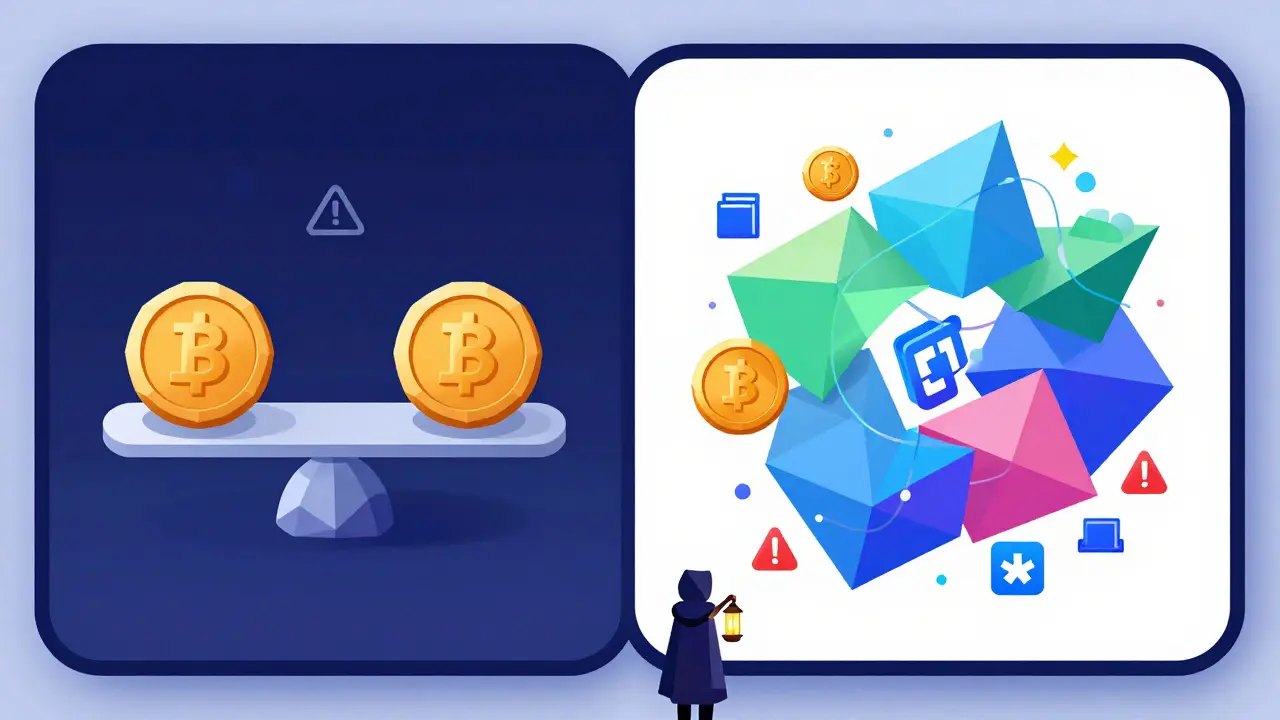
Key Differences at a Glance
Let’s break it down clearly. Here’s how liquidity mining and yield farming stack up:
| Aspect | Liquidity Mining | Yield Farming |
|---|---|---|
| Primary Goal | Provide liquidity to DEXs for trading | Maximize returns by moving assets across protocols |
| Typical Platforms | Uniswap, SushiSwap, Curve Finance | Aave, Yearn, Beefy, Pendle |
| Reward Structure | Trading fees + governance tokens | Interest + bonus tokens + auto-compounded yields |
| Complexity | Low to moderate | High |
| Time Required | Hours per month | Hours per week (or daily) |
| Main Risk | Impermanent loss | Smart contract exploits, rug pulls, volatile token prices |
| Capital Efficiency | Low (assets locked in one pair) | High (assets reused across multiple strategies) |
Notice how liquidity mining is focused on one job - keeping a DEX working. Yield farming is about playing the system: stacking, compounding, and exploiting inefficiencies. One is about stability; the other is about speed.
Which One Should You Choose?
There’s no "better" option - only the right one for your situation.
If you’re new to DeFi, start with liquidity mining. Pick a well-known pair like ETH/USDT on Uniswap or SOL/USDC on Raydium. Use a reputable platform with audited contracts. Keep your exposure small. Understand impermanent loss. Don’t chase the highest APY - that’s usually a trap.
If you’ve been in DeFi for a while and you’re comfortable reading smart contract audits, tracking gas fees, and monitoring token price swings, then yield farming might be worth exploring. Use yield aggregators like Yearn or Beefy to reduce manual work. Start with one strategy - like staking stablecoins on Aave and compounding the rewards - before jumping into multi-layered farming.
Never put in more than you can afford to lose. DeFi rewards can be huge, but so can the losses. A 200% APY today could be a 0% APY tomorrow if the protocol runs out of funds or gets hacked. In 2023, over $2 billion was lost to DeFi exploits - many of them targeting yield farmers.

The Bigger Picture: Why This Matters
Liquidity mining and yield farming aren’t just ways to earn crypto. They’re the engine behind DeFi’s growth. Without liquidity mining, DEXs like Uniswap wouldn’t work - no one could trade ETH for LINK. Without yield farming, there’d be no reason for capital to flow into new protocols. These strategies keep the system alive.
They also distribute power. Instead of a few big players controlling liquidity, thousands of everyday users become stakeholders. Governance tokens give them voting rights. That’s decentralization in action.
But as DeFi matures, things are changing. Layer-2 networks like Arbitrum and Base are cutting gas fees. Automated strategies are getting smarter. New protocols are building in safety features - like insurance pools and time-locked rewards - to reduce risk. The wild west days of 2021 are over. The next wave will reward knowledge, not luck.
Final Thoughts
Liquidity mining is the quiet backbone of DeFi. Yield farming is the high-octane race to the top. One gives you steady, predictable exposure to a market. The other turns your crypto into a trading strategy.
If you want simplicity and lower risk, go with liquidity mining. Stick to major tokens. Avoid exotic pairs. Monitor price changes. Keep your LP tokens safe.
If you want higher returns and don’t mind the grind, try yield farming. Start small. Use automation. Always check the audit status. And never, ever stop learning.
DeFi doesn’t reward greed. It rewards patience, discipline, and understanding. The biggest mistake isn’t losing money - it’s thinking you know more than you do.
Can you do liquidity mining and yield farming at the same time?
Yes, and many experienced users do. For example, you might supply ETH-USDT liquidity to Uniswap (liquidity mining) while simultaneously staking the UNI tokens you earn into a yield pool on Yearn (yield farming). This combines both strategies: you earn trading fees from liquidity and bonus yields from staking. But this also multiplies your risks - impermanent loss, token volatility, and smart contract exposure all stack up.
Is liquidity mining riskier than yield farming?
It depends. Liquidity mining carries high risk from impermanent loss, especially with volatile token pairs like ETH-DOGE. Yield farming carries risk from protocol failures, rug pulls, and complex interactions between smart contracts. Many experts say yield farming is riskier overall because it involves more moving parts. But for beginners, liquidity mining can feel more dangerous because impermanent loss is invisible until you withdraw.
Do you need to be a crypto expert to start?
Not to start small, but yes to succeed. You don’t need to code or understand blockchain internals, but you do need to know how to read a token’s contract, check for audits (like Certik or Hacken), and understand what APY really means. If you don’t know what a governance token is or how compounding works, you’re gambling, not farming.
Are liquidity mining rewards guaranteed?
No. Rewards are paid in protocol tokens - not stablecoins - and those tokens can crash. Also, protocols can run out of funds. Many early DeFi projects offered huge rewards to attract users, then stopped payments once their treasury was empty. Always check how long the reward schedule lasts and whether the team has enough reserves to sustain payouts.
What’s the best platform to start with?
For liquidity mining: Uniswap (Ethereum), SushiSwap (multi-chain), or PancakeSwap (BSC). For yield farming: Yearn Finance (for automation), Beefy Finance (for multi-chain), or Aave (for stablecoin lending). Stick to platforms with over $1 billion in Total Value Locked (TVL) and public audits. Avoid anything with "new token launch" hype.
Howard Headlee
March 12, 2026 AT 18:46karan narware
March 13, 2026 AT 07:41Michael Suttle
March 15, 2026 AT 05:27Douglas Anderson
March 17, 2026 AT 04:15Lindsay Girvan
March 17, 2026 AT 15:46Jenni James
March 19, 2026 AT 02:30Jennifer Pilot
March 19, 2026 AT 13:11Anshita Koul
March 21, 2026 AT 07:42PIYUSH KOTANGALE
March 21, 2026 AT 12:36Craig Gregory
March 22, 2026 AT 14:21Tina Keller
March 22, 2026 AT 22:04vishnu mr
March 23, 2026 AT 15:22Sharon Tuck
March 25, 2026 AT 15:17Julie Tomek
March 26, 2026 AT 23:25Brandon Kaufman
March 27, 2026 AT 09:33Grace van Gent-Korver
March 28, 2026 AT 00:38Zephora Zonum
March 29, 2026 AT 09:45Chelsea Boonstra
March 31, 2026 AT 06:11