
Isolated Margin vs Cross Margin: Which Crypto Trading Mode Saves Your Account?

You open a leveraged trade on Bitcoin. The market dips. Suddenly, your entire account balance vanishes in seconds. Did you expect that? Most traders don’t realize until it’s too late that their choice of margin mode determined whether they lost just one position or their whole portfolio.
In cryptocurrency derivatives trading, how you handle collateral changes everything. It isn't just about picking the right direction for price movement. It is about deciding where your money lives when things go wrong. This decision comes down to two main systems: isolated margin and cross margin. Understanding the difference between these two can mean the difference between surviving a volatile week and getting wiped out completely.
The Core Difference: Silos vs. Shared Pools
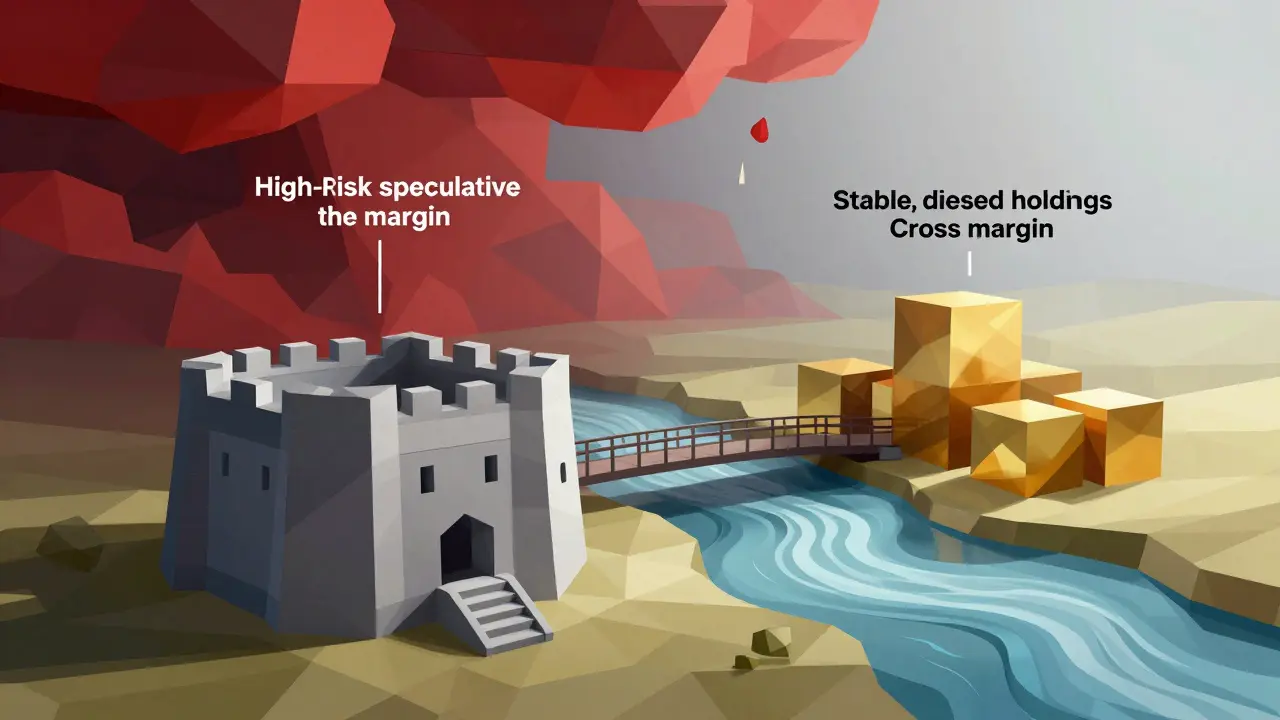
To grasp why this matters, imagine you are running a business with multiple projects. In an isolated margin setup, each project has its own bank account. If Project A fails, it goes bankrupt, but Projects B and C remain untouched because their funds are locked away separately. This is exactly how isolated margin works in crypto trading. You allocate a specific amount of capital to a single position. That amount is the maximum you can lose. If the trade hits your stop-loss or liquidation price, only that allocated chunk disappears. The rest of your wallet stays safe.
Now, imagine a different scenario. You have one big corporate bank account shared by all projects. This is cross margin. When Project A starts losing money, the system automatically pulls cash from the shared pool to keep it alive. If Project B is making a profit, those unrealized gains act as extra cushion for Project A. The goal here is to prevent any single failure from triggering a total collapse. However, if every project starts bleeding at once, the entire company goes under. In crypto terms, if your cross-margin positions all move against you simultaneously, your entire exchange balance is at risk.
| Feature | Isolated Margin | Cross Margin |
|---|---|---|
| Risk Scope | Limited to allocated position | Entire account balance |
| Liquidation Trigger | Based on position-only equity | Based on total account equity |
| Capital Efficiency | Lower (idle funds sit unused) | Higher (all funds work together) |
| Management Style | Active manual control | Passive automatic adjustment |
| Best For | High-risk/speculative trades | Hedged portfolios/hands-off approach |
How Isolated Margin Protects Your Downside
Let’s look at a concrete example. Suppose you have 1 BTC in your exchange account. You want to bet on Ethereum rising, but you’re nervous about the volatility. You decide to use 10x leverage. With isolated margin, you manually assign 0.1 BTC to this specific trade. Even if Ethereum crashes 10% instantly, hitting your liquidation point, you lose only that 0.1 BTC. Your remaining 0.9 BTC is completely safe. You can still trade other assets, withdraw funds, or wait for the market to recover without panic.
This method gives you precise control over risk per trade. It forces discipline. You cannot accidentally over-leverage yourself because the system physically separates the collateral. Platforms like BitMEX and Binance allow you to adjust this allocation easily via sliders in the interface. If you see the trade turning bad, you know exactly what the worst-case scenario is before you even click “buy.”
However, there is a catch. Because funds are siloed, you might leave capital idle. If you have 1 BTC total but only allocate 0.1 BTC to a trade, the other 0.9 BTC earns nothing while sitting in your spot wallet. For some traders, this inefficiency feels wasteful. Also, if you want to increase your position size later, you must manually transfer more funds into the isolated pool. There is no automatic help coming from your other balances.

Why Cross Margin Feels Safer (Until It Isn’t)
Cross margin appeals to traders who want simplicity and maximum efficiency. Instead of managing separate wallets for each trade, you let the exchange do the heavy lifting. Let’s say you have three open positions: two are profitable, and one is losing. In cross margin mode, the profits from the winning trades automatically support the losing one. The system calculates your overall health based on the net value of all positions combined.
This creates a buffer against sudden market dips. A small drop might not liquidate you because your other trades are covering the gap. It reduces the frequency of forced closures, allowing you to hold through temporary volatility. Many beginners prefer this because it feels less stressful-you don’t have to constantly monitor individual position margins. Exchanges often set cross margin as the default for this reason.
But here lies the danger. Cross margin hides risk. You might think you’re safe because your total account balance looks healthy, ignoring that one specific trade is dangerously close to wiping everything out. If the market moves sharply against all your correlated positions-for instance, if Bitcoin drops and most altcoins follow-your entire balance gets drained. Unlike isolated margin, where loss is capped, cross margin can lead to total account destruction. Professional traders warn that relying solely on cross margin without strict stop-losses is a recipe for disaster during black swan events.
When to Choose Which Mode
Selecting the right margin type depends heavily on your strategy and psychological tolerance for risk. Are you a scalper looking for quick gains on high-leverage trades? Or are you a swing trader holding positions for days?
- Use Isolated Margin when: You are testing a new strategy, taking a high-risk speculative bet, or using high leverage (50x+). It acts as a circuit breaker. If you believe a trade has asymmetric upside but limited downside potential, isolate the risk so a mistake doesn’t kill your career.
- Use Cross Margin when: You have a diversified portfolio with uncorrelated assets, such as long positions in tech tokens and short positions in energy coins. Here, losses in one area may be offset by gains in another. It also suits traders who prefer a hands-off approach and trust their overall market thesis rather than individual entry points.
Some advanced traders use a hybrid approach. They keep their core portfolio in cross margin for stability but open isolated accounts for experimental trades. This way, they enjoy capital efficiency for their main holdings while protecting themselves from reckless experimentation.
Common Mistakes Traders Make
Even experienced users fall into traps when switching between modes. One common error is forgetting which mode is active. You might place a large order thinking it’s isolated, but the exchange defaults to cross margin. When the trade turns red, you watch your entire balance shrink instead of just the allocated portion. Always double-check the margin mode indicator before executing any leveraged trade.
Another pitfall is misunderstanding liquidation prices. In isolated margin, the liquidation price is fixed based on the allocated collateral. In cross margin, it shifts dynamically as other positions gain or lose value. This makes it harder to predict exactly when you’ll get kicked out. Relying on mental math here is dangerous. Use the exchange’s calculator tools to simulate scenarios.
Finally, don’t ignore fees. Both margin types incur funding rates and trading fees, but cross margin can sometimes result in higher cumulative costs if you hold many small losing positions open longer than necessary, hoping they’ll turn around. Isolated margin forces you to cut losses sooner because the pain is localized and visible.
Platform Variations Matter
Not all exchanges implement these features identically. On BitMEX, cross margin is the default, requiring manual switches to isolated. On others like PrimeXBT or Margex, the interfaces vary in how they display available collateral and liquidation thresholds. Some platforms offer partial isolation options or tiered margin systems. Before committing real funds, test both modes in demo environments. Understand how the specific platform handles margin calls, auto-deleveraging, and emergency shutdowns.
Regulatory changes also impact margin rules. As jurisdictions tighten oversight on leveraged crypto products, exchanges may restrict leverage levels or mandate clearer disclosures. Staying informed about local regulations ensures you aren’t caught off guard by sudden policy shifts affecting your margin eligibility.
Can I switch from isolated to cross margin mid-trade?
Yes, most major exchanges allow you to switch margin modes while a position is open. However, doing so immediately changes your liquidation price and risk exposure. Switching from isolated to cross margin will likely lower your liquidation price since your full balance backs the trade. Conversely, switching to isolated margin may trigger immediate liquidation if the allocated amount is insufficient to cover current losses. Always check the warning prompts carefully before confirming the change.
Which margin mode is safer for beginners?
Isolated margin is generally safer for beginners. It limits your maximum loss to the amount you explicitly allocate, preventing accidental wipeouts of your entire account. Cross margin requires a deeper understanding of portfolio correlation and dynamic risk management. Starting with isolated margin teaches discipline and helps you learn how leverage affects individual positions without catastrophic consequences.
Does cross margin save money on fees?
No, margin mode does not directly affect trading fees or funding rates. Fees are calculated based on volume and leverage multipliers regardless of whether you use isolated or cross margin. However, cross margin might indirectly reduce costs by keeping positions open longer during minor dips, avoiding premature liquidation penalties. But this benefit is risky and unpredictable.
What happens if my cross margin account goes negative?
In rare cases of extreme volatility, a cross margin account can briefly go negative due to slippage during liquidation. Most reputable exchanges have insurance funds to cover these deficits so traders don’t owe money beyond their initial deposit. However, relying on this safety net is unwise. Proper risk management should prevent such scenarios entirely.
Can I use both margin types simultaneously?
Yes, you can have multiple open positions using different margin modes within the same account. For example, you could run a conservative hedging strategy in cross margin while speculating on a meme coin using isolated margin. Just ensure you track each position’s status separately to avoid confusion during market stress.
Jocelyn Garcia
May 19, 2026 AT 19:37look at this whole isolated vs cross debate like it is some grand philosophical dilemma when really it is just basic risk management 101. the jargon here is heavy but the concept is simple silos save lives while shared pools drown you. i have seen too many retail traders get wrecked because they thought their 'portfolio' was diversified enough to handle a black swan event in crypto. it never is. the correlation between assets during a crash is basically 1.0 so your cross margin buffer evaporates instantly. stick to isolated if you want to sleep at night without checking your phone every five minutes.
Amit Varpe
May 21, 2026 AT 13:05cross margin is for people who cannot handle discipline. stop crying about efficiency and start respecting capital preservation. :)
Bronwen Butler
May 21, 2026 AT 21:29actually both are flawed systems designed to extract fees from gamblers. the real winner is the exchange taking your spread regardless of which mode you pick. nobody cares about your portfolio theory when the liquidity dries up. punctuation is optional but logic is not
Pauline Larocco71
May 22, 2026 AT 01:29i feel like everyone is so focused on the mechanics that they forget the human element of trading. its scary to watch your balance drop no matter what mode you use. i used to think cross margin was safer because it felt like having a safety net but then i realized the net has holes. now i use isolated mostly but sometimes i mix them depending on how confident i am in the trade. its all about finding what works for your own peace of mind honestly. typos happen when im typing fast but hope this helps someone out there feeling lost
beti macedo
May 22, 2026 AT 17:14it is truly inspiring to see such detailed analysis on risk management strategies. many individuals overlook the importance of structured financial planning in volatile markets. by adhering to strict protocols one can achieve greater stability and success in their endeavors. let us continue to support each other in learning these vital skills for our economic well being
Michelle Bonahoom
May 24, 2026 AT 15:50most people reading this will still blow up their accounts because they lack self control. why bother explaining the difference when the outcome is always the same for amateurs. keep your money in savings accounts where it belongs instead of gambling on digital tokens. typical american greed driving you to ruin yourselves over leverage
Matt Davis
May 26, 2026 AT 14:22this entire discussion is utterly pointless drama manufactured by exchanges to keep you engaged. the market does not care about your margin settings. you are all ants marching toward extinction believing you have control. the house always wins and you are merely providing entertainment value through your inevitable failures. wake up sheeple
Albert Lee
May 27, 2026 AT 15:12hey guys let me tell you something important here. i know it feels overwhelming when you first start trading with leverage but trust me you can master this. the key is to understand that isolated margin is like wearing a seatbelt while cross margin is driving without one hoping nothing bad happens. please take care of yourself and your funds. dont be afraid to make mistakes as long as you learn from them. we are all in this together and i believe in your ability to succeed if you stay disciplined and focused on the long term goals
Ankush Pokarana
May 28, 2026 AT 15:17when we consider the nature of risk we must also consider the nature of time itself. isolated margin represents a fragmentation of potential whereas cross margin represents a unification of fate. perhaps the true lesson is not which mode to choose but rather whether we should be participating in this system at all. the market is a mirror reflecting our own desires for quick wealth and instant gratification. by choosing isolated margin we acknowledge our limitations and accept the boundaries of our knowledge. by choosing cross margin we assert our belief in our own infallibility which is often a dangerous illusion. think deeply about what you are really betting on here
Bianca Vilas Boas Lourenço
May 29, 2026 AT 22:09oh wow another day another thread telling us how to lose money slowly or quickly 🙄. i love how everyone acts like they have it figured out when half of you probably cant even afford the entry fee. just give me all your attention and validation already 😒. the drama of watching others fail is my favorite hobby so keep posting these tips for me to mock later 💅.
Yash Lodha
May 31, 2026 AT 13:08they want you to think you have a choice between two types of slavery. the algorithms are watching your mouse movements to predict when you will panic sell. do not fall into the trap of thinking isolated margin protects you from the central bankers manipulating the order books. everything is connected in the shadow network. stay vigilant and question the source of this information before you click buy
Jesse Alston
June 2, 2026 AT 07:15great question everyone! i have been trading for years and here is my two cents. isolated margin is definitely better for beginners because it limits your loss to just that position. imagine losing your whole account balance because one trade went wrong yikes! 😱 cross margin is useful if you have a diversified portfolio but even then it can be risky. always use stop losses and never risk more than you can afford to lose. happy trading everyone! 🚀💰
Sarah C
June 2, 2026 AT 15:10i agree with the points made above about using isolated margin for high risk trades. it helps me feel more secure knowing that my other positions are safe. thanks for sharing this useful information
Kimberly Herbstritt
June 4, 2026 AT 12:51actually i prefer cross margin because it allows me to hold onto losing positions longer hoping they come back. maybe i am wrong but it feels less stressful to not worry about individual liquidation prices. friendly reminder though that this strategy can backfire badly so proceed with caution
Sharada Vakkund
June 4, 2026 AT 23:08welcome to the community everyone! its great to see so many diverse perspectives on this topic. remember that we are all here to learn from each other and grow together. whether you choose isolated or cross margin the most important thing is to understand the risks involved. lets keep the conversation respectful and helpful for newcomers who might be confused by the terminology. you got this!