
How Network Effects Drive Crypto Valuation: Bitcoin, Ethereum, and the Hidden Mechanics Behind Price

When you hear someone say Bitcoin is valuable because it's the first cryptocurrency, they're missing the real reason. It's not because it came first. It's because millions of people use it, trust it, and depend on it - and every new user makes it stronger for everyone else. This is called a network effect, and it's the single most powerful force behind why some cryptocurrencies rise in value while others fade into obscurity.
Think of a fax machine. In 1985, owning one was useless unless someone else had one too. But as more people bought fax machines, the value of owning one exploded. The same thing happened with telephones, email, and now, cryptocurrencies. The more people on the network, the more valuable it becomes - not linearly, but exponentially. That’s Metcalfe’s Law: the value of a network grows with the square of its users (N²). In crypto, that means if Bitcoin doubles its users, it doesn’t just double in value - it quadruples. And that’s exactly what’s happening.
Bitcoin: The Ultimate Network Effect Machine
Bitcoin isn’t valuable because of its code. Its algorithm is simple. It doesn’t process smart contracts. It doesn’t run dApps. What makes Bitcoin powerful is its security, history, and adoption. Since 2009, it’s never been hacked. Over 420 million people now hold or use Bitcoin. Thousands of businesses accept it. Institutions like BlackRock and Fidelity now offer Bitcoin ETFs. Each new user adds to the network’s resilience.
The protocol itself reinforces this. Every 2,016 blocks - roughly every two weeks - Bitcoin automatically adjusts mining difficulty to keep block times steady at 10 minutes. This keeps the network stable even as computing power shifts. Then there’s the halving: every 210,000 blocks (about every four years), the reward for miners is cut in half. This predictable scarcity has driven price spikes in 2012, 2016, 2020, and 2024. But the real magic? These mechanics don’t just create scarcity - they create trust. People know what to expect. That predictability attracts more users, which strengthens the network further.
As Lyn Alden pointed out in 2021, Bitcoin acts like a “machine for generating market capitalization.” It doesn’t need profits. It doesn’t need revenue. It just needs users. And it has them. In Q3 2023, Bitcoin averaged 1.1 million daily active addresses. That’s not a number - it’s a fortress. No new coin has come close to matching that level of sustained, organic adoption.
Ethereum: The Developer Network That Feeds Itself
Ethereum’s network effect works differently. Instead of being a digital gold store, it’s a platform. Its value comes from the apps built on top of it. As of 2023, over 4,000 decentralized applications (dApps) run on Ethereum - from lending platforms to NFT marketplaces, from DAOs to gaming economies. Each app attracts users. Each user pays transaction fees. Those fees reward developers and validators. More rewards mean more developers build more apps. More apps mean more users. It’s a loop that feeds itself.
This is where Reed’s Law kicks in. Unlike Metcalfe’s Law (N²), which focuses on connections between users, Reed’s Law (2^N) says the value of a network explodes when users can form groups. Ethereum lets people create decentralized communities - DAOs, token pools, prediction markets - that operate without central control. That’s why Ethereum’s quarterly transaction volume hit $1.2 trillion in 2023. It’s not just about sending ETH. It’s about using it to power entire economies.
But this strength has a dark side. During the 2021 NFT boom, Ethereum got clogged. Gas fees spiked from $1.50 to over $65 in a few months. Users complained they were paying more in fees than the NFTs cost. That’s a negative network effect - more users made the network worse. Ethereum responded with upgrades. The Merge in 2022 switched it from energy-hungry mining to efficient proof-of-stake. The Shanghai upgrade in 2023 let users withdraw staked ETH. These fixes didn’t just improve tech - they restored trust. Staking participation jumped 45%. The network got stronger again.
Why Most Altcoins Fail - Even If They’re “Better”
There are thousands of cryptocurrencies. Many have faster transactions, lower fees, or better privacy. Yet none come close to Bitcoin or Ethereum’s market share. Why? Because network effects are irreversible.
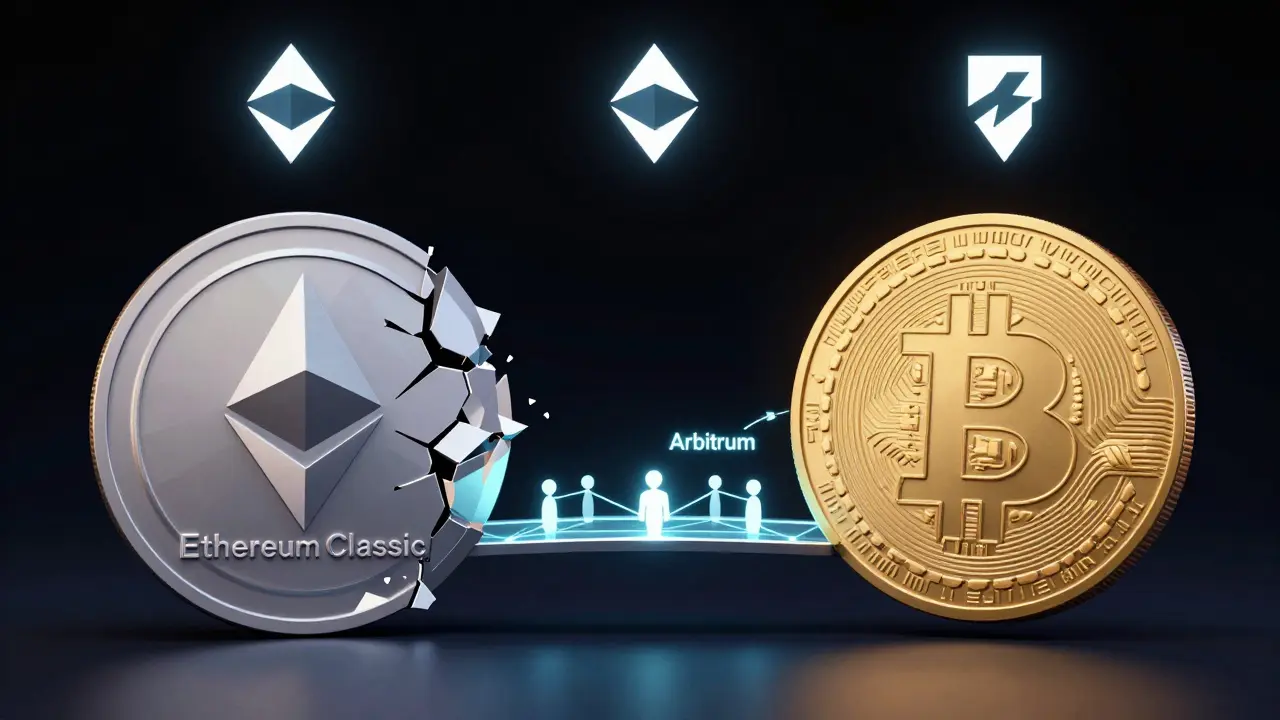
Ethereum Classic is a perfect example. It’s a direct copy of Ethereum’s code - forked after the DAO hack in 2016. Same code. Same features. But its market cap is 0.5% of Ethereum’s. Why? Because Ethereum had the users, the developers, the exchanges, the wallets, the apps. You can copy code. You can’t copy a community. You can’t copy trust built over years.
Same goes for Solana, Cardano, or Avalanche. They may have technical advantages. But if they don’t have the critical mass of users and developers, they’re just experiments. Chainlink’s 2023 analysis puts it simply: “Code is easy to fork. Network effects are not.”

How to Spot Real Network Effects - Not Just Hype
Not every crypto project with rising prices has real network effects. Many are fueled by speculation, token incentives, or pump-and-dump schemes. To tell the difference, look at three things:
- Active addresses: How many real people are using it daily? Bitcoin’s 1.1 million is solid. A coin with 50,000 might be a bubble.
- Developer activity: Are developers building on it? Ethereum had 2,300+ monthly active developers in 2023. A coin with 50 is not sustainable.
- Transaction volume vs. price: Is value growing because people are using it - or because speculators are buying? Ethereum’s $1.2 trillion in transaction volume shows real use. A coin with $10 billion in market cap but $50 million in volume? Red flag.
Also watch for negative signals. Are gas fees or transaction costs skyrocketing? Are users leaving because the network is too slow or expensive? That’s a warning sign the network effect is breaking down.
The Future: Layer 2s, Institutional Adoption, and the Winner-Takes-Most Pattern
The crypto market is becoming more like the internet in the 1990s - consolidation is happening. In 2023, Bitcoin and Ethereum together held 70% of the total $1.65 trillion crypto market cap. The next 10 coins shared just 20%. That’s a classic network effect pattern. The leader gets stronger. Everyone else fights for scraps.
Layer 2 solutions are changing the game. Ethereum’s Layer 2 networks - like Arbitrum and Optimism - now handle 68% of all Ethereum transactions by volume. They’re not replacing Ethereum. They’re enhancing it. More users get on-chain benefits without paying high fees. This isn’t dilution - it’s expansion. The core network stays strong while the ecosystem grows.
Bitcoin’s Lightning Network is doing the same. In 2021, it processed $1 million in daily volume. By late 2023, it hit $150 million. That’s a 150x increase. Lightning doesn’t compete with Bitcoin - it makes Bitcoin more usable. That’s how network effects scale.
Institutional adoption is another accelerator. Forty percent of Fortune 500 companies are now exploring blockchain integration - and over 80% of them are choosing Ethereum because of its developer ecosystem. That’s not random. It’s because the network effect is proven. Companies don’t gamble on untested tech. They bet on what already works.
By 2030, Galaxy Digital predicts the top three blockchains will hold 85% of crypto value. That’s not speculation. It’s math. Network effects compound. The bigger you get, the harder it is to catch up.
What Could Break It?
Network effects are powerful - but not invincible. Three risks could weaken them:
- Regulation: If the U.S. SEC bans crypto exchanges or blocks Bitcoin ETFs, adoption could stall. China’s blockchain initiatives show how government control can create regional networks - but also isolate them.
- Technological disruption: What if a new protocol emerges that’s 10x more efficient, secure, and user-friendly? It’s possible. But it would need to replicate a decade of network trust - something no project has done yet.
- Economic model failure: Many tokens rely on inflationary rewards to attract users. When those rewards stop, users leave. That’s why DeFi projects with 3,000% TVL growth in 2021 collapsed in 2022. Real network effects come from organic use - not bribes.
The key is sustainability. Bitcoin’s halvings, Ethereum’s staking rewards, and Layer 2 scaling aren’t just tech upgrades - they’re economic designs that keep users coming back.
Final Thought: It’s Not About the Tech - It’s About the People
Crypto isn’t about blockchain. It’s not about mining. It’s not even about decentralization. It’s about people. The more people who believe in a network, use it, and depend on it - the more valuable it becomes. Bitcoin’s network effect isn’t magic. It’s math. Ethereum’s isn’t luck. It’s momentum.
If you’re evaluating a cryptocurrency, stop asking, “What does it do?” Start asking, “Who uses it? Why? And will they still be using it in five years?” That’s where the real value lives.
What exactly is a network effect in cryptocurrency?
A network effect in cryptocurrency happens when a blockchain or token becomes more valuable as more people use it. Each new user adds value to everyone else - whether by increasing liquidity, supporting more apps, or strengthening security. This creates a self-reinforcing cycle: more users → more utility → higher value → attracts even more users. Bitcoin and Ethereum are the clearest examples.
How does Metcalfe’s Law apply to Bitcoin and Ethereum?
Metcalfe’s Law says a network’s value grows with the square of its users (N²). So if Bitcoin has 10 million users, its value isn’t proportional to 10 million - it’s proportional to 100 trillion. This explains why Bitcoin’s price has surged despite no major technical upgrades. Its user base has grown from a few thousand in 2010 to over 400 million today. That exponential growth is why its market cap exceeds $1 trillion. Ethereum follows the same pattern - more users mean more dApps, more transactions, and more value locked in DeFi.
Can a cryptocurrency with better technology beat Bitcoin or Ethereum?
It’s extremely unlikely. Even if a new coin has faster transactions, lower fees, or better privacy, it still needs to replicate the trust, user base, developer ecosystem, and institutional adoption that Bitcoin and Ethereum have built over 10-15 years. Ethereum Classic, a direct copy of Ethereum’s code, has only 0.5% of Ethereum’s market cap. Code is easy to copy. Network effects aren’t.
What are negative network effects in crypto?
Negative network effects happen when more users make the network worse. Ethereum experienced this during the 2021 NFT boom. As demand surged, gas fees spiked from $1.50 to over $65. Many users abandoned transactions because they cost more than the NFTs themselves. High fees scared away newcomers, slowed adoption, and damaged trust. That’s a negative feedback loop. Upgrades like The Merge and Layer 2 scaling were designed to fix this - and they worked.
How do Layer 2 solutions help network effects?
Layer 2s like Arbitrum, Optimism, and Bitcoin’s Lightning Network solve scalability without weakening the main chain. They handle most transactions off-chain, reducing fees and congestion. This keeps the core network fast, secure, and valuable - while letting more users join. Ethereum’s Layer 2s now process 68% of its total transaction volume. Instead of diluting the network, they amplify it. That’s how network effects scale sustainably.
Is network effect the only factor in crypto valuation?
No - but it’s the most important one. Other factors like tokenomics, team credibility, and regulatory environment matter. But if a coin lacks user adoption and community trust, none of that matters. Bitcoin and Ethereum dominate because their networks are so strong they absorb shocks - from crashes to regulatory threats. That’s why they’re not just assets - they’re infrastructure.
christopher luke
February 22, 2026 AT 05:13Bitcoin’s network effect is just wild when you think about it. I remember when I bought my first 0.1 BTC for $500 back in 2017 and everyone laughed. Now my grandma uses it to send money to her cousin in Mexico. That’s the real magic - not code, not mining, just people.
Michelle Xu
February 22, 2026 AT 18:12Metcalfe’s Law explains so much about why Ethereum’s DeFi ecosystem exploded. It’s not just about the number of users - it’s about how each user connects to multiple protocols. A single wallet can interact with lending, staking, swaps, and DAOs. That combinatorial growth is why TVL keeps climbing even during bear markets.
Jeremy buttoncollector
February 24, 2026 AT 03:43Let’s be real - network effects are just emergent properties of collective action bias amplified by game theory. The real driver isn't N² - it's the psychological anchoring of institutional memory. Bitcoin isn’t valuable because it’s decentralized - it’s valuable because it’s the last standing monument to the 2008 financial collapse. We don’t use it because it’s better - we use it because we’re traumatized by the alternatives.
Also, the halving isn’t scarcity - it’s ritual. It’s the crypto equivalent of Easter. People show up because they have to. Not because they understand it. Because they believe in it. And belief is the ultimate consensus algorithm.
Kristi Emens
February 24, 2026 AT 13:04I’ve been following crypto since 2015. What strikes me most is how Bitcoin’s stability comes from its simplicity. No smart contracts. No governance votes. Just a ledger. And that’s why it survives when everything else crashes. People don’t need to understand it - they just need to trust it. And after 15 years, that trust is baked in.
Amanda Markwick
February 25, 2026 AT 01:46It’s insane how Ethereum’s ecosystem just keeps growing like a living organism. Every time someone says it’s dead, a new DAO pops up or a game launches with 50k daily users. The devs don’t need funding - they just build because the network rewards them. It’s organic. It’s beautiful. And honestly? We’re still in the early chapters.
Sriharsha Majety
February 26, 2026 AT 01:06Neeti Sharma
February 26, 2026 AT 11:10Bitcoin is american innovation. Ethereum is global. Why do you think china banned crypto but still built their own blockchain? Because they know network effects can't be copied. Only dominated. And we're not talking tech - we're talking culture. The west built the internet. Now we're building the next one. And you can't outsource that.
Fiona Monroe
February 28, 2026 AT 10:30It is imperative to clarify that the application of Metcalfe’s Law to cryptocurrency is not universally accepted within academic economic circles. While empirically observable in certain datasets, the N² model lacks rigorous statistical validation in non-linear, decentralized systems. Furthermore, transaction volume does not equate to intrinsic value - a critical distinction often overlooked by retail investors.
Lucy Simmonds
February 28, 2026 AT 22:27Network effects? Please. The real reason Bitcoin is up is because the Fed printed 10 trillion dollars and they needed somewhere to hide it. The whole 'decentralized money' thing is a distraction. It's just digital gold for billionaires who don't trust paper. And don't even get me started on Ethereum - it's a Ponzi with smart contracts.
Also, who let these devs make their own rules? No one asked me if I wanted to pay $50 to send $10. This is rigged.
Maggie House
March 2, 2026 AT 17:12Love this post! I just started learning about crypto last year and honestly, the network effect thing clicked when I saw my friend use MetaMask to buy an NFT for her dog’s birthday. It’s not about tech - it’s about people making weird, beautiful things together. I’m excited to see what happens next.
Dana Sikand
March 3, 2026 AT 03:25Y’all are underestimating how deep this goes. Bitcoin isn’t just a currency - it’s a cultural artifact. Like the pyramids. People don’t visit them because they’re useful. They visit because they’re symbolic. Ethereum’s dApps? They’re the new cathedrals. And we’re all just pilgrims with wallets.
And Layer 2s? They’re like highways built around the city so the cathedral doesn’t get traffic. Genius. I’m crying. This is art.
Elizabeth Smith
March 3, 2026 AT 10:30Everyone talks about network effects like they’re natural laws. But what about the people who got left behind? The ones who can’t afford gas fees? The ones who don’t have a smartphone? This isn’t progress - it’s exclusion dressed up as innovation. The rich get richer. The network gets stronger. And the rest of us? We’re just spectators.
Robert Kromberg
March 5, 2026 AT 00:20I think the real story here is resilience, not just growth. Bitcoin survived the 2014 Mt. Gox collapse. Ethereum survived the DAO hack. Both could’ve died. But they didn’t. Because communities chose to rebuild. That’s not luck. That’s collective will. And that’s harder to kill than any algorithm.
Daisy Boliaan
March 5, 2026 AT 11:24OMG I JUST REALIZED - Ethereum is basically a giant TikTok for devs. Everyone’s posting new apps and getting likes in ETH. And the more likes you get, the more money you make. It’s not finance - it’s social media with blockchain. I’m so here for it.
Jessica Carvajal montiel
March 5, 2026 AT 14:19Network effects? Nah. This is all controlled by the same 10 whales who own 40% of Bitcoin. The whole thing is a psyop. The halving? A marketing stunt. The ETFs? A Fed-backed trap. They want you to believe in 'trustless' systems while they sit on 10 million BTC. Wake up. This isn’t revolution - it’s rebranding.
And don’t get me started on Layer 2s. They’re just centralized relayers with fancy names. You think Arbitrum is decentralized? Lol. It’s run by a VC-backed team in San Francisco. The whole thing is a house of cards.
bella gonzales
March 5, 2026 AT 23:36Why is everyone so obsessed with Bitcoin and Ethereum? I mean, I get it. But like… what about the other 10,000 coins? Are they just… garbage? I feel like we’re being brainwashed into thinking there’s only two winners. What if the future is 100 different blockchains? Why do we need to pick sides?
Samantha Stultz
March 6, 2026 AT 09:42You’re all missing the point. Network effects don’t scale - they fracture. Ethereum’s L2s aren’t enhancing the network - they’re splintering it. Each chain has its own liquidity, its own users, its own governance. That’s not expansion. That’s fragmentation. And fragmentation kills network effects. The real value is in centralization - not decentralization.
Bitcoin’s simplicity is its weakness. It can’t evolve. Ethereum’s complexity is its death sentence. The next 5 years will be a bloodbath. And the only winners? The ones who predicted this. I’m one of them.