
How Market Makers Use Order Books in Crypto and Traditional Markets
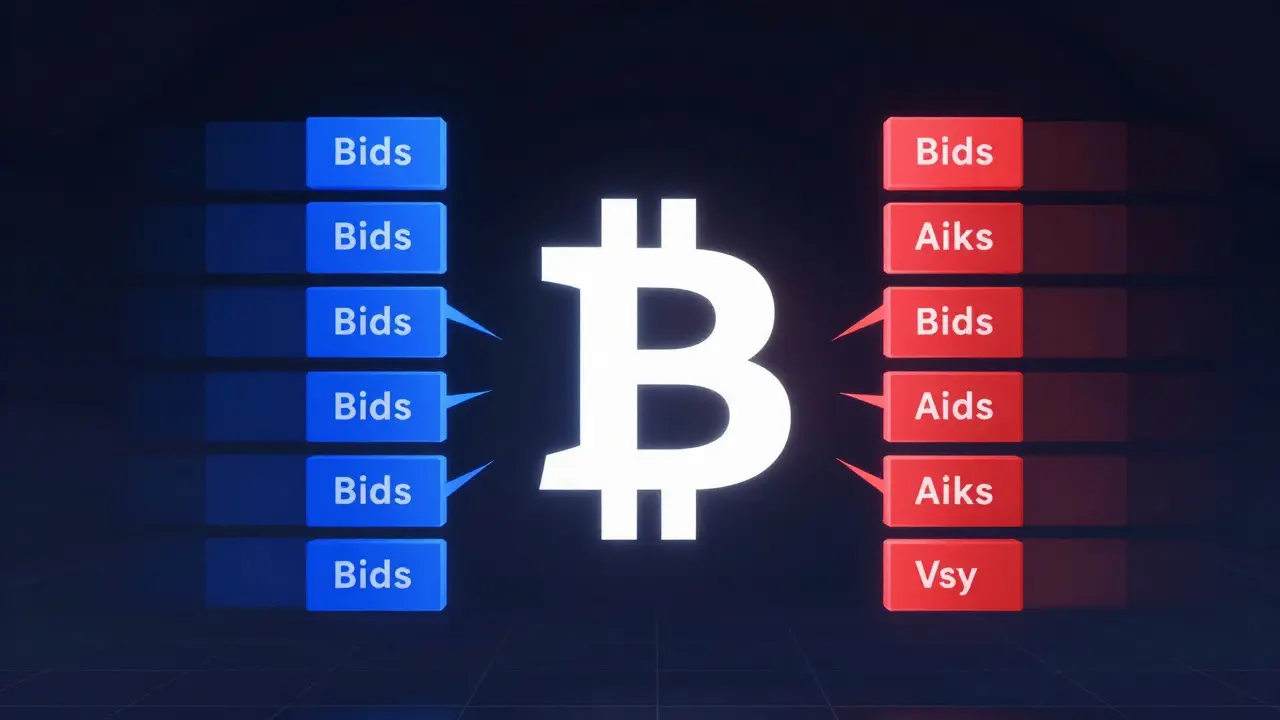
When you buy or sell a cryptocurrency like Bitcoin or Ethereum, you might think you're trading directly with another person. But behind the scenes, there’s a quiet, constant force making sure there’s always someone to trade with-market makers. These traders don’t bet on price direction. Instead, they make money by providing liquidity, and they do it all through the order book.
What Is an Order Book?
An order book is a live, digital list of all buy and sell orders for a specific asset. It shows you who wants to buy, who wants to sell, and at what prices. On a typical exchange, you’ll see two sides:
- Bids: Buyers offering to purchase at certain prices, listed from highest to lowest.
- Asks: Sellers offering to sell at certain prices, listed from lowest to highest.
The top bid is the highest price someone is willing to pay right now. The top ask is the lowest price someone is willing to sell for. The gap between them? That’s the bid-ask spread. Market makers live in that gap.
Every time an order comes in, the book updates in real time. If someone places a large buy order that eats through all the available sell orders at the best price, the system automatically moves to the next price level up. This keeps trades flowing without big price jumps.
How Market Makers Use the Order Book
Market makers don’t just watch the order book-they shape it. Here’s how:
- Posting Limit Orders: Instead of market orders that execute immediately, market makers place limit orders on both sides. For example, they might bid $60,000 for BTC and ask $60,010. They’re not trying to guess if Bitcoin will go up or down. They’re just offering to buy and sell at a small spread.
- Managing Inventory: If too many people are buying from them, they end up holding too much of the asset. If too many are selling to them, they run out of it. Market makers use automated systems to rebalance their holdings, buying or selling elsewhere to stay neutral.
- Adjusting Spreads Dynamically: When markets are calm, spreads might be just $10 wide. When news breaks or volatility spikes, they widen to $500 or more. This protects them from sudden moves they can’t react to fast enough.
- Reading Order Flow: They track not just prices, but volume. If 100 BTC are being bid at $60,000 but only 5 BTC are offered at $60,010, that’s a sign buyers are eager. Market makers might raise their ask price slightly to catch that momentum.
They use tools that show color-coded depth charts, real-time volume imbalances, and historical replay of order book changes. Some systems update every millisecond. A single microsecond delay can cost them thousands.
Order Book Mechanics: Price-Time Priority
Not all orders are treated the same. Exchanges use a simple but powerful rule: price-time priority.
- Price: The best price always executes first. The highest bid wins. The lowest ask wins.
- Time: If two bids are at $60,000, the one placed first gets filled first.
This is why market makers don’t just post orders-they race to be first. A firm like Optiver spends millions on co-located servers, fiber-optic cables, and low-latency networks just to get their orders into the book a few microseconds ahead of the competition.
It’s not about being smarter. It’s about being faster.
Market Makers on Decentralized Exchanges (DEXs)
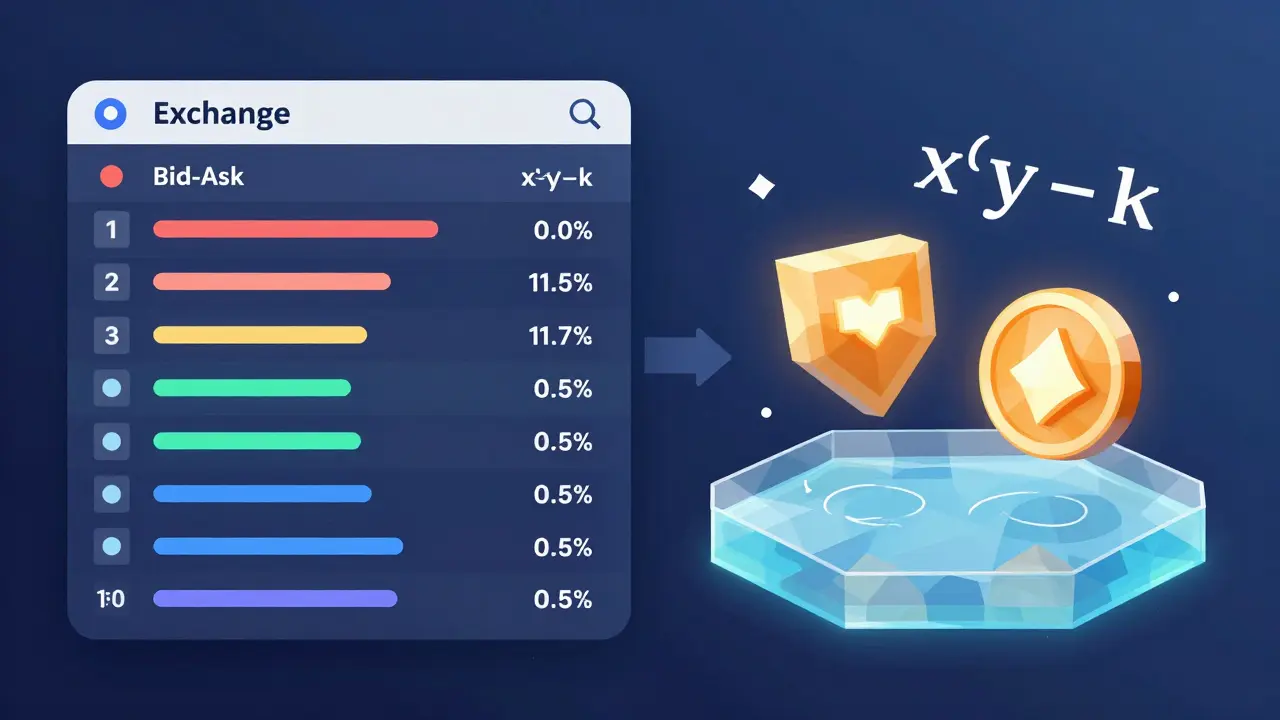
On centralized exchanges like Binance or Coinbase, the order book is managed by a central server. On decentralized exchanges like Uniswap or SushiSwap, there’s no order book-at least not in the traditional sense.
DEXs use automated market makers (AMMs). Instead of limit orders, they rely on mathematical formulas (like x*y=k) to set prices based on pool reserves. Liquidity providers deposit tokens into pools and earn fees, but they don’t set bid/ask levels like traditional market makers.
So what’s the difference?
| Feature | Traditional Order Book | Automated Market Maker (DEX) |
|---|---|---|
| Price Discovery | Driven by buyer/seller orders | Driven by algorithm and token ratios |
| Liquidity Source | Professional market makers | Individual liquidity providers |
| Spread | Can be as tight as $0.01 | Typically wider, 0.1%-0.5% |
| Slippage | Low for small trades | High for large trades |
| Speed | Microsecond execution | Block-time delays (12-15 seconds) |
Market makers still operate on DEXs-but differently. Some firms now run bots that monitor multiple DEXs and centralized exchanges at once. If Bitcoin is trading at $60,000 on Binance but $60,050 on Uniswap, they buy on Binance and sell on Uniswap. That’s arbitrage. And it’s how they make money even when there’s no traditional order book.
The Tech Behind the Scenes
Modern market making isn’t done by humans staring at screens. It’s run by algorithms fed with real-time data:
- Level 2 Data Feeds: Show all bids and asks, not just the top five.
- Volume-Weighted Average Price (VWAP): Helps them calculate fair value across multiple trades.
- Order Flow Imbalance Indicators: Tell them if buyers or sellers are dominating.
- Smart Order Routing: Automatically sends trades to the venue with the best price.
- Inventory Risk Calculators: Track exposure across 50+ assets and auto-hedge positions.
These systems don’t just react-they predict. Machine learning models analyze past order book behavior to forecast where liquidity will dry up or surge. One firm reported reducing slippage by 37% in 2025 by using AI to adjust quote placement 200 times per second.
Why Market Makers Matter
Without them, markets would be messy. Imagine trying to sell your Bitcoin but no one’s buying. You’d have to drop your price way down. Or worse-you couldn’t sell at all.
Market makers prevent that. They:
- Keep spreads tight, so traders pay less to enter and exit.
- Ensure there’s always a buyer and seller, even during panic or hype.
- Help prices reflect true value by constantly adjusting quotes based on supply and demand.
In crypto, where trading happens 24/7 across dozens of exchanges, their role is even more critical. A sudden 10% drop in Ethereum? Market makers absorb the sell pressure instead of letting prices crash.
The Future of Market Making
The next five years will see market makers become even more automated. AI will handle 90% of quote placement. Risk models will adjust in real time based on global news, social sentiment, and even weather patterns affecting mining operations.
Regulators are also catching up. In 2025, the U.S. SEC began requiring crypto market makers to disclose their liquidity commitments. The EU is rolling out similar rules. This means market makers can’t just vanish when volatility hits-they’ll be held accountable.
And as blockchain technology evolves, we’ll see hybrid models: order books on Layer 2 networks, with settlement on Ethereum. Market makers will need to operate across multiple chains, protocols, and time zones.
Their core job won’t change: provide liquidity, manage risk, and profit from the spread. But the tools, speed, and complexity? They’re only getting harder.
Jessica Beadle
March 14, 2026 AT 16:18Zachary N
March 16, 2026 AT 09:47Brenda White
March 18, 2026 AT 03:19Ricky Fairlamb
March 18, 2026 AT 06:43Arlene Miles
March 18, 2026 AT 08:02Tobias Wriedt
March 19, 2026 AT 04:47Konakuze Christopher
March 19, 2026 AT 13:45Prakash Patel
March 20, 2026 AT 15:06Elizabeth Kurtz
March 20, 2026 AT 21:49john peter
March 22, 2026 AT 08:19Marc Morgan
March 23, 2026 AT 07:10Kira Dreamland
March 23, 2026 AT 20:37Derek Lynch
March 24, 2026 AT 10:29Shreya Baid
March 25, 2026 AT 16:23Diane Overwise
March 27, 2026 AT 05:53Ann Liu
March 27, 2026 AT 08:31Dionne van Diepenbeek
March 27, 2026 AT 13:03Jessica Beadle
March 28, 2026 AT 10:51