
Future of DAO Governance Models in 2026: How Decentralized Decision-Making Is Evolving

By 2026, DAO governance isn’t just about voting with tokens anymore. It’s a living system-part human, part machine, part legal experiment-that’s slowly fixing its biggest flaws. Five years ago, if you held 1% of a DAO’s tokens, you got 1% of the vote. Simple. Fair? Not really. The biggest holders, often called "whales," could push through proposals even if 90% of members disagreed. That’s not democracy. It’s plutocracy with a blockchain logo.
Why Token Voting Alone Is Failing
Token-based voting still powers 58% of DAOs, but it’s losing ground fast. The problem isn’t the tech-it’s the incentive. If you own 100,000 tokens, your vote weighs more than 1,000 small holders combined. In 2024, 73% of contentious votes were decided by wallets holding over 30% of the total supply, according to ECGI Global’s research. That’s not community control. That’s corporate boardroom dynamics with crypto names.
And voter turnout? It’s dismal. On average, only 17% of token holders bother to vote. Why? Because proposals are long, confusing, and often irrelevant to small holders. One Reddit user summed it up: "I hold tokens in 12 DAOs but only vote in 3. I don’t have time to read 17 proposals a week." That’s not apathy-it’s rational behavior.
The Rise of Hybrid Models
The smartest DAOs in 2026 don’t rely on one system. They mix and match. Think of it like building with LEGO: you pick the pieces that fit your community’s needs.
Quadratic voting is one of the biggest shifts. Instead of one token = one vote, you pay for votes in a squared cost: 1 vote = 1 token, 2 votes = 4 tokens, 3 votes = 9 tokens. This lets small holders express strong opinions without letting whales drown them out. Gitcoin DAO saw a 22% drop in whale influence after switching. One participant said: "For the first time, my 500 tokens actually mattered."
Reputation-based systems are gaining traction too. Colony, for example, tracks 27 different contributions-writing docs, fixing bugs, moderating forums-and gives governance weight based on that, not token balance. In their DAO, reputation makes up 65% of voting power. That means a contributor who’s been active for a year but owns zero tokens can have more say than a whale who just bought in.
Liquid democracy lets you vote directly-or delegate your vote to someone you trust. If you’re busy, you can hand your vote to a security expert, a legal advisor, or a community veteran. Karma DAO found that 42% of members delegated at least some of their voting power in 2024. It’s not perfect, but it’s a bridge between mass participation and expert input.
AI Is No Longer Optional
AI isn’t replacing humans in DAOs-it’s making them more effective. By 2026, 43% of DAOs use AI tools to handle routine tasks: summarizing 10-page proposals into two bullet points, flagging risky treasury moves, or even auto-rejecting spam proposals. Snapshot’s AI summarizer cut proposal review time by 47%, according to GitHub developers.
Some DAOs now have AI delegates. These aren’t autonomous agents making decisions-they’re assistants. For example, an AI might suggest: "This treasury proposal would deplete reserves below 30-day safety buffer. Recommend delay." But the final call? Still human. AI circuit breakers pause actions if thresholds are breached, giving members time to react. Twenty-eight percent of AI-integrated DAOs use these safeguards.
And AI isn’t just for proposals. It’s used to score member engagement, predict voter turnout, and even match new members with mentors. The goal? Reduce noise. Increase clarity. Keep the human focus where it matters: strategy, ethics, and long-term vision.
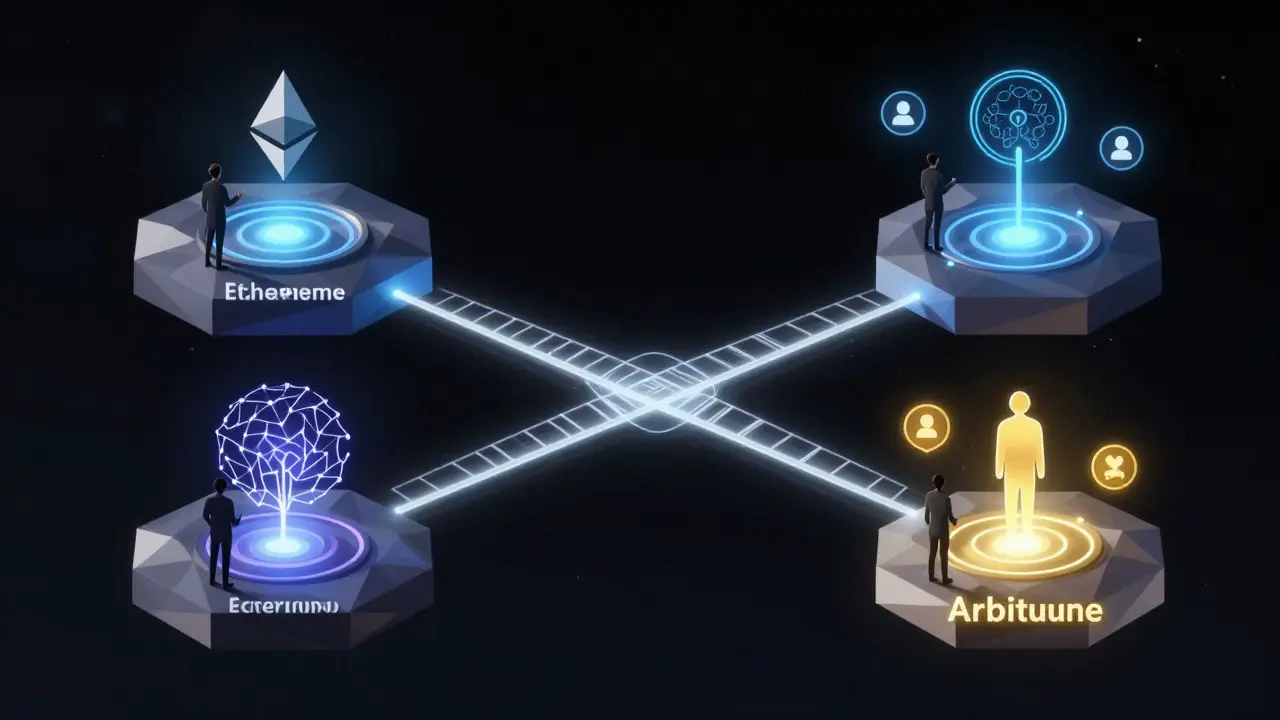
Cross-Chain Governance Is Here
DAOs used to be locked to one blockchain. Now, 68% operate across two or more chains. Why? Because users are everywhere-Ethereum, Polygon, Arbitrum, Cosmos, Solana. If your DAO only works on Ethereum, you’re ignoring 70% of potential contributors.
Tools like Polkadot’s XCMP and zk-based bridges now let DAOs coordinate votes across chains without trusted intermediaries. A proposal can be submitted on Ethereum, voted on by members on Arbitrum, and executed on Cosmos-all in one synchronized process. This isn’t just convenience. It’s survival. DAOs that stay on one chain risk becoming irrelevant as users migrate to cheaper, faster networks.
Legal Uncertainty Is the Biggest Hurdle
Technology is advancing fast. The law? Not so much. As of January 2026, only seven countries have clear legal frameworks for DAOs. Wyoming, Tennessee, and the Marshall Islands lead the way, granting DAOs legal personhood-meaning they can own property, sign contracts, and be sued as an entity.
In the U.S., the SEC’s February 2025 enforcement action against unregistered security offerings sent shockwaves through the space. Sixty-two percent of U.S.-based DAOs now worry their governance tokens could be classified as securities. That’s a nightmare for anyone trying to build a community-driven project. Without legal clarity, banks won’t hold DAO treasuries. Investors won’t commit. And developers won’t build.
The EU’s 2025 Digital Governance Act is a step forward, offering provisional recognition to 17 DAOs already operating under its rules. But global alignment? Still years away.

How DAOs Are Surviving (and Thriving)
The most successful DAOs in 2026 have three things in common:
- They use hybrid governance. No single model fits all. They blend reputation, quadratic voting, and delegation.
- They reduce friction. Onboarding now takes 8 minutes, not 45. Tools like Tally and Aragon make voting as easy as clicking a button.
- They have exit ramps. Rage-quit mechanisms, pioneered by MolochDAO, let members leave with their share of funds if they disagree with a vote. Sixty-one percent of DAOs now include this. It’s not about forcing consensus-it’s about respecting dissent.
Take CityDAO, which bought 40 acres of land in Wyoming. They didn’t vote on every tree to plant. They used reputation scores to assign task ownership, AI to manage legal filings, and quadratic voting only for major decisions like zoning changes. Result? 32% voter turnout-double the DAO average.
Or Gitcoin DAO, which distributed $47 million to open-source developers in 2025. Their success? Reputation-based grants + quadratic funding. Contributors weren’t just paid-they were empowered.
What’s Next? The 2030 Vision
By 2030, DAOs managing over $1 trillion in assets are possible-if they solve three things:
- Meaningful participation: Targeting 35%+ voter turnout, not 17%.
- Legal recognition: Clear, global standards for DAO status, liability, and taxation.
- Anti-centralization: Preventing the rise of new whales through smart design, not just hope.
The future isn’t fully autonomous machines running everything. It’s not a boardroom of anonymous token holders either. It’s a symbiotic system: humans make the big calls. AI handles the busywork. Reputation rewards real contribution. And everyone, no matter how many tokens they hold, gets a real voice.
DAOs aren’t the end of organizations. They’re the next step-messy, experimental, and alive. And if you’re still thinking of them as just "crypto voting," you’re already behind.
What’s the most common problem with DAO governance today?
The biggest problem is low voter participation-only about 17% of token holders vote on average. This lets a small group of large token holders, called "whales," control decisions even when most members disagree. Many people also feel overwhelmed by too many proposals or don’t understand them, so they just opt out.
How does quadratic voting fix whale dominance?
Quadratic voting makes it expensive for large holders to stack votes. Instead of one token = one vote, the cost rises quadratically: 1 vote = 1 token, 2 votes = 4 tokens, 3 votes = 9 tokens, and so on. This lets small holders express strong opinions without being drowned out. DAOs like Gitcoin saw a 22% drop in whale influence after switching to this system.
Can AI really help DAOs make better decisions?
Yes, but only as a tool-not a replacement. AI helps by summarizing long proposals, flagging risky treasury moves, and auto-rejecting spam. Some DAOs use AI delegates to handle routine tasks like rebalancing stablecoins. But humans still vote on big decisions. AI reduces noise; it doesn’t replace judgment.
Why do some DAOs use reputation instead of tokens for voting?
Because holding tokens doesn’t mean you know how to govern. Reputation systems reward real contributions-like writing code, moderating, or teaching others. In Colony DAO, reputation makes up 65% of voting power. This ensures that experienced members have more influence, even if they don’t own many tokens. It’s fairer and more effective for complex projects.
Are DAOs legal right now?
Only in a few places. As of 2026, only seven countries have clear legal frameworks for DAOs, including Wyoming, Tennessee, and the Marshall Islands. In the U.S., the SEC’s 2025 enforcement actions created uncertainty-many DAOs worry their tokens could be classified as securities. Without legal personhood, DAOs can’t sign contracts, open bank accounts, or protect members from liability.
What’s the biggest barrier to DAO adoption in 2026?
Legal uncertainty. Technology has moved far ahead-AI, cross-chain voting, reputation systems-all work well. But without clear laws, banks won’t hold DAO treasuries, investors won’t commit, and developers won’t build. Until governments recognize DAOs as legal entities, mainstream adoption will stall.
kristina tina
January 16, 2026 AT 19:35This is the most hopeful thing I've read about DAOs in years. Finally, someone gets it-governance isn’t about who has the most tokens, it’s about who shows up, contributes, and cares. Reputation systems? Yes. AI summarizers? Absolutely. Quadratic voting? Long overdue. We’re not building a bank. We’re building a community. And communities need hearts, not just wallets.
Chris Evans
January 17, 2026 AT 18:18Token voting as plutocracy? That’s not even controversial anymore-it’s tautological. The real tragedy is that we’ve been replicating Wall Street’s structural violence on-chain and calling it ‘decentralized.’ We fetishize permissionless access while ignoring that power asymmetries don’t vanish with blockchain-they just get cryptographically encoded. Quadratic voting is a bandage. What we need is a complete epistemic overhaul: ontological pluralism in governance models, not just algorithmic tweaks.
Nishakar Rath
January 18, 2026 AT 02:13Reputation systems? LOL. Who decides what counts as a contribution? Some rich dude with a GitHub profile? Meanwhile real builders get ignored because they don’t write fancy docs. This whole thing is just VC-funded theater. You think a whale won’t just buy reputation? Give me a break. Crypto always ends the same way-rich people win. Again.
Haley Hebert
January 18, 2026 AT 18:39Okay but can we talk about how insane it is that we’re still arguing about whether humans should vote? AI is already doing 47% of the prep work and we’re acting like it’s magic. I mean-imagine if your boss summarized every meeting for you and flagged the weird ones? You’d be thrilled. Why are we scared of tools that make our lives easier? 🙃
Jill McCollum
January 18, 2026 AT 18:42cross chain governance is the real MVP here. i’ve been in daos on eth and solana and switching between them is like trying to use a toaster and a microwave at the same time. now? seamless. i actually vote now. not because i care about tokens but because i can actually understand what’s happening. thank you to whoever built the bridges. 🙏
Michael Jones
January 19, 2026 AT 18:24Legal recognition remains the critical bottleneck. Without legal personhood, DAOs cannot enter into binding contracts, hold intellectual property, or shield members from liability. The SEC’s actions were predictable, but the response has been inadequate. Jurisdictions like Wyoming offer a template, but adoption must be global. Without standardized regulatory clarity, DAOs remain in legal limbo-technologically advanced, institutionally fragile.
Ashlea Zirk
January 21, 2026 AT 07:36The data here is compelling, but I’d urge caution in over-optimizing for participation metrics. A 35% voter turnout sounds impressive, but if the voters are not representative, it’s just a more efficient form of tyranny. Reputation systems risk creating new elites. AI summarizers may reduce noise, but they also risk filtering out dissenting voices that don’t fit the algorithm’s notion of ‘clarity.’ We must preserve the messiness of democracy-it’s where innovation lives.
Bryan Muñoz
January 23, 2026 AT 00:39AI delegates?? 😂 they’re already watching you. they’re not helping they’re learning. every vote you make they log it. every proposal you skip they tag you as ‘low engagement.’ next thing you know your wallet gets flagged for ‘low trust score’ and you can’t even join a new dao. this is not freedom. this is social credit with crypto vibes. 🤖👁️
Rod Petrik
January 24, 2026 AT 07:58you think whales are the problem? think again. the real power is in the wallets that own the AI tools. who coded them? who owns the servers? who controls the training data? the same people who run the big exchanges. this whole thing is a front. reputation? quadratic voting? all just camouflage. the boardroom is still there. they just moved it to a cloud server in Nevada
Telleen Anderson-Lozano
January 25, 2026 AT 04:11I love how this post breaks it all down-but I have to say, the rage-quit mechanism is the most underrated innovation here. Seriously. It’s not about forcing everyone to agree-it’s about respecting the right to walk away. That’s the only ethical way to build a voluntary association. I’ve used it twice. Left with my share. Didn’t look back. Freedom isn’t about having a voice-it’s about having an exit. And DAOs finally get that.
Pat G
January 26, 2026 AT 05:55Wyoming? Tennessee? You’re kidding me right? We’re letting states that still don’t recognize same-sex marriage decide the future of global governance? This isn’t innovation. It’s American exceptionalism wrapped in blockchain glitter. If you think this is the future, you haven’t been paying attention to the rest of the world. The EU’s Digital Governance Act is the only real path forward. The rest is cowboy capitalism with a whitepaper.
Andre Suico
January 27, 2026 AT 09:02One thing missing from this analysis: the human cost of constant governance participation. Even with AI summaries and quadratic voting, the cognitive load of staying engaged across multiple DAOs is unsustainable for most. We need to design for attention scarcity, not just token distribution. The goal shouldn’t be higher turnout-it should be sustainable, meaningful involvement. Not everyone can be a governance ninja. And that’s okay.