
Cryptocurrency Scalability Solutions: How Blockchains Handle High Traffic

Imagine trying to buy a coffee in New Zealand with Bitcoin. You hand over the coins, but instead of an instant receipt, you wait ten minutes for confirmation. Then you check your wallet and see that the network fee cost more than the latte itself. This isn't just an inconvenience; it's a dealbreaker for mass adoption. For years, this was the reality on major networks like Ethereum and Bitcoin. As user numbers grew, these blockchains hit a wall. They couldn't process transactions fast enough or cheaply enough to compete with traditional payment processors like Visa.
This bottleneck is known as the scalability problem. It sits at the heart of what experts call the Blockchain Trilemma-the idea that it is nearly impossible to achieve decentralization, security, and scalability all at once without sacrificing one. But developers haven't given up. Over the last decade, they have engineered sophisticated solutions to break this trilemma. Today, we have a landscape filled with Layer 1 upgrades, Layer 2 rollups, and sharding techniques that are reshaping how digital assets move.
The Core Problem: Why Blockchains Struggle to Scale
To understand the solution, you first need to grasp why the problem exists. Most public blockchains, such as Bitcoin and early Ethereum, were designed with a focus on security and decentralization. Every node (computer) on the network verifies every single transaction. This ensures no one can cheat, but it creates a massive bottleneck. If every computer has to do the same work, the speed is limited by the slowest participant and the storage capacity of the average user.
In 2017, Bitcoin faced severe congestion. The network had a hard limit of 1MB per block, which allowed only about 7 transactions per second (TPS). When demand spiked, users battled for space in each block, driving average fees up to $55. Compare that to Visa, which handles roughly 65,000 TPS. The gap was enormous. Developers realized that if cryptocurrencies wanted to become global currencies rather than niche stores of value, they needed to process thousands of transactions per second while keeping costs near zero.
Layer 1 Solutions: Upgrading the Foundation
Layer 1 (L1) solutions involve changing the base protocol of the blockchain itself. Think of this as widening the highway rather than building new roads on top of it. These changes require consensus from the network participants, often through hard forks, making them complex to implement but powerful in their effect.
Segregated Witness (SegWit) was one of the first major L1 improvements for Bitcoin, launched in August 2017. By separating signature data from transaction data, SegWit effectively increased block capacity without technically changing the block size limit. It recovered wasted space, allowing more transactions into each block. While it didn't solve the entire problem, it reduced fees significantly during its initial rollout.
Another approach is increasing block sizes directly. In 2017, Bitcoin Cash forked from Bitcoin to increase the block size limit to 8MB, later raising it to 32MB. This allowed higher throughput but sparked debates about centralization, as larger blocks require more powerful hardware to validate, potentially pushing smaller nodes out of the network.
Perhaps the most ambitious L1 change is Sharding. Proposed originally for Ethereum, sharding splits the database into smaller pieces called shards. Instead of every node processing every transaction, different nodes handle different shards simultaneously. Ethereum's roadmap included plans for 64 shards, theoretically boosting capacity exponentially. However, implementation proved difficult due to security risks associated with cross-shard communication. Consequently, the Ethereum community pivoted toward a different strategy, focusing on Layer 2 solutions instead of pure sharding for execution.
Consensus mechanism upgrades also play a huge role. Ethereum's transition from Proof-of-Work (PoW) to Proof-of-Stake (PoS) in September 2022 (The Merge) was a monumental shift. While primarily aimed at reducing energy consumption by 99.95%, PoS laid the groundwork for faster finality and easier integration with Layer 2 technologies. Networks like Cardano and Avalanche built their protocols around efficient PoS variants from the start. Avalanche, for instance, claims sub-second finality and up to 4,500 TPS, demonstrating how native protocol design can prioritize speed.
Layer 2 Solutions: Building Off-Chain Highways
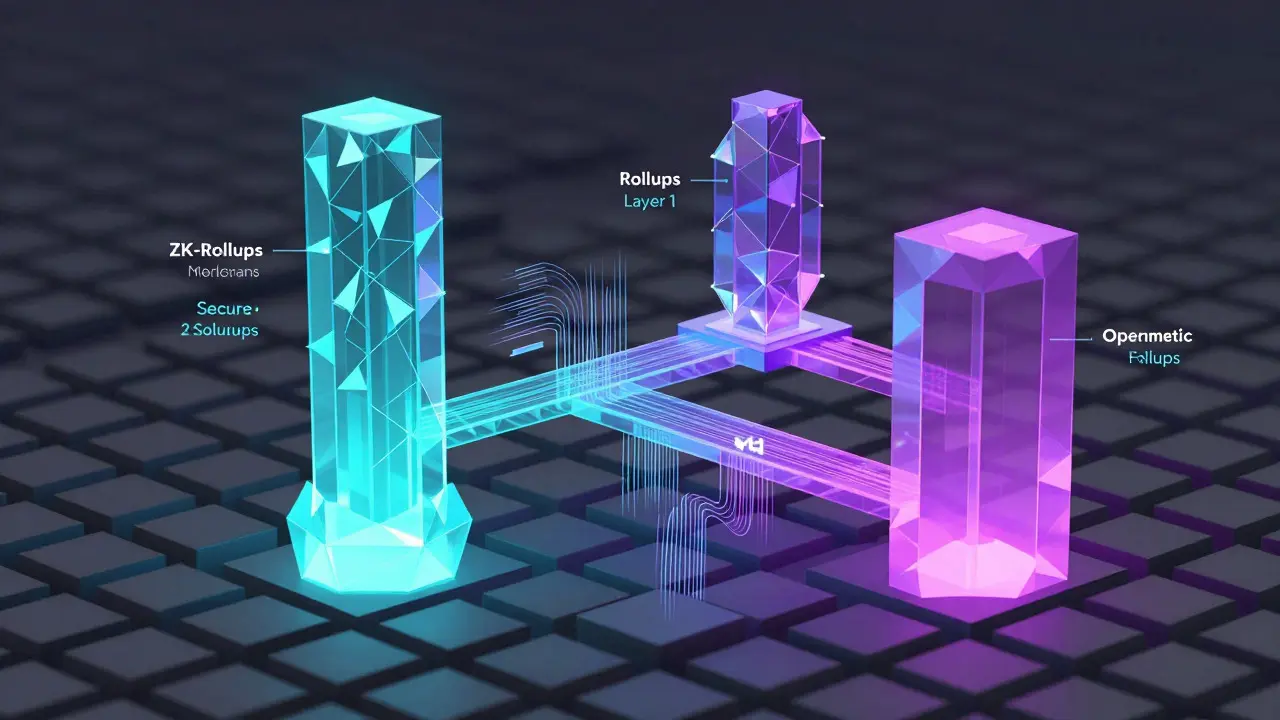
If Layer 1 is the foundation, Layer 2 (L2) solutions are the skyscrapers built on top. These systems handle transactions off the main chain and then settle the results back onto the Layer 1 blockchain. This keeps the security of the main chain while drastically increasing throughput and lowering costs.
The most popular L2 category today is Rollups. Rollups bundle hundreds of transactions into a single batch and submit it to the main chain. There are two main types: Optimistic Rollups and Zero-Knowledge (ZK) Rollups.
Optimistic Rollups, used by platforms like Optimism and Arbitrum, assume transactions are valid unless someone proves otherwise. They include a 7-day "fraud proof" window where anyone can challenge a bad transaction. If no one challenges it, the transaction is finalized. This approach is cheaper and easier to develop but introduces a delay in finality. Users must wait days before they can withdraw funds to the main chain with certainty.
Zero-Knowledge Rollups (ZK-Rollups), such as zkSync and StarkNet, use cryptographic proofs (zk-SNARKs or zk-STARKs) to verify transactions instantly. No waiting period is needed because the math guarantees validity. This offers near-instant finality and better security but requires significant computational power to generate the proofs, making development harder and sometimes more expensive for users depending on gas prices.
Other L2 technologies include State Channels like the Lightning Network for Bitcoin. Launched in 2018, Lightning allows users to open private channels between themselves to conduct unlimited micro-transactions instantly. Only the opening and closing of the channel are recorded on the main Bitcoin blockchain. By Q3 2023, Lightning was processing over $10.5 million in daily volume. It works exceptionally well for small payments under $100 but struggles with routing larger amounts due to liquidity constraints.
Sidechains like Polygon operate as independent blockchains connected to the main chain via a two-way bridge. Polygon's PoS chain processes around 7,000 TPS with fees often below $0.001. Because sidechains have their own validators, they don't inherit the full security of the main chain, which is a trade-off users must consider.
| Solution Type | Example Platforms | Throughput (TPS) | Finality Time | Security Model |
|---|---|---|---|---|
| Layer 1 (Base Chain) | Ethereum, Bitcoin | 15-45 (ETH), ~7 (BTC) | Seconds to Minutes | Highest (Native Consensus) |
| Optimistic Rollup | Arbitrum, Optimism | 2,000-4,000 | 7 Days (Withdrawal) | High (Fraud Proofs) |
| ZK-Rollup | zkSync, StarkNet | 2,000-10,000+ | Minutes (Near Instant) | Very High (Crypto Proofs) |
| Sidechain | Polygon PoS | ~7,000 | Seconds | Medium (Independent Validators) |
| State Channel | Lightning Network | Unlimited (Off-chain) | Instant | High (Main Chain Settlement) |
Choosing the Right Solution for Your Needs
There is no single "best" scalability solution. The right choice depends entirely on what you are trying to build or use. If you are a developer building a decentralized exchange (DEX) that requires instant swaps and deep liquidity, a ZK-Rollup might be ideal due to its fast finality. If you are creating a gaming application where users make thousands of tiny moves per hour, a Sidechain or State Channel could offer the lowest friction.
For everyday users, the experience is becoming increasingly seamless. Many wallets now abstract away the complexity, automatically routing transactions through the cheapest available Layer 2 network. However, understanding the trade-offs remains crucial. For instance, while Polygon offers incredibly low fees, bridging assets from Ethereum to Polygon involves trusting the bridge's security model. In contrast, using a Rollup means your funds remain secured by Ethereum's mainnet consensus, albeit with withdrawal delays for Optimistic models.
Enterprise adoption is also shifting. According to Gartner's 2023 survey, 73% of Fortune 500 companies are experimenting with blockchain scalability solutions. Financial institutions tend to prefer Layer 1 solutions or permissioned sidechains where they have control over validators. Meanwhile, the NFT and gaming sectors heavily favor Layer 2s. DappRadar reported in mid-2023 that 87% of the top 50 NFT marketplaces utilized Polygon or similar L2s to keep minting costs affordable for collectors.
Future Trends: The Multi-Layered Ecosystem
The future of cryptocurrency scalability is not about one network winning; it's about interoperability. Vitalik Buterin, co-founder of Ethereum, described this vision in his "Endgame" post, outlining a multi-layered architecture where Ethereum serves as the secure settlement layer, and various Rollups handle execution. This modular approach allows specialization. One Rollup might optimize for AI computation, another for high-frequency trading, and another for social media interactions.
Recent developments support this trend. Ethereum's Dencun upgrade, implemented in March 2024, introduced proto-danksharding (EIP-4844). This update allows Rollups to post data to Ethereum more cheaply, reducing fees by 10 to 100 times. Similarly, Polygon's "Infinity DAO" initiative aims to create a network of interconnected ZK-Rollups, enhancing composability across different chains. Avalanche's "Avalanche Connect" enables developers to migrate Ethereum dApps with minimal code changes, broadening the ecosystem's reach.
Regulatory frameworks are also catching up. The EU's Markets in Crypto-Assets (MiCA) regulation, effective June 2024, requires clear disclosure of scaling solution security models. This pushes projects to be more transparent about whether they rely on fraud proofs, cryptographic proofs, or independent validators. As regulations tighten, solutions that offer clearer audit trails and faster finality will likely gain institutional trust.
By 2026, the industry is moving toward hybrid approaches. A CoinDesk survey of blockchain architects indicated that 68% believe hybrid scaling-combining multiple layers and techniques-will dominate. We are seeing fewer isolated blockchains and more interconnected ecosystems where assets and data flow freely across Layers 1 and 2. The goal is simple: make the technology invisible so users can transact globally as easily as sending an email.
What is the difference between Layer 1 and Layer 2 scalability?
Layer 1 scalability involves upgrading the base blockchain protocol itself, such as increasing block size or changing the consensus mechanism (e.g., Ethereum's switch to Proof-of-Stake). Layer 2 scalability builds additional networks on top of the base chain to process transactions off-chain, settling results back on the main layer to save space and reduce costs (e.g., Rollups or the Lightning Network).
Are Layer 2 solutions safe?
Generally, yes, but safety varies by type. ZK-Rollups are considered very secure because they use mathematical proofs to guarantee transaction validity. Optimistic Rollups are also secure but rely on a 7-day challenge period where users can report fraud. Sidechains are less secure than the main chain because they have their own separate set of validators, meaning a breach in the sidechain doesn't necessarily affect the main chain but could result in lost funds on the sidechain.
Why are transaction fees still high on some networks?
Fees remain high when demand exceeds the network's capacity. On Layer 1 networks like Ethereum, if many users try to transact at once, they bid up the price for block space. Using Layer 2 solutions bypasses this congestion by processing transactions off-chain, which dramatically reduces fees. Additionally, network upgrades like EIP-4844 aim to permanently lower these costs for Rollups.
What is Sharding and why did Ethereum pause it?
Sharding divides the blockchain into smaller pieces (shards) that process transactions in parallel. Ethereum initially planned to implement sharding to boost speed. However, developers found that securing cross-shard communications was complex and risky. Instead, Ethereum pivoted to using Rollups as the primary execution layer, using a form of data sharding (proto-danksharding) to make Rollups cheaper, rather than executing transactions directly on shards.
Which scalability solution is best for DeFi applications?
For DeFi, ZK-Rollups and Optimistic Rollups are currently the most popular choices. They offer high throughput and low fees while inheriting Ethereum's security. ZK-Rollups are preferred for applications needing instant finality, such as high-frequency trading, while Optimistic Rollups are widely adopted for general-purpose DeFi due to their maturity and ease of development.