
Crypto VPN Detection Rates: Why Exchanges Flag You and How to Stay Safe
There is a persistent rumor in crypto circles that exchanges detect VPN usage with a staggering 70-80% accuracy rate. If you are trying to access a restricted platform or hide your location for privacy, this number sounds like a death sentence for your anonymity. But here is the truth: that specific percentage is largely a myth born from confusion between basic IP blocking and sophisticated behavioral analysis. The reality is far more nuanced, dangerous, and dependent on the quality of the tools you use.
When you connect to a cryptocurrency exchange through a Virtual Private Network (VPN), you are entering a digital minefield designed by compliance officers and security engineers. They are not just looking for a masked IP address; they are hunting for patterns that suggest fraud, money laundering, or regulatory evasion. Understanding how these detection systems actually work is the only way to navigate them without losing your account-or worse, your funds.
How Exchanges Actually Detect VPNs
Crypto platforms do not rely on a single method to catch users hiding behind privacy tools. Instead, they layer multiple detection vectors to build a profile of risk. The first and most common layer is the IP Reputation Database. These are massive lists of known data center IPs, hosting providers, and free VPN servers. If your connection comes from an IP address shared by thousands of other users in a different country, the exchange flags it immediately. This is why free VPNs almost always fail-they use crowded, well-known server pools that are blacklisted by every major exchange.
Beyond simple IP checks, exchanges employ Behavioral Analysis. This is where the "70-80%" figure might have originated, but it applies only to suspicious behavior, not mere VPN use. Algorithms monitor login frequency, geographic consistency, and transaction timing. If you log in from New York, then five minutes later from Tokyo, and attempt a large withdrawal, the system triggers an automatic freeze. It does not matter if your VPN is high-quality; the inconsistency in metadata raises red flags for anti-money laundering (AML) protocols.
Advanced platforms also use technical fingerprinting techniques. WebRTC Leaks can expose your real local IP address even if your browser is routed through a VPN tunnel. Similarly, DNS leak detection ensures that your domain name requests aren't bypassing the encrypted tunnel. Some exchanges even analyze traffic flow characteristics-looking at packet sizes and timing intervals-to distinguish between standard web browsing and the distinct signature of certain VPN protocols like OpenVPN or WireGuard.
The Role of KYC and Regulatory Pressure
You cannot separate VPN detection from the legal framework governing crypto today. In 2026, the landscape is dominated by strict Know Your Customer (KYC) regulations. Major jurisdictions like the United States, the European Union, and the UK require exchanges to verify the physical identity and location of every user. This isn't optional; it's a license requirement.
Exchanges like Coinbase and Binance face billions in potential fines for non-compliance. Therefore, their primary goal is not necessarily to ban all VPN users, but to ensure that no anonymous entity can move significant capital. When you use a VPN, you obscure one piece of the puzzle: your location. To compensate, exchanges often impose tiered restrictions. You might be allowed to view prices, but any attempt to deposit, trade, or withdraw will trigger a mandatory identity verification process. If your documents show a residence in a sanctioned country, or if your IP location contradicts your stated address, the account is suspended indefinitely.
This creates a paradox for privacy-conscious traders. You might use a VPN to protect yourself from hackers, but the exchange interprets that same protection as an attempt to evade jurisdiction. The result is a friction-heavy experience where legitimate privacy concerns clash with rigid compliance algorithms.
Why Free VPNs Are a Liability
If you are using a free VPN service to access crypto exchanges, stop immediately. Not only are these services easily detected, but they also pose severe security risks. Free providers often monetize your data by selling browsing habits to advertisers or, worse, injecting malware into your traffic. For a crypto trader, this is catastrophic.
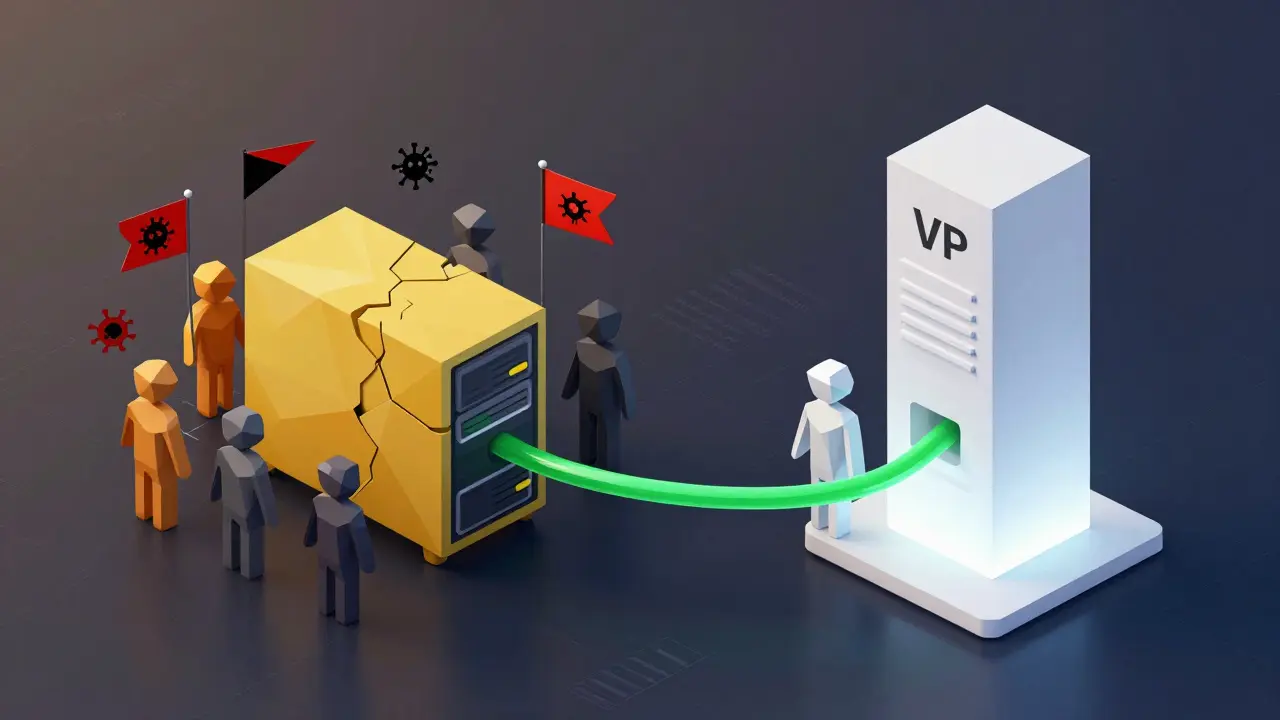
From a detection standpoint, free VPNs share IP addresses among hundreds of users. If one person on that IP commits fraud, the entire pool gets blacklisted. Exchanges maintain dynamic blocklists that update in real-time. A connection that worked yesterday may be blocked today because another user on the same server triggered a fraud alert. Furthermore, free VPNs rarely offer features like kill switches or DNS leak protection, leaving your true IP exposed during brief connection drops-a window long enough for an exchange’s monitoring system to capture your real location.
Premium Solutions for Crypto Traders
For those who need reliable access due to regional restrictions or heightened privacy needs, premium VPN services are the only viable option. However, not all premium services are equal when it comes to crypto trading. The key differentiator is the availability of Dedicated IP Addresses.
A dedicated IP assigns a unique address solely to you. Since it is not shared with thousands of other users, it does not appear in mass-blacklists associated with spam or fraud. Services like NordVPN have adapted to this market by offering static IPs in major financial hubs. NordVPN, for instance, operates servers in over 118 countries and uses RAM-only servers to ensure no logs are written to disk, aligning with strict privacy standards. They also accept cryptocurrency payments via gateways like CoinGate, allowing users to subscribe without linking their bank accounts.
ExpressVPN is another top contender, known for its robust infrastructure across 94 countries. While it accepts Bitcoin, its strength lies in speed and reliability, which is crucial for day traders who cannot afford latency spikes. Both providers implement obfuscation technologies that disguise VPN traffic as regular HTTPS web browsing, helping to bypass deep packet inspection used by some restrictive networks.
| Provider | Dedicated IP Available | Crypto Payment Accepted | No-Logs Jurisdiction | Best For |
|---|---|---|---|---|
| NordVPN | Yes | Yes (BTC, ETH, LTC, TRX) | Panama | Privacy & Static Access |
| ExpressVPN | No (Shared) | Yes (BTC only) | British Virgin Islands | Speed & Reliability |
| CyberGhost | Yes | Yes (Various Altcoins) | Romania | User-Friendly Interface |
Advanced Evasion Techniques and Risks
Some advanced users turn to Residential Proxies instead of traditional VPNs. Unlike data center IPs, residential proxies route traffic through actual internet service provider (ISP) connections, making them appear as ordinary home users. This significantly reduces the chance of being flagged by IP reputation databases.
However, this approach carries higher costs and complexity. Managing residential proxies requires technical expertise to rotate IPs effectively and avoid triggering behavioral anomalies. Additionally, many proxy providers operate in legal gray areas, and using them to bypass geo-restrictions may violate the Terms of Service of your exchange. Violating TOS can lead to permanent account closure and forfeiture of assets, a risk that outweighs the convenience of unrestricted access.
Another technique involves GPS spoofing on mobile devices. While this changes your reported location within apps, it does not change your IP address. If your app says you are in London but your IP traces back to a server in Singapore, the discrepancy is an instant red flag for fraud detection systems. Consistency across all data points-IP, GPS, device language, and timezone-is essential for maintaining account health.

Security vs. Anonymity: The Trade-Off
It is vital to remember why you are using a VPN in the first place. For most traders, the primary threat is not the exchange detecting their location, but rather malicious actors stealing their credentials. Phishing sites, keyloggers, and man-in-the-middle attacks are rampant in the crypto space. A high-quality VPN encrypts your connection, protecting sensitive data like seed phrases and login details from being intercepted on public Wi-Fi networks.
Services like NordVPN offer additional layers such as Dark Web Monitoring, which alerts you if your email or passwords appear in known breach databases. This proactive security measure is often more valuable than the ability to bypass a geo-block. Prioritize security features like a Kill Switch (which cuts internet access if the VPN drops) and Double VPN (routing traffic through two servers) to mitigate risks while trading.
Practical Checklist for Safe Access
- Choose a Premium Provider: Avoid free services. Opt for providers with strong no-logs policies and dedicated IP options.
- Maintain Geographic Consistency: Do not switch server locations frequently. Pick one stable region and stick with it to avoid behavioral flags.
- Enable Leak Protection: Ensure DNS and WebRTC leak protections are active in your VPN settings.
- Verify Identity Early: Complete KYC requirements before attempting to trade. Having verified documents reduces the likelihood of suspension when using privacy tools.
- Monitor Account Status: Keep an eye on withdrawal limits and notifications. Sudden restrictions may indicate your activity has been flagged.
- Use Hardware Wallets: Never store large amounts on exchanges. Use cold storage solutions like Ledger or Trezor to minimize exposure.
Is the 70-80% VPN detection rate accurate?
No, this specific statistic is not substantiated by industry data. Detection rates vary wildly based on the VPN quality, the exchange's sophistication, and user behavior. Basic free VPNs are detected nearly 100% of the time, while premium services with dedicated IPs may go undetected indefinitely unless behavioral anomalies occur.
Can I use a VPN to bypass KYC requirements?
No. VPNs mask your IP address, but they do not hide your identity. Exchanges require government-issued ID and proof of address. Using a VPN to evade KYC is a violation of Terms of Service and can result in immediate account termination and loss of funds.
Which VPN is best for crypto trading in 2026?
NordVPN is widely regarded as the top choice due to its dedicated IP offerings, acceptance of cryptocurrency payments, and strong privacy jurisdiction in Panama. ExpressVPN is a close second for its speed and reliability, though it lacks dedicated IPs.
Will using a VPN slow down my trading?
Premium VPNs like ExpressVPN and NordVPN have minimal impact on latency, typically adding less than 5-10 milliseconds. However, connecting to distant servers can increase ping times. For high-frequency trading, choose a server geographically close to your physical location or the exchange's servers.
Are residential proxies better than VPNs for crypto?
Residential proxies are harder to detect because they use real ISP IPs, but they are more expensive and complex to manage. They also lack the comprehensive encryption and security features of a full VPN, making them less suitable for general browsing and more risky for casual users.