
Coins.ph Crypto Exchange Review: Is It Worth Your Time in 2026?
Buying Bitcoin with cash from a pawnshop and paying your electricity bill with the same app sounds like a fever dream, but for millions of Filipinos, it’s just Tuesday. Coins.ph is the Philippines' pioneering cryptocurrency exchange and wallet platform, founded in 2014 and operating under the strict regulatory oversight of the Bangko Sentral ng Pilipinas (BSP). It’s not just another crypto dashboard; it’s a financial Swiss Army knife that has grown to serve over 18 million users. But does convenience come at the cost of performance? If you’re looking for advanced charting tools or the lowest fees on Earth, you might find yourself frustrated. If you want a safe, legal way to dip your toes into digital assets while keeping your daily life running smoothly, this might be exactly what you need.
The Regulatory Safety Net
Let’s talk about the elephant in the room: trust. In the wild west of crypto, where exchanges vanish overnight with user funds, Coins.ph stands out because it plays by the rules. It holds a license from the Bangko Sentral ng Pilipinas (BSP), the central bank of the Philippines. This isn’t just a badge; it’s a shield. For Filipino users, this means their local currency deposits are protected under national financial regulations in ways that international giants like Binance or Coinbase often cannot match locally.
This regulatory compliance creates a unique moat. While global exchanges struggle with local banking partners and regulatory hurdles in Southeast Asia, Coins.ph integrates directly with the Philippine financial infrastructure. You aren’t fighting against the system; you’re working within it. This makes it particularly attractive for beginners who are wary of sending money offshore. However, don’t mistake regulation for perfection. The platform has faced scrutiny, and its Google Play Store rating dipped significantly in 2025 due to technical issues and customer service complaints. Still, the fact that it remains operational and licensed suggests resilience.
More Than Just Trading: The Ecosystem
Here is where Coins.ph separates itself from pure-play exchanges. It started as a mobile wallet, and that DNA is still very much alive. You can use the app to pay over 120 utility bills, buy mobile load, and send money to friends via GCash or PayMaya integration. Imagine buying Ethereum, holding it for a few days, and then selling it to instantly pay your internet provider without ever leaving the app. That seamless transition between digital assets and fiat reality is the core value proposition.
The platform supports two distinct modes:
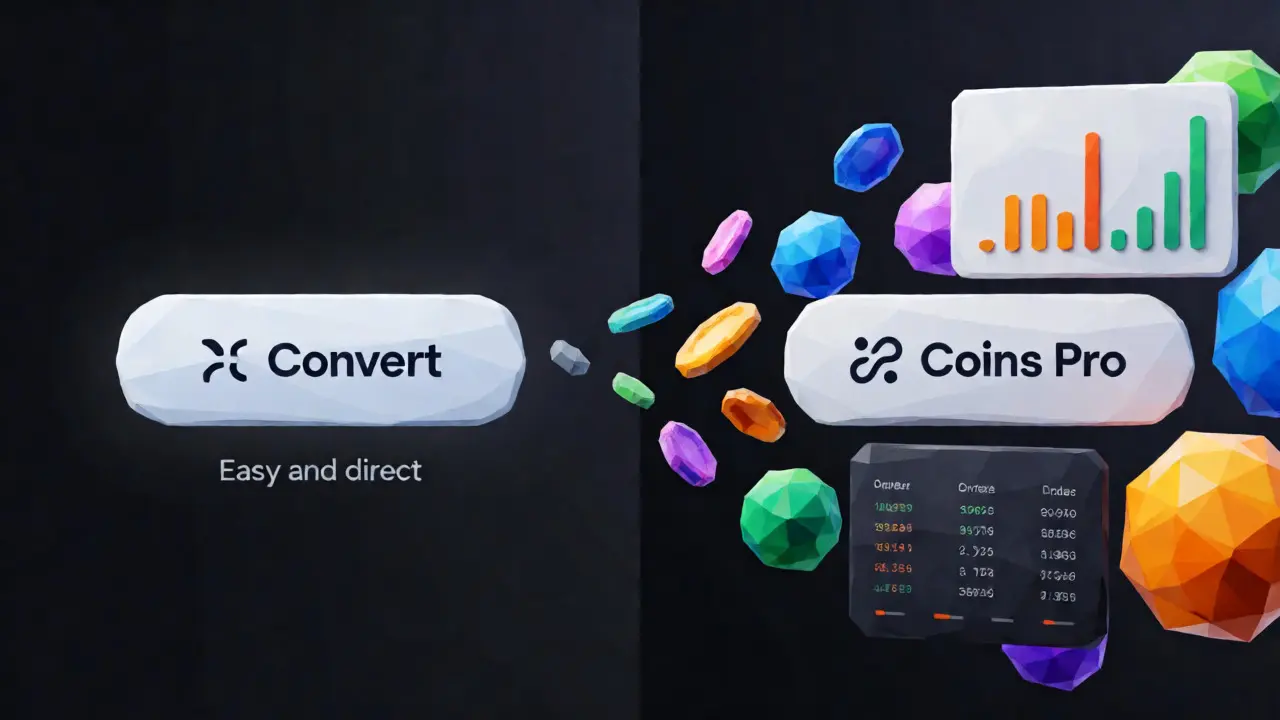
- Coins Convert: A simple buy/sell interface designed for casual users. Think of it as a vending machine for crypto. You pick an amount, click buy, and done.
- Coins Pro: A more sophisticated spot trading interface for those who care about order books, limit orders, and price charts.
For most people, the Convert feature is enough. But if you’re trying to time the market, you’ll need to switch to Coins Pro. The learning curve here is steeper than the basic mode, but it offers the necessary tools for serious traders. Just be aware that the interface isn’t as polished as something like Bybit or Kraken, and some advanced features found globally are missing here.
Fees and Costs: Where Does It Stand?
Money talks, so let’s look at the numbers. Coins.ph isn’t the cheapest option out there, but it’s not highway robbery either. Traders Union gave it a 7.75/10 score for fees, which is a solid "good" grade. The fee structure is tiered based on your trading volume over the last 30 days.
| Feature | Details | Notes |
|---|---|---|
| Spot Trading Fees | 0.1% - 0.15% | Decreases with higher 30-day volume |
| Minimum Order (Major Pairs) | PHP 60 | Applies to BTC/PHP, ETH/PHP, USDT/PHP |
| Minimum Order (Other Pairs) | PHP 100 | Standard minimum for less liquid pairs |
| OTC Minimum Trade | PHP 1 Million | For institutional or whale-sized trades |
If you’re a high-volume trader, you can access Over-The-Counter (OTC) services for trades starting at PHP 1 million. This is crucial for avoiding slippage when moving large amounts of capital. However, for the average retail investor, the spread on the "Convert" feature can sometimes feel wider than the explicit trading fees on Coins Pro suggest. Always check the final execution price before confirming a transaction.

Asset Selection and Liquidity
You won’t find every obscure meme coin here. Coins.ph supports over 206 coins, with around 170 available for active trading. This includes the heavy hitters: Bitcoin (BTC), Ethereum (ETH), and Ripple (XRP), along with stablecoins like USDC and the local PHPC token. While this covers 95% of what most people actually trade, altcoin hunters looking for the next 100x gem might find the selection limiting compared to global exchanges that list thousands of tokens.
Liquidity is generally good for major pairs like BTC/PHP and ETH/PHP. You can execute market orders quickly without massive price impacts. However, liquidity thins out significantly on smaller altcoin pairs. If you’re trading a low-cap asset, expect wider spreads and potentially slower fills during volatile market conditions.
User Experience and Technical Hiccups
We have to address the recent past. In mid-2025, Coins.ph saw a noticeable drop in user satisfaction ratings. Why? Two main reasons: technical glitches and customer support delays. During periods of high market volatility-like when Bitcoin spikes unexpectedly-the platform has occasionally struggled to handle the traffic. Users reported frozen screens and delayed transactions.
Customer support operates during business hours, which is a pain point for a 24/7 market. If you have an issue at 2 AM on a Sunday, you might be waiting until Monday morning. Reddit threads and community forums highlight this frustration repeatedly. On the flip side, many users praise the security features and the ease of depositing cash through physical outlets like Palawan Pawnshop and Cebuana Lhuillier. This accessibility is a massive win for unbanked or underbanked populations who prefer cash-in/cash-out methods over traditional bank wires.
Who Should Use Coins.ph?
So, is it right for you? Let’s break it down by persona.
- The Beginner: Yes. The KYC process is straightforward, the UI is intuitive, and the ability to pay bills with crypto balances reduces friction. You get regulatory peace of mind without needing to understand complex withdrawal protocols.
- The Daily User: Absolutely. If you live in the Philippines and use crypto as part of your daily financial flow, the integration with local payment rails is unmatched.
- The Active Trader: Maybe. Coins Pro offers decent tools, but if you need margin trading, futures, or perpetual swaps, you’ll need to look elsewhere. Coins.ph is spot-only.
- The Altcoin Degen: Probably not. The asset list is curated, not exhaustive. If you chase micro-caps, you’ll be bored here.
It’s also worth noting that while Coins.ph is excellent for local operations, many Filipinos use a hybrid approach. They use Coins.ph for on-ramping fiat to crypto and off-ramping back to cash, but move larger holdings to self-custody wallets or global exchanges for long-term storage and advanced trading.
Final Verdict
Coins.ph isn’t trying to be the best global exchange; it’s trying to be the best Filipino exchange. And in that specific niche, it succeeds remarkably well. The combination of BSP licensing, deep local payment integration, and a user-friendly interface makes it a powerhouse for domestic adoption. The fees are fair, the assets are solid, and the safety net is real.
However, it’s not flawless. The lack of derivatives, occasional technical instability during peaks, and limited customer support hours are valid criticisms. If you prioritize cutting-edge tech and lowest-possible fees above all else, you might find better options internationally. But if you value convenience, legality, and local relevance, Coins.ph remains the gold standard in the Philippines.
Is Coins.ph safe to use?
Yes, Coins.ph is considered safe primarily because it is licensed and regulated by the Bangko Sentral ng Pilipinas (BSP). This provides a layer of consumer protection and legitimacy that many unregulated international exchanges do not offer to Filipino residents. Additionally, the platform employs standard security measures like two-factor authentication (2FA) and cold storage for majority of user funds.
What are the fees for withdrawing money to my bank account?
Withdrawal fees vary depending on the method used. Transfers via InstaPay or PESONet to supported banks typically incur small fixed fees or percentage-based charges, which are clearly displayed before confirmation. Cash withdrawals through partner outlets like Palawan Pawnshop or Cebuana Lhuillier also have associated service fees. Always check the current fee schedule in the app, as these can change based on network conditions and regulatory updates.
Can I trade crypto with USD on Coins.ph?
While the primary base currency is PHP, Coins.ph supports stablecoins like USDC and USDT. You can trade these stablecoins against other cryptocurrencies. However, direct fiat-to-crypto trading is heavily optimized for the Philippine Peso (PHP). To use USD effectively, you would typically convert your USD to USDC or USDT first, then trade from there. Direct USD bank transfers are less common than local PHP integrations.
Does Coins.ph offer margin or futures trading?
No, currently Coins.ph focuses exclusively on spot trading. It does not offer margin trading, futures contracts, or perpetual swaps. If you need leverage or derivative products, you will need to use a different exchange such as Binance, Bybit, or OKX, which may require additional steps for local fiat deposits.
How long does KYC verification take?
KYC verification times can vary. In ideal conditions, it can be completed within minutes using automated checks. However, during periods of high demand or if manual review is required, it can take up to several business days. Ensuring your documents are clear and legible helps speed up the process. Note that full features, including higher transaction limits, are only unlocked after successful KYC completion.