
Coingi Crypto Exchange Review: Fees, Features, and Missing Details
When you're looking for a new crypto exchange, you want to know three things: Can you trade what you need? Are the fees fair? And Can you trust it? Coingi claims to offer a simple, low-fee platform-but the deeper you look, the more answers vanish.
Coingi charges a flat 0.20% fee on every trade, whether you're making or taking liquidity. That’s lower than the industry average of 0.25%. For comparison, Kraken’s taker fees start at 0.40% and drop to 0.01% for high-volume traders. Binance US runs 0%-0.6%, and Coinbase charges 0%-3.99% depending on how you pay. Coingi’s flat fee sounds clean, but it doesn’t tell the whole story. What if you trade $10,000 a week? What if you’re a market maker? With most exchanges, volume lowers your fee. Coingi doesn’t say if that’s even possible.
Withdrawals are another story. Bitcoin withdrawals cost 0.001 BTC. That’s standard. But what about Ethereum? Solana? USDT? Coingi mentions withdrawal fees for other coins and fiat currencies-but never lists them. No table. No breakdown. Just silence. If you’re trying to plan your cash flow, this isn’t just inconvenient-it’s risky. You could send $5,000 in ETH and get charged $150 in fees without knowing until it’s too late.
Deposit options? Wire transfers only. No credit cards. No PayPal. No Apple Pay. No bank links like Plaid. That’s not a bug-it’s a dealbreaker for many. New users don’t have crypto to deposit. They need to buy with fiat. And if you can’t use a card, you’re stuck waiting days for a bank transfer. That’s fine if you’re in Europe with SEPA. But if you’re in the U.S. or Brazil? You’re out of luck.
Here’s the biggest red flag: no one is talking about Coingi.
Check Trustpilot. Nothing. Reddit? No threads. YouTube reviewers who cover 40+ exchanges in 2025? Coingi isn’t mentioned once. Not by CoinGecko. Not by CryptoCompare. Not by any major crypto news site. Even the most obscure exchanges have at least one forum post or a Reddit thread asking, “Is this legit?” Coingi has zero.
What about security? Does Coingi use cold storage? Is it insured? Does it require KYC? Is it licensed? No answers. No whitepaper. No audit reports. No regulatory disclosures. Not even a “About Us” page with a team photo. You can’t verify who runs it. Where it’s based. Or if it’s even active.
Compare that to Kraken, which publishes monthly proof-of-reserves. Or Coinbase, which is regulated in 50+ countries. Or even lesser-known platforms like Bitstamp, which clearly lists its EU license number. Coingi gives you nothing. Not even a hint.
And yet, the website exists. You can sign up. You can see a trading interface. You can even deposit via wire. But there’s no customer support phone number. No live chat. No email address you can verify. No help center. No FAQ. If something goes wrong-your deposit disappears, your order fails, your account gets locked-how do you fix it? You can’t.
Some exchanges are small because they’re niche. Coingi doesn’t seem niche. It seems abandoned. There are no user reviews from 2024 or 2025. No news about updates. No social media activity since 2022. Even the domain registration details are hidden. That’s not privacy-it’s suspicion.
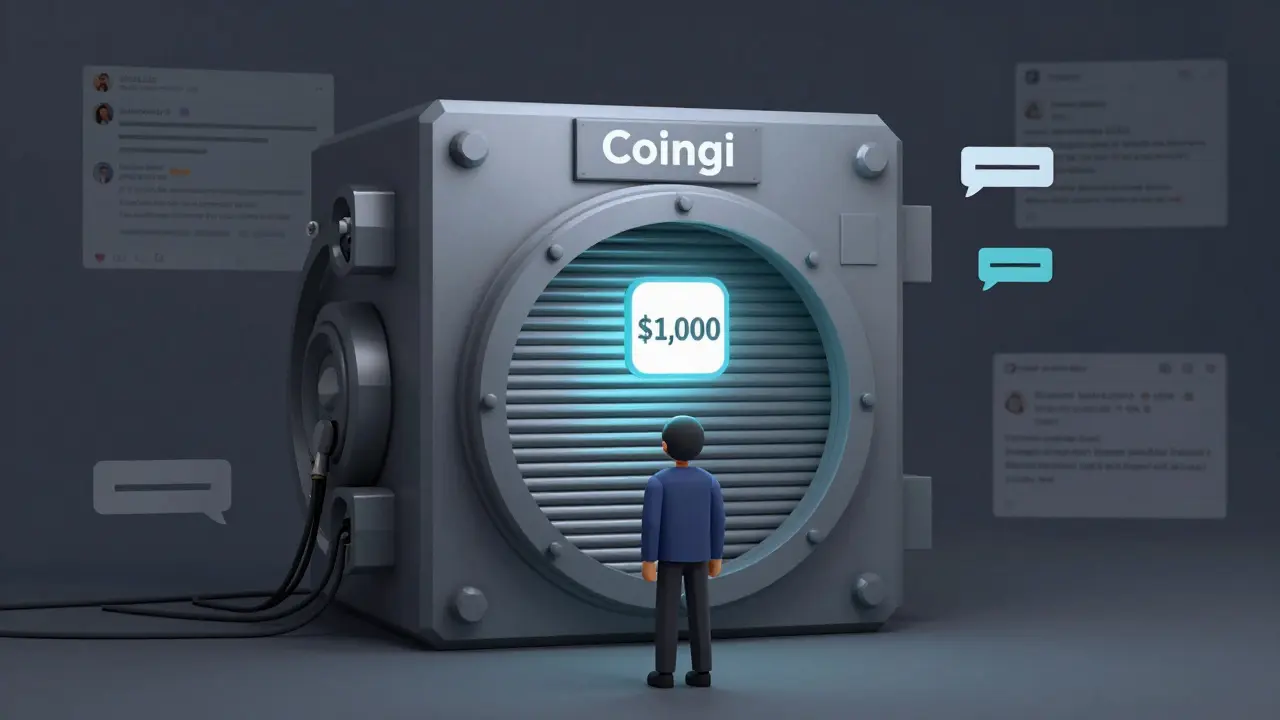
Let’s say you’re a beginner. You heard Coingi has low fees. You think, “Great, I’ll try it.” You deposit $1,000 via wire. You trade a little. Then you want to cash out. You click withdraw. The system says “processing.” Days pass. No update. You email. No reply. You check the website. It’s still up. But the trading volume? Zero. No one else is trading. The order book is empty. You’re stuck.
That’s not hypothetical. That’s what happens when you pick an exchange with no reputation, no transparency, and no community. You become the experiment.
Coingi might have once been real. Maybe it was a side project. Maybe it got bought out. Maybe it shut down quietly. But right now, it’s a ghost platform. It looks like a real exchange. It has the right numbers. But it’s missing everything that makes an exchange trustworthy: accountability, communication, and proof.
There are better options. Kraken has lower fees for high-volume traders and full transparency. Coinbase is regulated and easy to use. Crypto.com offers card rewards and 300+ coins. Even Bitfinex, which has its own issues, at least has active user forums and public updates.
If you’re looking for a low-fee exchange, go for one that shows its work. Not one that hides behind silence.
Coingi’s 0.20% fee is attractive on paper. But without knowing what you’re actually getting, it’s not a deal-it’s a gamble.
What Coingi Doesn’t Tell You
Coingi doesn’t say which countries it serves. Is it available in the U.S.? The EU? India? Brazil? No info. No disclaimer. No geo-blocking notice. You could be in a restricted jurisdiction and not even know it.
It doesn’t list supported coins. Bitcoin? Yes. Ethereum? Maybe. Dogecoin? Unlikely. But you won’t find a list. You can’t search for a coin unless it’s already there. That’s not user-friendly-it’s exclusionary.
There’s no API for traders. No charting tools beyond basic candlesticks. No stop-loss or limit orders beyond the bare minimum. No mobile app. No desktop app. Just a browser-based interface that looks like it was built in 2018.
Even the website’s design feels outdated. No SSL padlock icon? Check. No security certifications? Check. No mention of two-factor authentication? Check. If you’re using this to hold serious funds, you’re asking for trouble.
Who Should Avoid Coingi
- Anyone who needs to deposit with a credit card
- Traders who want low fees at high volume
- Users who need customer support
- Newcomers looking for a simple onboarding process
- Anyone who cares about security, regulation, or transparency

Who Might Still Consider It (With Caution)
- Someone with a bank account in a supported country who wants to test a low flat fee
- A trader with a tiny amount of crypto who doesn’t mind risking a silent platform
- A researcher studying obscure exchanges
Even then, use only what you can afford to lose. And never store more than a few dollars on it.
Alternatives to Coingi
If Coingi feels too risky, here are real alternatives with verified track records:
- Kraken: 466+ coins, maker fees from 0.25% down to 0%, taker fees from 0.40% down to 0.01%. Fully regulated, public audits, 24/7 support.
- Bybit: Flat 0.1% fee, strong derivatives market, mobile app, active community, no KYC for basic trading.
- Bitstamp: Founded in 2011, licensed in EU, 24/7 support, 100+ coins, transparent fee schedule.
- Coinbase: Easy for beginners, insured custodial wallets, card deposits, 350+ coins.
None of these are perfect. But they all answer your questions. Coingi doesn’t.
Is Coingi a scam?
Coingi isn’t officially listed as a scam by regulators, but it shows every red flag of one: no transparency, no user feedback, no regulatory info, no support, and no updates since 2022. It operates in a gray zone-technically alive, but functionally abandoned. Treat it like a ghost platform: use it only with money you’re willing to lose.
Can I deposit with a credit card on Coingi?
No. Coingi only accepts bank wire transfers. No credit cards, PayPal, or instant bank links. This makes it very difficult for new users to get started, especially in countries where wire transfers are slow or expensive.
What cryptocurrencies does Coingi support?
Coingi doesn’t publish a list of supported coins. Bitcoin is confirmed. Ethereum and other major coins may be available, but there’s no official confirmation. You can’t search for a coin-you can only trade what’s already listed on the platform, and there’s no way to know what that is in advance.
Is Coingi regulated?
There is no public record of Coingi holding any financial license from any jurisdiction. No mention of MiCA, FinCEN, FCA, or any other regulatory body. Without regulation, there’s no legal recourse if funds are lost or frozen.
Why is there no user reviews for Coingi?
The absence of reviews on Trustpilot, Reddit, or forums isn’t normal-it’s alarming. Legitimate exchanges, even small ones, have at least a few user experiences. The fact that Coingi has zero suggests either very low activity, or users who tried it didn’t survive the experience long enough to leave feedback.
Does Coingi have a mobile app?
No. Coingi offers only a web-based interface with no iOS or Android app. This limits usability for traders who need to monitor positions on the go. Most modern exchanges prioritize mobile access-Coingi doesn’t.
Final Verdict
Coingi isn’t a scam in the way a fake website stealing passwords is. But it’s just as dangerous. It looks real. It has real fees. But it’s built on silence. No answers. No support. No history. No community. If you’re looking for a crypto exchange, you need more than a low fee. You need trust. And Coingi doesn’t offer a single reason to trust it.
Kaitlyn Clark
February 22, 2026 AT 23:45Michelle Xu
February 23, 2026 AT 05:48Amanda Markwick
February 23, 2026 AT 13:56Sriharsha Majety
February 24, 2026 AT 21:22Andrew Hadder
February 25, 2026 AT 04:41Molley Spencer
February 26, 2026 AT 01:28John Fuller
February 27, 2026 AT 08:05Cameron Pearce Macfarlane
February 28, 2026 AT 02:59Daisy Boliaan
March 2, 2026 AT 00:08Nicki Casey
March 3, 2026 AT 23:35Elana Vorspan
March 5, 2026 AT 07:27