
Cloud Mining vs Home Mining: Which Is Better in 2025?
Mining Profitability Calculator
Home Mining
Based on your inputs:
Cloud Mining
Based on your inputs:
Recommendation
Key Factors
This calculation is based on data from the article, including typical electricity costs and mining hardware specifications in 2025.
Remember: Cloud mining often has hidden fees and limited control, while home mining requires upfront investment but provides ownership and flexibility.
Cloud Mining vs Home Mining: What’s Really Better in 2025?
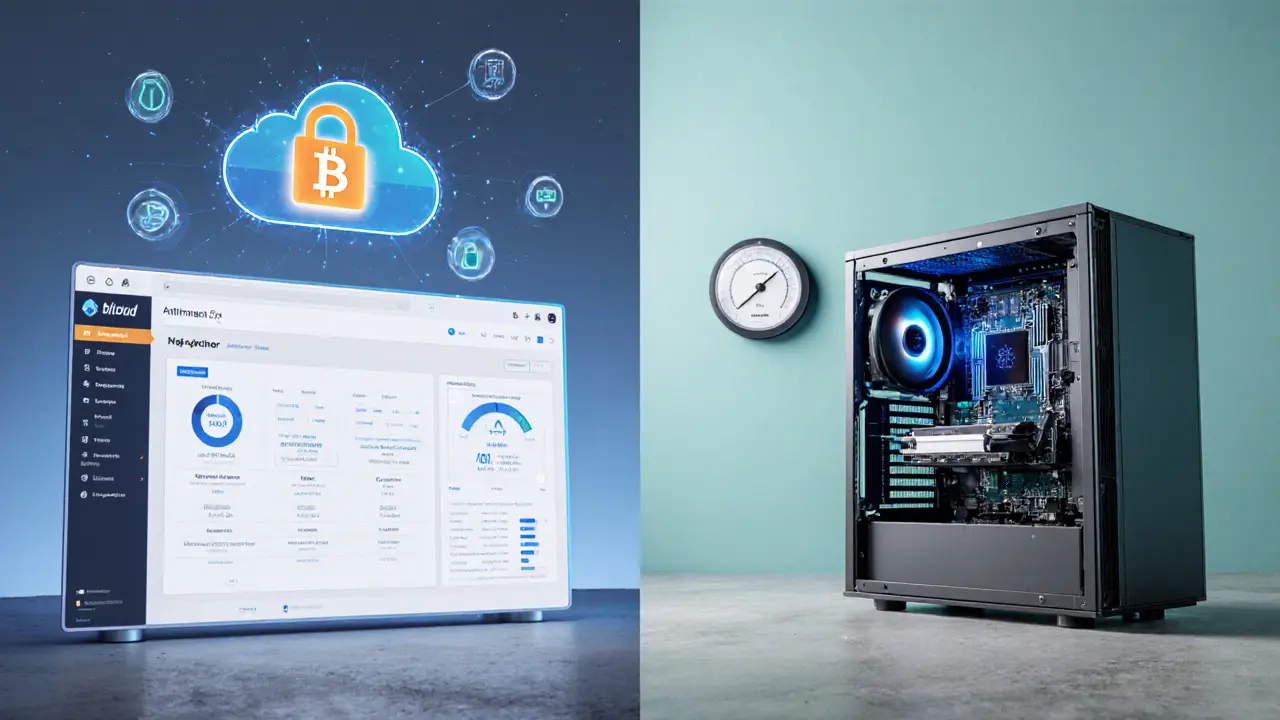
You want to mine Bitcoin. You’ve heard it’s still possible. But now you’re stuck between two paths: cloud mining or home mining. One promises ease - just pay and wait. The other demands effort - buying hardware, fixing fans, wrestling with electricity bills. Which one actually makes sense today?
Let’s cut through the hype. In 2025, neither option is a get-rich-quick scheme. But one can still turn a profit if you know where to stand. The other? It’s a gamble with your cash.
Cloud Mining: The Easy Button That Often Breaks
Cloud mining sounds perfect. No noise. No heat. No need to learn how to wire a power supply. You sign up, pay $4,000, and get 150 TH/s of hashing power. The provider handles everything: cooling, electricity, hardware upgrades. You log in, watch your balance tick up, and call it a day.
But here’s the catch: you don’t own anything. You’re renting. And rent can disappear.
In 2023, over 60% of fraudulent crypto mining platforms were cloud mining services. The IC3 reported average losses of $1,850 per victim. Even legit providers like Bitdeer and ViaBTC have faced complaints: contracts canceled without warning, hash rates cut overnight, withdrawals delayed for weeks. A 2024 Trustpilot analysis of 3,852 reviews showed 41% of users didn’t renew their contracts - not because they were rich, but because they lost money after the first term.
And the math doesn’t always add up. At $0.12 per TH/day for the contract plus $0.06/day for maintenance, your $4,000 buys you 150 TH/s for 360 days. That’s roughly $27,000 in total fees over the year. Meanwhile, a single Antminer S21 - which you can buy outright for $3,500 - uses 3,250 watts and runs 24/7. At $0.08/kWh, your monthly electricity cost is $192. Over a year? $2,300. You’re paying $25,000 in fees for cloud mining versus $2,300 in electricity for home mining. And with home mining, you still own the machine. With cloud mining? You own nothing.
There’s another hidden cost: control. You can’t switch mining pools. You can’t update firmware. You can’t undervolt your rigs to save 12% on power. You’re locked in. And when Bitcoin surges, your returns stay fixed. Home miners cash in. Cloud miners just wait.
Home Mining: The Hard Path That Still Pays
Home mining isn’t glamorous. It’s loud. It’s hot. It’s a 60-hour learning curve before you even turn it on. You need a 20-amp dedicated circuit. You need to know how to set a static IP. You need to pray your power supply doesn’t fry after three months.
But if you live in a place with cheap electricity - say, under $0.10/kWh - it’s the only way to make real money.
Take the Bitmain Antminer S21. At 200 TH/s, it costs $3,800. Add a good PSU and cooling, and you’re at $4,200. At $0.07/kWh, it breaks even in 287 days. After that? Pure profit. In 2024, users on Reddit with S19j Pros (100 TH/s) were pulling in $120-$180/month net profit after electricity. That’s $1,440-$2,160 a year. On a $1,200 investment.
And here’s the kicker: you own the hardware. If Bitcoin hits $100,000, your returns jump. You can sell the miner for 60-70% of its original value. You can upgrade. You can move it to a cheaper region. You’re not stuck with a contract that expires in 360 days.
Yes, you’ll have hardware failures. 32% of home miners report PSU issues. 27% deal with thermal throttling. But these aren’t deal-breakers - they’re part of the game. The community on r/BitcoinMining has over 350 questions posted daily. Most get answered in under 24 hours. You’re not alone.
And the tech is improving. Canaan’s new Avalon A1466 Pro runs at 45 dB - quieter than a refrigerator. Older miners? 75 dB. That’s like having a vacuum cleaner running nonstop. New models fix that. Cooling systems are smarter. Power efficiency is up 18% since 2023.
The Electricity Factor: Where You Live Decides Everything
Electricity cost is the single biggest factor in mining profitability. Not the coin price. Not the hash rate. Not the brand. Just how much you pay per kilowatt-hour.
If you’re in Washington State at $0.04/kWh? Home mining is a no-brainer. You’ll make money even on older ASICs.
If you’re in Hawaii at $0.35/kWh? Don’t even think about it. Your electricity bill will eat your profits before you break even.
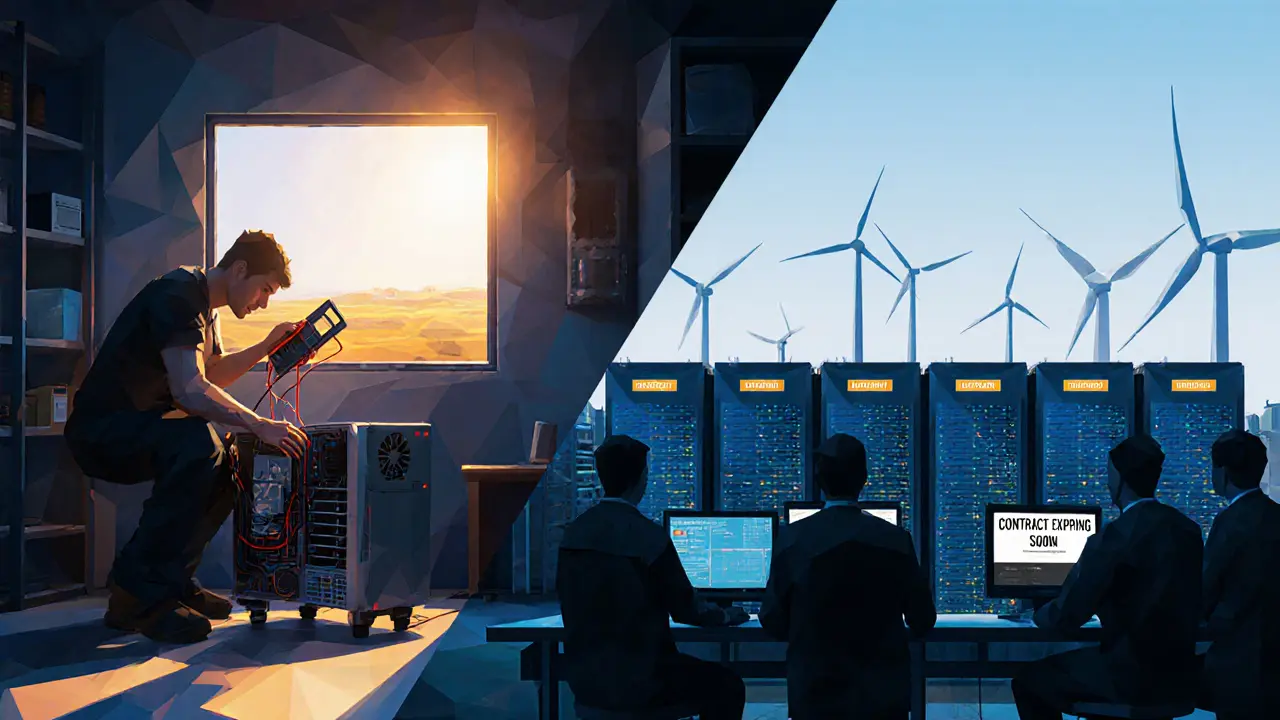
That’s where cloud mining sneaks in. Industrial mining farms - the kind running cloud services - pay $0.03-$0.06/kWh through bulk utility contracts. They’re in Kazakhstan, Georgia, Texas, and Canada. They have access to hydro, wind, and cheap natural gas. You don’t.
So if your home electricity is above $0.15/kWh, cloud mining might be your only viable option. But even then, you’re paying 27-33% more than the provider’s actual cost. You’re subsidizing their profit margin.
There’s no magic number. But here’s the rule: if your power costs more than 35% of your daily mining revenue, you’re losing money. Check your local rates. Plug them into a mining calculator. Don’t guess.
Control, Risk, and the Hidden Costs
Home mining gives you control. You pick your pool. You update your firmware. You monitor your temps. You know exactly what’s happening. You’re not trusting someone else’s dashboard.
Cloud mining gives you convenience. But convenience has a price: trust.
Blockchain Association’s 2024 report found 22% of cloud mining platforms had opaque ownership. 37% couldn’t prove they had real mining hardware. That’s not paranoia. That’s data.
And then there’s regulation. In October 2024, the SEC ruled that some cloud mining contracts are unregistered securities. Seventeen platforms shut down U.S. operations overnight. Your contract? Gone. Your money? Gone.
Home mining isn’t immune. California’s AB 1816, effective January 2025, adds fees for residential power use over 2,000 kWh/month. That’s about 3 ASICs running full tilt. You’ll pay extra. But you still own your gear. You can move it. You can sell it. You can wait out the storm.
Cloud mining? You’re at the mercy of a company that might not even exist next year.
Who Should Choose What?
Here’s the simple breakdown:
- Choose cloud mining if: You live where electricity costs over $0.15/kWh, you have zero technical skills, you want to test mining with $500, or you’re not planning to stay in mining long-term.
- Choose home mining if: You live where electricity is under $0.10/kWh, you’re willing to learn, you want real ownership, you’re in it for the long haul, or you believe Bitcoin will rise and you want to profit from it - not just rent a slice of it.
There’s a third option: hybrid. Buy one ASIC for home mining. Use it to learn. Then, if you want to scale, reinvest profits into more hardware. Don’t start with $10,000 in cloud mining contracts. Start with $4,000 in hardware. That way, even if Bitcoin crashes, you still have something physical.
The Bottom Line: Own Something
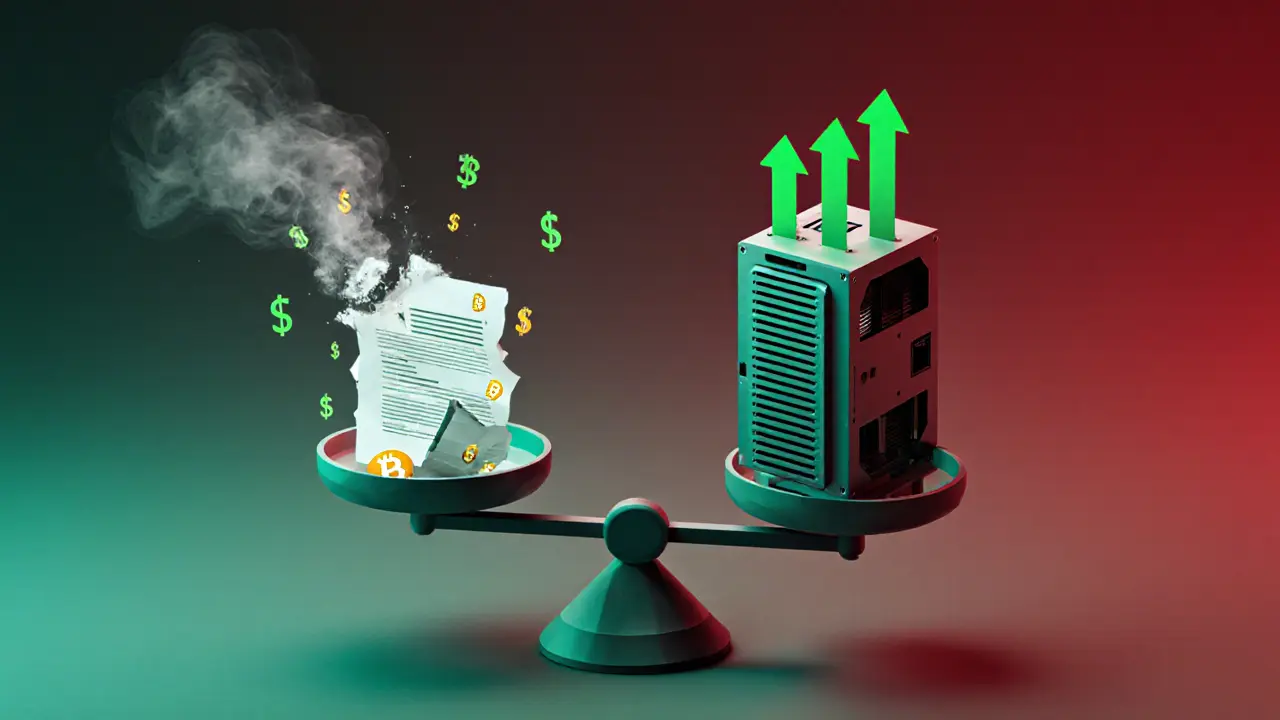
Cloud mining is a service. Home mining is an investment.
One gives you a digital receipt. The other gives you a machine that can be resold, upgraded, or moved.
One locks you into a contract that can be canceled. The other lets you adapt when the market shifts.
One relies on someone else’s honesty. The other relies on your ability to learn and manage risk.
In 2025, the most profitable miners aren’t the ones who paid the least upfront. They’re the ones who own their hardware, control their power, and stick around through the ups and downs.
If you’re serious about mining, don’t rent. Buy.
Frequently Asked Questions
Is cloud mining profitable in 2025?
Cloud mining can be profitable - but only if you live in a high-electricity-cost region (above $0.15/kWh) and you use a reputable provider like Bitdeer or ViaBTC. Even then, you’ll earn 18-22% less than a home miner with the same hash rate and cheap power. Most users don’t renew contracts because profits shrink after the first term, and hidden fees eat into returns.
Can I mine Bitcoin at home with a regular computer?
No. Bitcoin mining today requires ASIC miners - specialized hardware that’s thousands of times more efficient than GPUs or CPUs. A regular laptop or desktop can’t compete. Even a high-end gaming PC will use more electricity than it earns in Bitcoin. Stick to ASICs if you’re serious.
What’s the best ASIC miner for home mining in 2025?
The Bitmain Antminer S21 (200 TH/s) is the most efficient model available as of late 2024. It uses 3,250 watts and has a power efficiency of 13.5 J/TH. For budget buyers, the S19j Pro (100 TH/s) at $800-$1,200 still delivers solid returns in low-cost electricity areas. Avoid older models like the S17 - they’re too inefficient now.
How much electricity does a home mining rig use?
A single Antminer S21 uses 3,250 watts continuously. That’s about 78 kWh per day, or 2,340 kWh per month. If your electricity costs $0.10/kWh, that’s $234/month. At $0.05/kWh, it’s $117. Always calculate your local rate before buying hardware.
Are there legal risks to home mining?
Yes, but they’re regional. In California, new rules (AB 1816) add fees for residential power use over 2,000 kWh/month - roughly 3 ASICs. In some countries like China, mining is banned. In others like Germany or Canada, it’s legal but taxed. Check your local energy regulations before setting up. Never mine in a rental without written permission.
How long do ASIC miners last?
Most ASICs become unprofitable after 18-24 months due to rising network difficulty and falling Bitcoin rewards. But they can still run for 3-5 years. Many miners sell their older units on secondary markets for 40-60% of the original price. The hardware doesn’t die - it just stops being the best tool for the job.
Can I make a profit with cloud mining if I’m a beginner?
You might make a small profit in the first 3-6 months - but only if you pick a top-tier provider and your electricity is expensive. Most beginners lose money long-term because contracts expire, fees increase, and providers cut hash rates. Beginners are better off starting with one home miner to learn the system before risking money on cloud services.
What’s the biggest mistake people make with home mining?
Buying hardware without checking their electricity cost first. Many people buy an Antminer S21, only to realize their power bill is $300/month and they’re losing $50 a month. Always run a profitability calculator with your exact local rate before spending a dime.
Savan Prajapati
November 26, 2025 AT 13:52Abby cant tell ya
November 27, 2025 AT 03:59stephen bullard
November 27, 2025 AT 13:33George Kakosouris
November 27, 2025 AT 21:01SHASHI SHEKHAR
November 28, 2025 AT 05:55Michael Labelle
November 29, 2025 AT 19:49Janice Jose
December 1, 2025 AT 00:03Brian Bernfeld
December 2, 2025 AT 09:51Joel Christian
December 3, 2025 AT 22:47jeff aza
December 5, 2025 AT 19:20Ian Esche
December 6, 2025 AT 19:49Felicia Sue Lynn
December 7, 2025 AT 12:24Vaibhav Jaiswal
December 8, 2025 AT 18:26