
Cat.Ex Crypto Exchange Review: High Withdrawal Fees & Regulatory Risks

Imagine finding a cryptocurrency exchange that promises low trading fees and lets you earn tokens just by trading. It sounds like the perfect setup for a trader looking to squeeze every bit of profit from their portfolio. That is exactly how Cat.Ex positions itself in the crowded world of digital asset trading. Launched in August 2018, this platform has managed to survive for nearly eight years, which is no small feat in an industry where many competitors vanish overnight. But survival does not always mean safety or profitability. As we move through 2026, the landscape for crypto exchanges has shifted dramatically toward regulation and transparency. Does Cat.Ex still hold up against these new standards? The short answer is complicated. While it offers some unique features for niche traders, significant red flags regarding fees, regulation, and accessibility make it a risky choice for most users.
What Is Cat.Ex and How Does It Work?
To understand whether Cat.Ex is right for you, you first need to grasp its core model. Unlike major exchanges like Binance or Coinbase that focus purely on facilitating trades, Cat.Ex operates as a "transaction mining" platform. This means that when you trade, you don't just buy or sell assets; you also mine the platform's native token, CATT. CATT is the utility token used within the Cat.Ex ecosystem to reduce fees and provide rewards..
The idea is simple: the more you trade, the more CATT you earn. These tokens can then be used to lower your withdrawal fees or held for potential appreciation. On paper, this creates a loop where active traders are rewarded for their volume. However, the reality is more nuanced. The platform supports spot trading only, with a strict 1:1 leverage. If you are looking for futures, margin trading, or complex derivatives, you will not find them here. The selection of cryptocurrencies is also limited compared to giants. Recent data suggests support for around 29 coins across roughly 40 trading pairs. While older sources claimed over 200 coins, the current offering is much narrower, focusing on major assets like Bitcoin (BTC), Ethereum (ETH), and stablecoins like USDT.
The Hidden Cost: Analyzing Fees and Withdrawals
This is where things get tricky. When evaluating an exchange, the headline trading fee is often misleading if you ignore the withdrawal costs. Cat.Ex advertises competitive trading fees, with maker fees as low as 0.05% and taker fees starting at 0.1%. For high-volume day traders who never withdraw their funds, these rates look attractive. But almost every trader eventually wants to move their profits off the exchange.
| Fee Type | Rate/Cost | Notes |
|---|---|---|
| Maker Trading Fee | 0.01% - 0.05% | Competitive for spot trading |
| Taker Trading Fee | 0.02% - 0.1% | Standard market order cost |
| Withdrawal Fee | 3.5% Flat Rate | Applied to all withdrawals unless discounted by CATT holdings |
| Bitcoin Withdrawal | 0.0005 BTC + 3.5% | Network fee plus platform penalty |
| Ethereum Withdrawal | 0.008 ETH + 3.5% | Network fee plus platform penalty |
| USDT Withdrawal | 5 USDT + 3.5% | Fixed network fee plus platform penalty |
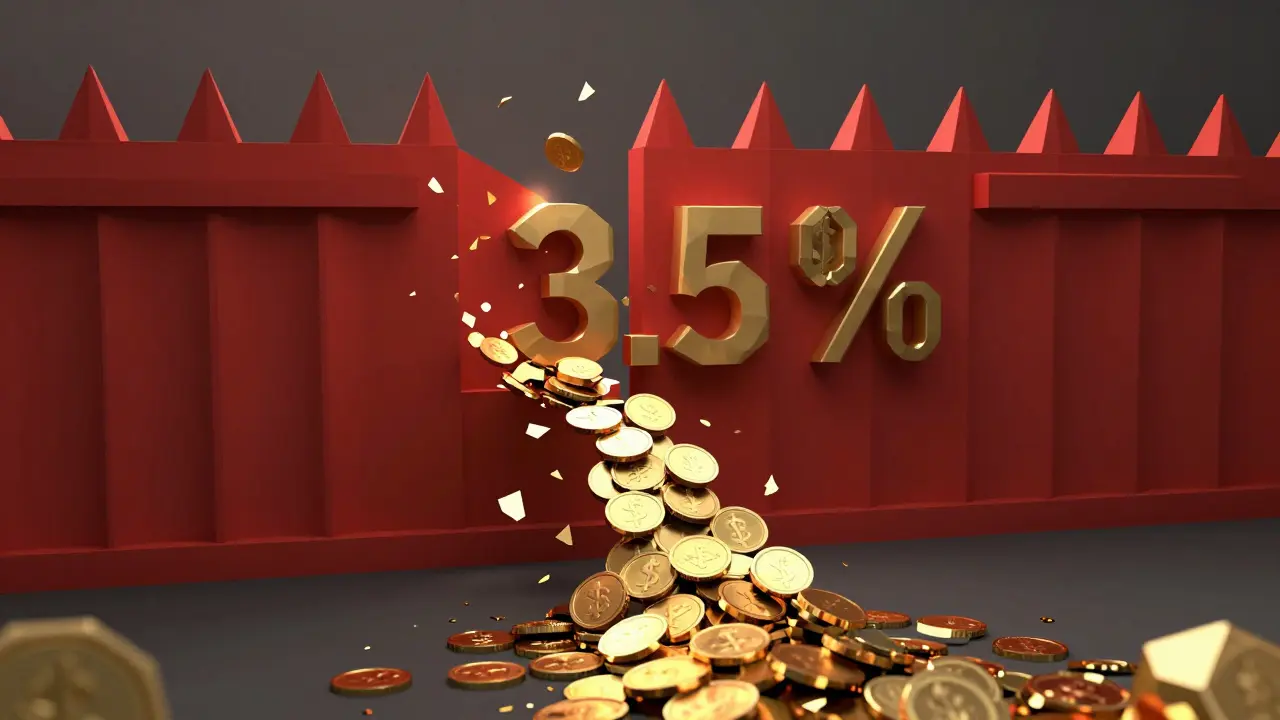
That 3.5% withdrawal fee is a massive hurdle. To put that in perspective, if you withdraw $1,000 worth of Bitcoin, you lose $35 immediately. Most regulated exchanges charge a flat network fee (e.g., $1-$5) regardless of the amount withdrawn. Cat.Ex’s percentage-based fee punishes large withdrawals heavily. The only way to mitigate this is by holding significant amounts of CATT tokens. The platform uses an 11-tier system where higher CATT balances unlock deeper discounts. At Tier 10, which requires holding 20 million CATT tokens, you get a 100% discount on withdrawal fees. For the average retail trader, reaching this tier is practically impossible without substantial capital investment, locking your funds into a volatile utility token rather than secure assets.
Regulatory Status and Geographic Restrictions
In 2026, regulatory compliance is not just a legal formality; it is a primary indicator of an exchange's legitimacy and safety. Cat.Ex is officially registered in China. This presents a fundamental contradiction. Since 2021, China has enforced strict bans on cryptocurrency trading and mining operations. An exchange claiming Chinese registration while operating globally raises serious questions about its legal standing and operational continuity.
More importantly, Cat.Ex lacks oversight from any major financial authority. You will not find approvals from the U.S. Securities and Exchange Commission (SEC), the UK Financial Conduct Authority (FCA), or the Australian Securities and Investments Commission (ASIC). This absence of regulation means there is no recourse if the platform freezes your account, suffers a hack, or ceases operations. Your funds are entirely at the mercy of the platform's internal policies.
Consequently, Cat.Ex blocks access from over 23 jurisdictions, including the United States, United Kingdom, Canada, France, Germany, and China itself. If you reside in one of these regions, you cannot legally or technically use the platform. Users from Brazil and South Korea have reported successful usage, indicating that the platform remains active in less strictly regulated markets. However, this geographic fragmentation limits liquidity and makes the platform a niche option rather than a global standard.
Security Features and User Experience
When an exchange lacks regulatory backing, security becomes the user's responsibility to verify. Cat.Ex implements mandatory two-factor authentication (2FA) for logins, trading, and withdrawals. This is a basic but essential layer of protection. Industry experts consider 2FA non-negotiable for any crypto account. However, beyond 2FA, information about advanced security measures like cold storage ratios, multi-signature wallets, or regular third-party audits is scarce. The lack of transparent security reporting is a common trait among unregulated platforms and should give cautious traders pause.
From a user experience perspective, the interface is described as intuitive and beginner-friendly. Navigation is straightforward, and the technical analysis tools provided are sufficient for basic charting and price movement tracking. The "transaction mining" dashboard is integrated directly into the trading view, allowing users to see their CATT earnings in real-time. However, the complexity of the fee tier system often confuses new users. Many report difficulty understanding how much CATT they need to hold to achieve meaningful fee reductions, leading to frustration when attempting to withdraw profits.
Pros and Cons: Is Cat.Ex Worth the Risk?
Before deciding whether to deposit funds, weigh the following factors carefully. The platform serves a specific type of trader-those in permitted jurisdictions who prioritize low entry fees and are willing to lock up capital in CATT tokens to avoid exit penalties.
- Pros:
- Low trading fees for makers and takers.
- Unique transaction mining feature allows earning CATT through activity.
- Simple interface suitable for beginners.
- Anonymity options available during initial registration.
- Cons:
- Extremely high withdrawal fees (3.5%) unless you hold massive amounts of CATT.
- No regulatory oversight from major financial authorities.
- Registered in China, a jurisdiction hostile to crypto, creating operational uncertainty.
- Limited cryptocurrency selection (approx. 29 coins).
- Geographic restrictions block users from major economies (US, EU, UK).
- No customer service via phone or live chat; reliance on tickets and Telegram.

Alternatives to Consider
If the high withdrawal fees and regulatory risks of Cat.Ex concern you, several established alternatives offer better protection and transparency. For users in restricted regions, Coinbase (US/EU) or Kraken provide robust regulatory compliance and insured custodial services. For those seeking low fees without the hidden withdrawal penalties, Binance (in compliant jurisdictions) or Bybit offer competitive structures with clearer fee schedules. While these platforms may not offer "transaction mining," they provide superior liquidity, wider asset selection, and the peace of mind that comes with institutional-grade security and legal accountability.
Final Verdict
Cat.Ex occupies a precarious position in the 2026 crypto market. Its longevity since 2018 proves it has retained a user base, but its business model relies on keeping funds on-platform through punitive withdrawal fees. The lack of regulatory oversight and its Chinese registration pose significant long-term risks. For experienced traders in permitted countries who understand the CATT tokenomics and plan to keep funds on the exchange for extended periods, it might serve as a secondary tool. For everyone else, especially beginners or those in restricted jurisdictions, the risks outweigh the benefits. Stick to regulated exchanges where your capital is protected by law, not just by a website's promise.
Is Cat.Ex safe to use in 2026?
Safety depends on your definition. Technically, it uses 2FA and has operated since 2018. However, financially and legally, it carries high risk due to zero regulatory oversight and a 3.5% withdrawal fee structure that can trap your funds. It is not recommended for users prioritizing capital protection.
Can I use Cat.Ex in the United States or Europe?
No. Cat.Ex explicitly blocks users from the United States, United Kingdom, France, Germany, Canada, and other major jurisdictions. Attempting to bypass these restrictions may result in account freezing and loss of funds.
How do I reduce the 3.5% withdrawal fee on Cat.Ex?
You must hold the platform's native token, CATT. The exchange uses an 11-tier system. To get a 100% discount on withdrawal fees, you need to hold 20 million CATT tokens at Tier 10. Lower tiers offer partial discounts, but achieving them requires significant capital allocation to CATT.
What is transaction mining on Cat.Ex?
Transaction mining is a mechanism where users earn CATT tokens automatically when they execute trades. Instead of traditional Proof-of-Work mining, your trading volume generates rewards. These tokens can be used to pay for fees or traded on the open market.
Does Cat.Ex support margin or futures trading?
No. Cat.Ex only supports spot trading with 1:1 leverage. There are no futures contracts, margin lending, or derivative products available on the platform.
Barclay Chantel
June 1, 2026 AT 03:45Oh, please. Another piece of clickbait designed to scare the unwashed masses away from 'exotic' platforms. The author clearly lacks the nuance to understand that regulatory arbitrage is simply a feature, not a bug, in the early stages of technological adoption. To suggest that Chinese registration is an automatic death sentence for legitimacy is intellectually lazy and borders on hysterical.
I have been trading on offshore platforms since the days when Silk Road was considered 'risky.' The notion that one must rely on the SEC or FCA for safety is a testament to how thoroughly we have been brainwashed by institutional propaganda. Cat.Ex has survived eight years. Eight years! Do you know how many 'regulated' US banks collapsed in that same period? The answer is more than you think. The withdrawal fee structure is merely a mechanism to ensure liquidity retention, a standard practice in any serious financial ecosystem that isn't subsidizing its users with taxpayer money.
The real issue here is not the fees, but the lack of sophistication among the retail traders who complain about them. If you cannot afford to hold the requisite CATT tokens to mitigate costs, perhaps you should not be trading at all. It is that simple. This article reads like it was written by someone who has never successfully executed a trade outside of Coinbase's walled garden.
Edith Mair
June 1, 2026 AT 13:21You are completely missing the point, Barclay. Survival does not equal safety. Just because a scam doesn't get shut down immediately doesn't mean it's legitimate. The 3.5% withdrawal fee is predatory, plain and simple. It's a trap designed to lock your money in until the rug pull happens. I don't care about your 'nuanced' view on regulatory arbitrage; I care about my capital not disappearing into a black hole registered in a country that bans crypto.
Stop acting like complaining about high fees makes you stupid. It makes me smart enough to walk away. There are dozens of exchanges with transparent fee structures and actual legal recourse. Why would anyone choose this over Kraken or Binance? You're defending a platform that actively blocks users from major economies because it knows it can't meet basic compliance standards. That's not 'arbitrage,' that's guilt.
Sam Dashti
June 1, 2026 AT 20:51Whoa there, Edith! Let's not throw around words like 'scam' without a little bit of evidence, shall we? I mean, sure, the fees are kinda wild, like trying to buy a coffee at an airport terminal, but let's look at the bigger picture here. The whole concept of transaction mining is actually pretty clever if you think about it. It's like getting paid to shop, except instead of points, you get tokens that might go up in value. Sure, the CATT token needs to pump hard for that discount tier to make sense, but hey, nothing in crypto is guaranteed anyway.
I've seen worse. I remember when Poloniex was still around and they had their own shenanigans. But look, if you're just holding BTC and ETH, yeah, maybe stick to the big boys. But for those of us who like to tinker with niche pairs and don't mind a bit of complexity, Cat.Ex offers something different. It's not for everyone, obviously. It's like driving a manual transmission car in a world of autos. Some people hate it, others love the control. Just don't expect it to drive itself.
Eric Grosso
June 2, 2026 AT 16:26i dont get why ppl r so mad abt the fees. if u cant pay 3.5% to move ur money, maybe u shudnt b tradin in da first place? lol. also, chineese regs r strict but dat doesnt mean da exchange is fake. lots of good tech comes from china. why r yall so scared of everything?
Joshua Alcover
June 3, 2026 AT 05:37The fundamental flaw in this discourse lies in the superficial analysis of geopolitical risk vectors. One must consider the macroeconomic implications of operating within jurisdictions that possess robust infrastructure yet divergent regulatory frameworks. The assertion that Chinese registration constitutes an inherent liability is a reductive fallacy often propagated by Western-centric media narratives that fail to appreciate the strategic agility required in global digital asset management.
Furthermore, the criticism regarding withdrawal fees ignores the operational overheads associated with maintaining liquidity pools in volatile markets. The platform's model incentivizes long-term capital allocation, which stabilizes the market against speculative frenzies. Those who decry this as 'predatory' demonstrate a profound ignorance of financial engineering principles. The true patriot supports platforms that operate outside the stifling embrace of bureaucratic oversight, fostering innovation through freedom rather than restriction.
Miss Masquer
June 3, 2026 AT 23:29I really appreciate the detailed breakdown in this post, and I think it's important for us to have these kinds of conversations about transparency in the crypto space. As someone who has traveled extensively and used various exchanges across different continents, I can tell you that the experience varies wildly depending on where you are located. In some countries, having access to even a limited number of coins is a blessing, while in others, the options are plentiful but fraught with their own sets of challenges.
That said, I agree with the sentiment that high withdrawal fees are a significant barrier. It feels less like a service fee and more like a penalty for wanting to take your profits elsewhere. However, I wonder if there is a cultural difference in how these platforms view customer loyalty. In some regions, exchanges build communities around their native tokens, creating a sense of belonging that goes beyond just trading. Perhaps for some users, that community aspect outweighs the cost. It's a complex web of factors, and I think we need to listen to the experiences of users in those permitted jurisdictions to get the full picture. We shouldn't dismiss their choices outright.
Crystal Davis
June 4, 2026 AT 23:38Let's cut through the noise. The data speaks for itself. A 3.5% flat withdrawal fee is mathematically unsustainable for any trader who intends to realize gains. It's not 'community building'; it's a hostage situation. You lock up your principal in a volatile utility token (CATT) to avoid being taxed on your exit. If CATT drops 50%, your 'discount' is worthless, and you've lost half your capital just trying to save a few percent on fees.
The lack of regulatory oversight is the smoking gun. No SEC, no FCA, no ASIC. This means zero accountability. If the CEO decides to run off with the funds, or if the server gets hacked, you have literally nowhere to turn. Calling this 'strategic agility' is delusional. It's negligence wrapped in buzzwords. Anyone advocating for this platform either owns too much CATT to admit it's a bad investment or is being compensated to shill it. Stick to regulated entities. Your portfolio will thank you.
mark valmart
June 5, 2026 AT 18:39Hey guys, I hear ya. It's tough out there. I totally get why everyone is frustrated with the fees and the whole regulatory mess. It's scary enough dealing with crypto prices swinging all over the place without worrying if you can even get your money out. I'm just saying, maybe we should try to understand where these platforms are coming from? They gotta make money somehow, right? And hey, at least they're still around after all these years. That's gotta count for something, even if it's just survival. Let's not be too harsh on each other though. We're all just trying to navigate this crazy world together. Maybe there's a middle ground somewhere? Like, using it for small trades but keeping most of your stash elsewhere? Just a thought!
Hadleigh Edwards
June 5, 2026 AT 18:51Oh, I think there is absolutely a silver lining here if you look at it with the right perspective! Yes, the fees are high, and yes, the regulations are tricky, but think about the opportunity! Think about the learning experience! Every challenge is just a chance to grow stronger and smarter. Maybe Cat.Ex is teaching us all about the importance of diversification and risk management in a way that no textbook ever could. Who knows? Maybe CATT will moon and everyone will forget about the fees entirely! It's all about staying positive and keeping our eyes on the prize. The future is bright, and every step, even the rocky ones, brings us closer to financial freedom. Let's cheer each other on and keep exploring new horizons together! After all, isn't adventure part of the fun?
Christina Pearce
June 7, 2026 AT 11:45I think we can all agree that transparency is key here. While some of the comments above are quite passionate, I believe it's important to respect different viewpoints while also acknowledging the valid concerns raised in the original post. The fee structure is indeed unusual, and the lack of regulation is a serious red flag for many. However, dismissing the platform entirely might overlook the specific use cases for traders in regions with limited options.
Perhaps a balanced approach would be to use Cat.Ex only for specific strategies where the low trading fees outweigh the withdrawal costs, and always maintain a backup plan for moving funds. Communication and education seem to be the best tools here. Let's continue to share information and help each other make informed decisions without resorting to personal attacks or overly simplistic judgments. Thanks for sharing this review, it sparked a lot of interesting discussion!