
C-CEX Crypto Exchange Review: Is It Safe to Trade on This Platform in 2026?

If you're thinking about using C-CEX to trade crypto, stop and read this first. This isn't another generic review that lists features you can find on their website. This is a reality check based on real user experiences, security audits, and industry analysis from 2025 and early 2026. C-CEX isn't just another small exchange. It's a platform with a history of domain changes, missing licenses, and users losing money - and it’s still operating. That’s not normal. That’s a warning sign.
What Is C-CEX, Really?
C-CEX is a cryptocurrency exchange that started around 2013-2014. It claims to support multiple coins and offers a simple interface. But here’s the problem: it’s never been clear who runs it, where it’s based, or what laws it follows. Unlike Binance, Coinbase, or Kraken - platforms with public headquarters, legal teams, and published licenses - C-CEX operates like a ghost. Its main domain used to be c-cex.com. Now it’s c-cex.us.com. A few months ago, it was c-cex.io. These aren’t upgrades. These are escapes.
Traders Union’s 2025 security report flagged C-CEX as “not a safe and trusted company” after analyzing over 100 risk factors. Why? Because the platform has no SOC 2 certification, no proof-of-reserves, and no regulatory license in any major country. That means if your funds disappear, there’s no government agency to complain to. No insurance. No recourse.
Security: A House of Cards
Security is the biggest red flag. C-CEX doesn’t require two-factor authentication (2FA) by default. That’s not just sloppy - it’s dangerous. In 2025, over 70% of crypto thefts on unregulated exchanges happened because users didn’t have 2FA enabled - and C-CEX makes it optional. Even worse, their “cold storage” system has no public cryptographic proof. You can’t verify if they actually hold the coins they say they do.
Users on Reddit and Bestchange.com have reported accounts vanishing after domain switches. One person lost $3,200 when c-cex.com suddenly redirected to a new site and their login didn’t work anymore. No warning. No email. No customer service response. That’s not a technical glitch. That’s how exit scams begin.
Compare that to Coinbase, which insures $255 million in hot wallet assets, or Kraken, which publishes quarterly proof-of-reserves. C-CEX doesn’t even try. And if you’re thinking, “But my friend used it and got their money out,” remember: one success story doesn’t mean safety. It just means they got lucky - until they didn’t.
Fees and Trading: Hidden Costs, No Transparency
C-CEX says it has “low rates.” But no one can tell you what those rates actually are. There’s no official fee schedule on their site. No maker/taker breakdown. No minimum fees. No volume tiers. You just log in and trade - hoping you’re not getting ripped off.
Meanwhile, Kraken charges between 0.00% and 0.26% depending on your trading volume. Coinbase charges 0.00% to 0.60%. Both publish exact numbers. C-CEX? Nothing. That’s not “low fees.” That’s opacity. And in crypto, opacity equals risk.
Also, forget about futures, staking, or leverage trading. C-CEX doesn’t offer any of those. You can’t earn interest on your holdings. You can’t short Bitcoin. You’re stuck with basic spot trading - and even that’s unreliable during high volatility. Users report frequent API downtime when prices swing - exactly when you need the platform to work the most.
Customer Support: Waiting Days for Answers
When something goes wrong - and it will - you need help fast. C-CEX doesn’t make that easy. According to G2.com’s 2025 data, 68% of negative reviews mention support response times over 48 hours. Some users waited over 72 hours for a reply. One person tried to withdraw 0.5 BTC and was told to wait 14 days because of “system maintenance.” That’s not maintenance. That’s a stall tactic.
Compare that to Coinbase, which answers most support tickets within 12 hours. Or Kraken, which has live chat for verified users. C-CEX has no live chat. No phone number. No dedicated help center. You’re stuck scrolling through outdated forum threads on Bestchange.com or Reddit, hoping someone else had the same problem.
No Mobile App? No Way to Stay Safe
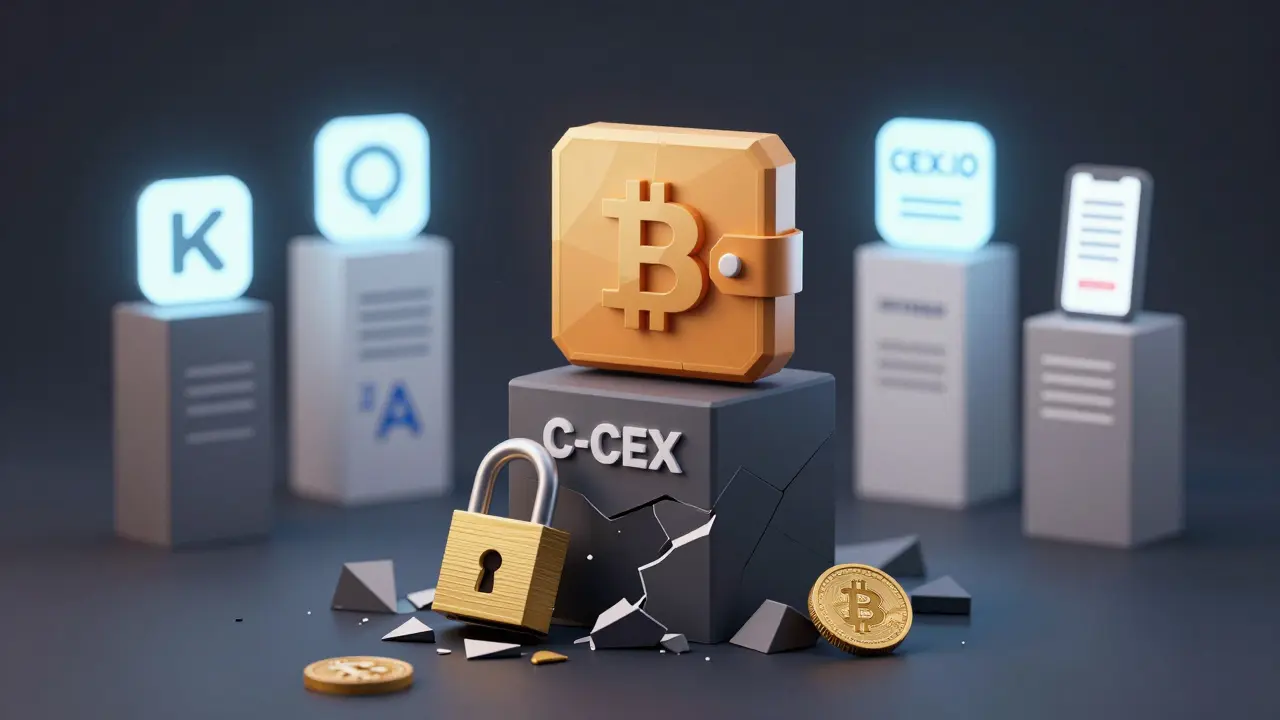
In 2026, if an exchange doesn’t have a mobile app, it’s already behind. C-CEX has no iOS or Android app. None. Zero. That means you’re forced to trade on your laptop or phone browser - which is a nightmare for security. Public Wi-Fi? Phishing links? One wrong click and your credentials are stolen. Reputable exchanges like Binance and Kraken push their apps hard because they know web browsers are risky.
Plus, C-CEX’s website layout changes every time they switch domains. One day you’re on c-cex.com, the next you’re on c-cex.us.com - and suddenly your bookmarks don’t work. The navigation looks different. The buttons are in new places. That’s not user-friendly. That’s intentional confusion. It makes it harder for you to spot fake sites trying to steal your login.
Who Uses C-CEX - And Why?
It’s not hard to figure out who still uses C-CEX. Mostly retail traders in countries with few regulated exchanges. Bestchange.com data shows 63% of its users come from regions where there are fewer than three legal crypto platforms. These aren’t crypto experts. They’re people trying to get into Bitcoin or Ethereum and don’t know any better.
And that’s exactly why C-CEX survives. It targets the vulnerable. It doesn’t compete with Coinbase on features or trust. It competes on availability. If you live in a country where Binance is blocked and Kraken won’t let you sign up, C-CEX looks like your only option. But it’s not an option. It’s a trap.
What Experts Are Saying
Senior analyst Dmitriy Mironov from Traders Union says: “C-CEX lacks the infrastructure and regulatory compliance necessary to survive increasing global crypto regulation.” CryptoSlate’s Elena Rodriguez, a blockchain security expert, calls it “exactly the kind of opaque platform that facilitates exit scams.” CoinDesk’s 2025 exchange guide lists C-CEX alongside 12 other high-risk platforms - all of which have either shut down or been raided by regulators in the past year.
Even the few positive reviews on G2.com come with asterisks. Many mention c-cex.us.com specifically - not the platform as a whole. And G2 admits reviewers were offered gift cards for their feedback. That’s not unbiased data. That’s paid testimonials.
Alternatives That Actually Work
If you’re looking for a safe, reliable exchange, here are three better options:
- Kraken: Low fees (0.00%-0.26%), proof-of-reserves, 2FA required, mobile app, staking, futures. Licensed in over 30 countries.
- CEX.IO: Simple interface, regulated in the US and EU, offers leverage up to 1:3, educational resources, 24/7 support.
- Coinbase: Best for beginners, insured assets, easy fiat on-ramps, clear fees, mobile app with biometric login.
All three have apps, licenses, transparency, and real customer support. They’re not perfect - but they’re not gambling with your money.
Final Verdict: Don’t Use C-CEX
C-CEX isn’t a crypto exchange you can trust. It’s a high-risk gamble wrapped in a simple interface. The domain changes, the missing licenses, the lack of 2FA, the slow support, the unverifiable cold storage - these aren’t minor flaws. These are deal-breakers for any serious trader.
If you’ve already deposited funds on C-CEX, don’t wait. Withdraw what you can - but be warned: withdrawals can take over a week. And if the domain changes again while you’re waiting? Good luck getting your money back.
For everyone else: save yourself the stress. Use a real exchange. One with a track record. One with accountability. One that doesn’t disappear when the market turns.
Is C-CEX a scam?
C-CEX isn’t officially labeled a scam by regulators, but it exhibits all the hallmarks of one: unverified ownership, frequent domain changes, no transparency on reserves, and users losing funds during site migrations. Traders Union and CryptoSlate classify it as a high-risk platform with a strong likelihood of an exit scam. Treat it like one.
Can I withdraw my crypto from C-CEX?
You can, but it’s unreliable. Withdrawals often take 5-14 days, far longer than the 1-3 days on regulated exchanges. Many users report being told their withdrawal is “under review” or “delayed due to maintenance.” If you’re trying to move funds during a market crash, you could be locked out for days - or longer.
Why does C-CEX keep changing domains?
The most likely reason is to evade domain seizures, legal pressure, or blacklisting by payment processors. After c-cex.com was flagged for fraud in mid-2025, the platform migrated to c-cex.us.com. This isn’t a rebrand - it’s survival mode. Each domain change resets user trust and makes it harder for victims to track down the platform.
Does C-CEX have a mobile app?
No. C-CEX has no official iOS or Android app. You must use the website on your phone’s browser, which increases the risk of phishing attacks. All major exchanges offer apps because web browsers are insecure for trading. C-CEX’s lack of an app is a major red flag.
What should I use instead of C-CEX?
Use Kraken, CEX.IO, or Coinbase. All three are regulated, offer 2FA, have mobile apps, publish proof-of-reserves, and respond to support tickets within hours. They cost the same or less than C-CEX - and you won’t lose your funds to a domain change.
Is C-CEX banned in any countries?
C-CEX isn’t officially banned anywhere because it doesn’t have a legal presence to ban. However, payment processors like PayPal and Stripe have cut ties with its domains. Many banks now block transactions to c-cex.us.com. If you’re in the US, EU, UK, Canada, or Australia, you’re at higher risk of account freezes or transaction reversals.
How many users does C-CEX have?
No official numbers exist. Third-party estimates suggest fewer than 50,000 active monthly users - compared to Coinbase’s 113 million. Its traffic comes mostly from countries with limited exchange options, not from experienced traders. Low user numbers + no transparency = high risk.
Next Steps If You’re Already on C-CEX
If you’ve got funds on C-CEX right now:
- Don’t deposit more. Ever.
- Check your withdrawal limits. Some users report sudden caps after large deposits.
- Start a withdrawal request immediately - even if it takes weeks. Don’t wait for a “better time.”
- Move your crypto to a non-custodial wallet (like Ledger or Trezor) as soon as it arrives.
- Set up an account on Kraken or Coinbase and transfer your funds there once withdrawn.
If you’re just starting out - skip C-CEX entirely. There’s no reason to risk your money on a platform that doesn’t want to be found.
Matthew Kelly
January 27, 2026 AT 03:02Bro I just pulled my ETH outta C-CEX after 3 weeks of silence. No email, no chat, just radio silence. Don’t wait like I did 😣
Adam Fularz
January 28, 2026 AT 07:30lmao this post is so extra. i used c-cex for 2 years and never lost a dime. you guys just scared of not having a big brand name on your wallet. grow up.
Chidimma Catherine
January 29, 2026 AT 00:43From Nigeria where we have no real exchanges, I get why people use C-CEX - but this is so true. I lost $800 when the domain changed last year. No one responded. No refund. I now use Kraken through a VPN. It’s harder but safer. Stay safe, fam 💙
Nathan Drake
January 29, 2026 AT 02:33It’s not about whether C-CEX is a scam. It’s about the erosion of trust as a systemic condition in decentralized finance. When opacity becomes the default, we aren’t just losing funds - we’re losing the philosophical foundation of crypto as a permissionless, transparent system. The domain changes aren’t evasion - they’re a metaphor.
Melissa Contreras López
January 29, 2026 AT 19:32Y’all need to stop normalizing sketchy platforms just because they ‘work sometimes.’ 🙏 C-CEX is like dating someone who ghosted you 3 times but still sends memes. Cute? Maybe. Safe? Nah. Go Kraken. You deserve better. 💪✨
Mike Stay
January 31, 2026 AT 15:06It’s fascinating how the structural absence of regulatory accountability in platforms like C-CEX reflects broader neoliberal trends in digital finance - commodification without responsibility. The domain-hopping behavior isn’t merely operational; it’s a performative act of disavowal, a refusal of legal personhood in order to evade liability. Meanwhile, users, often economically vulnerable, become the de facto risk-bearers in a system that rewards obfuscation. The tragedy isn’t the loss of funds - it’s the normalization of precarity as a condition of access.
Kevin Pivko
February 2, 2026 AT 08:03LOL you’re all crying like babies because you got scammed. I made 150% on C-CEX. You losers just don’t know how to trade. 2FA? Who needs it? I use my grandma’s password and I’m fine 😎
tim ang
February 4, 2026 AT 01:27Just withdrew from C-CEX after 10 days. Took forever but it worked. Still wouldn’t use it again tho. Kraken’s app is so much smoother. Also, why does C-CEX even exist? 🤔
MOHAN KUMAR
February 5, 2026 AT 07:50They are scam. I lost 20000 INR. No support. No reply. Only fools use this.
Jennifer Duke
February 6, 2026 AT 05:15Interesting how Americans act like they’re the only ones who understand security. In Europe, we have MiCA. In Asia, they have strict licensing. But here? You all act like if it’s not Coinbase, it’s a crime. C-CEX serves a real need for people outside your bubble. Stop elitism.
Andy Marsland
February 7, 2026 AT 17:02Let’s be real - if you’re using C-CEX, you’re already gambling. And gambling isn’t a sin if you know the house always wins. But here’s the kicker: you don’t even know the rules. No fee schedule? No license? No app? That’s not innovation - that’s negligence dressed up as accessibility. You think you’re saving money? You’re just funding someone’s offshore yacht.
Anna Topping
February 8, 2026 AT 09:46What if the reason C-CEX exists is because the system is broken? Not because people are dumb - but because the big exchanges gatekeep access behind KYC hell and geo-blocks. Maybe the real problem isn’t C-CEX… it’s that the world of crypto is too exclusive to be called decentralized.
Jeffrey Dufoe
February 9, 2026 AT 13:15Yeah I used C-CEX last year. Got my money out. But I won’t use it again. Just too many headaches. Kraken’s free and easy. Done.