
BitLicense Requirements for Crypto in New York: The Complete 2026 Guide
Trying to launch a cryptocurrency business in New York without a BitLicense is a regulatory framework established by the New York State Department of Financial Services (NYDFS) that mandates strict licensing for any entity engaging in Virtual Currency Business Activity within the state. It was created in 2015 under Superintendent Benjamin Lawsky to protect consumers and ensure financial stability.? You’re breaking the law. And if you think this is just another bureaucratic hurdle, think again. This isn’t just paperwork; it’s one of the most expensive, time-consuming, and rigorous compliance regimes in the world. As of mid-2026, the bar hasn’t lowered-it has arguably gotten higher with new guidance on token listings and blockchain analytics.
If you are reading this, you likely have two choices: either you are already operating in New York and need to get compliant before the regulators knock, or you are planning to enter the market and want to know if the cost is worth the reward. Let’s break down exactly what the BitLicense requires, how much it will cost you, and whether your business model can survive the scrutiny of the NYDFS.
What Exactly Is a BitLicense?
The term "BitLicense" is shorthand for the regulatory framework codified in 23 NYCRR Part 200 is the specific section of New York State regulations that governs money services businesses, including those dealing in virtual currency.. It came into effect on August 8, 2015. The core idea is simple but aggressive: if you touch virtual currency in New York, you are treated like a bank. You must prove you are solvent, secure, and honest.
You need a BitLicense if you engage in any of these five activities involving New York residents or entities:
- Transmission: Receiving virtual currency for transmission or transmitting it on behalf of others.
- Custody: Storing, holding, or maintaining control of virtual currency for customers.
- Trading as a Business: Buying and selling virtual currency as a customer business (not just personal investing).
- Exchange Services: Acting as an agent or broker in buying/selling virtual currency.
- Issuance: Controlling, administering, or issuing a virtual currency.
Note that this applies even if your company is based in Wyoming or Delaware. If you serve a user in Brooklyn, you need this license. There are very few exemptions, mostly for purely technical infrastructure providers who do not handle custody or exchange functions directly.
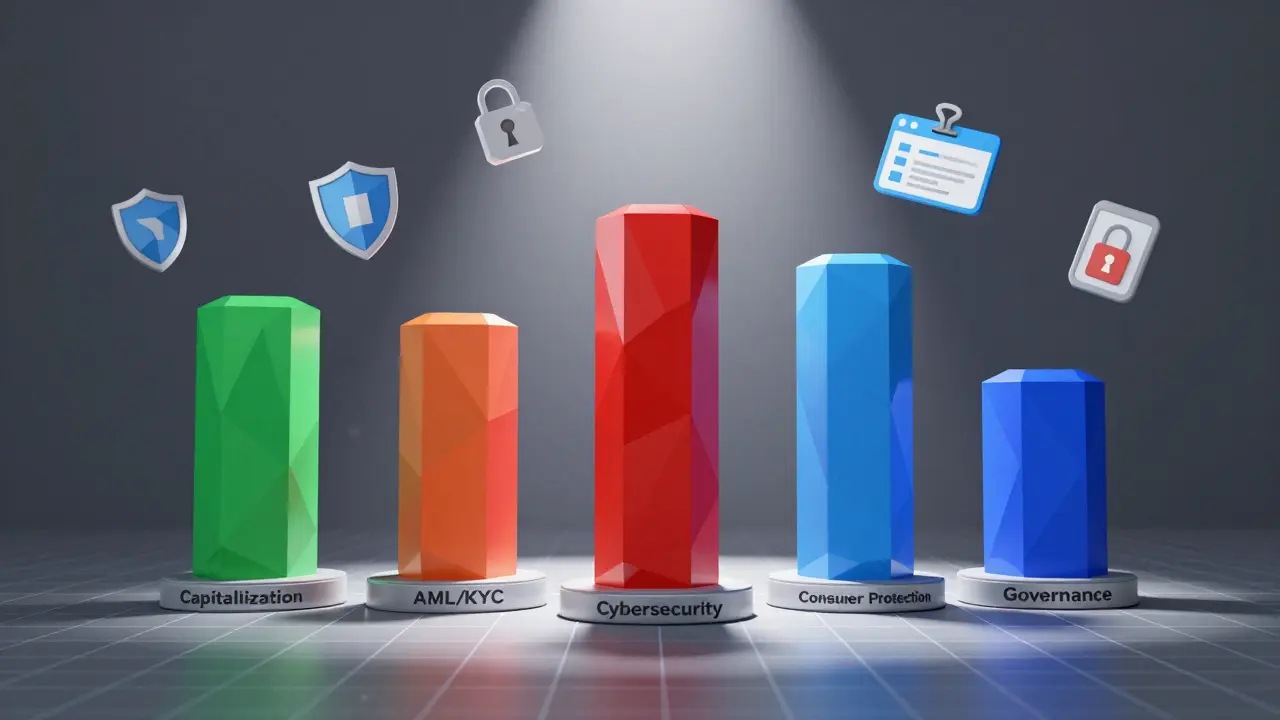
The Five Pillars of BitLicense Compliance
Getting approved isn’t about filling out a form. It’s about rebuilding your entire operational structure. The NYDFS looks at five critical areas. Fail one, and your application dies.
1. Capitalization and Surety Bonds
You cannot run a crypto business in New York on thin margins. Under 23 NYCRR 200.8 is the regulation specifying capitalization requirements for bitlicense applicants, ensuring they have sufficient funds to cover potential losses and operational risks., you must demonstrate adequate capital. While there is no fixed "minimum" dollar amount written in stone for every applicant, the reality is stark. Most successful applicants show between $1 million and $5 million in net capital, depending on their risk profile and transaction volume.
Additionally, you must post a surety bond or maintain a funded account for customer protection. The baseline is $500,000, but this scales up based on your business size. For a high-volume exchange, this requirement can jump to millions. This money is not yours to spend; it sits there to protect customers if you fail.
2. Anti-Money Laundering (AML) and KYC
Your AML program must meet Bank Secrecy Act standards. This means more than just checking IDs. You need automated systems that screen transactions against OFAC lists in real-time. You must file Suspicious Activity Reports (SARs) when necessary. The NYDFS expects your Know Your Customer (KYC) procedures to be robust. You must verify the identity of every customer and understand the source of their funds. In 2025, the NYDFS expanded expectations for blockchain analytics, requiring all covered institutions to use advanced tools to trace transaction flows. No more blind spots.
3. Cybersecurity Protocols
This is where many startups fail. You must comply with NYDFS Cybersecurity Regulation 500 is a comprehensive cybersecurity rule that sets minimum security standards for financial services organizations in New York, including mandatory penetration testing and incident reporting.. This includes:
- Mandatory annual penetration testing by third-party experts.
- Multi-factor authentication for all access to non-public information.
- A designated Chief Information Security Officer (CISO).
- Strict controls over remote access and data encryption.
"Military-grade" is the phrase often used by consultants. If your security team consists of one guy named Dave who also handles marketing, you will not pass.
4. Consumer Protection and Disclosure
New Yorkers must be told exactly what they are getting into. You need clear, plain-language disclosures about the risks of virtual currency. You cannot hide fees in fine print. You must have a process for handling customer complaints and disputes. The NYDFS views consumer harm as a primary failure mode, so your support infrastructure must be top-tier.
5. Governance and Fit & Proper
The regulators will look at you, your founders, and your board. Are you "fit and proper"? This means no criminal history, no prior regulatory violations, and a demonstrated understanding of the industry. They will interview key personnel. If your CEO has been banned from another jurisdiction, your application is dead on arrival.
The Cost of Entry: Money and Time
Let’s talk numbers. Why did Kraken exit New York? Why did Binance block users? Because the cost is prohibitive for many.
Direct Costs: According to 2025 analysis by Brico.ai, the upfront cost to apply exceeds $150,000. This includes the application fee, legal counsel, and compliance consultants. But that’s just the door opener.
Ongoing Annual Costs: Expect to spend $15,000 to $80,000 annually just on maintenance, renewals, and reporting. Larger firms spend significantly more.
Time Investment: The process takes 12 to 18 months. Yes, eighteen months. During this time, you cannot operate legally in New York. You are burning cash while waiting for approval. Coinbase and Gemini spent years building their compliance teams-teams of 20-30 people dedicated solely to New York regulations.
| Feature | BitLicense | Limited Purpose Trust Charter | State Bank Charter |
|---|---|---|---|
| Regulatory Body | NYDFS | NYDFS | NYDFS + Federal Reserve |
| Capital Requirement | $1M - $5M+ (varies) | Higher (Trust standards) | Highest (Banking standards) |
| Application Timeline | 12-18 Months | 18-24 Months | 24+ Months |
| Best For | Exchanges, Custodians, Payment Processors | Custody-focused firms seeking trust signal | Firms wanting full banking privileges |
| Market Perception | Gold Standard for Compliance | High Trust / Institutional Grade | Maximum Legitimacy |
Who Actually Has a BitLicense?
As of 2026, the list of major players is short. This scarcity is both a barrier and a moat. Only about 1.2% of U.S. crypto businesses hold a BitLicense, yet they process roughly 35% of all crypto transactions involving U.S. residents. Here is who is playing in the big leagues:
- Coinbase: One of the earliest adopters, leveraging its license as a competitive advantage.
- Gemini: Founded by the Winklevoss twins, built specifically around compliance.
- Circle: Issuer of USDC, received the first BitLicense in 2015.
- Robinhood: Operates with limited wallet functionality under the license.
- eToro: Entered the NY market in 2025 after securing compliance.
- MoonPay USA LLC: Granted full BitLicense in June 2025, showing the path is still open for fintech on-ramps.
- Uphold: Operates through a Limited Purpose Trust Charter, which offers similar oversight.
Notice who is missing? Kraken, Binance, and FTX (RIP). These companies chose not to play or failed to adapt. For consumers, this means fewer options but potentially safer ones. Reddit users in r/BitcoinNYC often debate this trade-off, with some missing the features of global exchanges but appreciating the security of licensed ones.
Recent Changes: The 2023-2026 Shift
The rules aren’t static. Two major updates have changed the game recently.
November 2023 Coin-Listing Guidance: The NYDFS released strict guidelines on listing new tokens. You can’t just add any coin to your exchange. You must evaluate each token for legitimacy, market manipulation risks, and securities law compliance. This has slowed down innovation for smaller exchanges that lack the legal resources to vet every new altcoin.
2025 Industry Letter: In early 2025, the NYDFS issued a letter expanding blockchain analytics requirements. Previously, only trust companies and bitlicensees had certain expectations. Now, all Covered Institutions must use advanced analytics. Furthermore, you must seek NYDFS approval at least 90 days before launching any new or significantly different virtual currency activity. No more surprise product launches.

Should You Apply? A Decision Framework
Before you hire lawyers, ask yourself these questions:
- Is New York essential to your growth? If you can serve 90% of the U.S. market without NY, the cost may not be justified. However, ignoring NY signals weakness to institutional investors.
- Do you have $2M+ in runway? You need deep pockets to survive the 18-month wait and the ongoing compliance costs.
- Can you build a dedicated compliance team? This is not a side project. You need full-time experts in AML, cybersecurity, and NY financial law.
- Is your business model transparent? If your revenue comes from opaque sources or high-risk jurisdictions, the NYDFS will reject you.
If you answered yes to all four, proceed. If you are a small startup with a lean team, consider partnering with an existing licensee or focusing on states with lighter regulations like Wyoming or Texas first.
Troubleshooting Common Pitfalls
Pitfall 1: Assuming "Technical" Means Exempt. Many developers think providing a node or API service exempts them. If you touch the keys or facilitate the trade, you are likely covered. When in doubt, consult a specialist.
Pitfall 2: Underestimating Cybersecurity Costs. Penetration tests alone can cost tens of thousands. Plus, you need to upgrade your infrastructure to meet Reg 500. Budget accordingly.
Pitfall 3: Ignoring the "Fit and Proper" Test. Background checks are thorough. Clean up your corporate history and personal records before applying. Any past red flags must be explained proactively.
How long does it take to get a BitLicense?
The average timeline is 12 to 18 months from initial submission to final approval. Complex applications or those requiring multiple rounds of clarification can take longer. The NYDFS conducts thorough reviews, including interviews with key personnel and audits of proposed systems.
What is the minimum capital required for a BitLicense?
There is no single fixed minimum, but applicants typically need between $1 million and $5 million in net capital depending on their business model and risk profile. Additionally, a surety bond or customer protection fund starting at $500,000 is required, scaling with transaction volume.
Can I operate a crypto exchange in New York without a BitLicense?
No. Operating a virtual currency business in New York without a BitLicense is illegal and subject to severe penalties, including fines and cease-and-desist orders. The only alternatives are obtaining a Limited Purpose Trust Charter or a State Bank Charter, which are even more stringent.
Why did Kraken and Binance leave New York?
These companies cited the high cost and complexity of compliance as reasons for exiting or restricting services in New York. The BitLicense requires significant investment in legal, compliance, and cybersecurity infrastructure that some international firms found incompatible with their global business models.
Does the BitLicense cover NFTs and DeFi?
Yes, if the activity involves Virtual Currency Business Activity as defined by 23 NYCRR Part 200. Selling, exchanging, or holding NFTs for customers likely requires a license. DeFi protocols that interact with New York users are increasingly scrutinized, especially following the 2025 Industry Letter emphasizing broader coverage.
What happens if my BitLicense application is denied?
You can appeal the decision, but success rates are low. More commonly, applicants withdraw and reapply after addressing the specific deficiencies identified by the NYDFS. This adds significant time and cost to the process. It is crucial to engage experienced legal counsel early to avoid common rejection reasons.
Autumn Story
July 9, 2026 AT 22:53Oh my gosh, this is such a huge help!! I was so confused about all the rules before... thank you for breaking it down so nicely! 🌟 It really makes me feel better knowing that even though it's hard, people are trying to make it safe. I hope everyone stays positive and keeps working hard towards their goals! 💖
Melissa Beckwith
July 10, 2026 AT 17:35While the post provides a superficial overview of the BitLicense requirements, it fails to adequately address the nuanced implications of the 23 NYCRR Part 200 regulations on decentralized autonomous organizations (DAOs) and non-custodial wallet providers who arguably do not engage in 'Virtual Currency Business Activity' as strictly defined by the NYDFS, yet still face regulatory ambiguity due to the expansive interpretation of 'transmission' and 'custody' clauses which often conflates technical infrastructure with financial intermediation, thereby creating a chilling effect on innovation that disproportionately impacts smaller entities lacking the legal resources to navigate the labyrinthine compliance landscape established by Superintendent Lawsky’s original framework which has since evolved into one of the most burdensome regulatory regimes globally, necessitating a more granular analysis of how recent guidance letters from 2023 and 2025 specifically alter the risk assessment matrix for token listings and blockchain analytics integration rather than simply stating that the bar has gotten higher without providing empirical data or comparative case studies against other jurisdictions like Wyoming or Singapore which have adopted more proportionate approaches to virtual asset regulation.
Ella Collinson
July 11, 2026 AT 16:27The systemic inefficiency inherent in the NYDFS mandate is glaringly obvious when analyzing the opportunity cost associated with the 12-18 month approval timeline versus the rapid iteration cycles required in Web3 development paradigms; furthermore, the arbitrary capitalization thresholds cited between $1M-$5M lack a robust actuarial basis tied to specific transaction volumes or counterparty risks, suggesting an arbitrary gatekeeping mechanism designed to consolidate market power among incumbent players like Coinbase and Gemini rather than fostering genuine consumer protection through competitive market dynamics, especially given that the cybersecurity protocols under Reg 500 are largely duplicative of existing SOC 2 Type II standards already mandated by enterprise clients, rendering the additional compliance overhead redundant and economically irrational for startups operating within lean resource constraints.
Andrew Schneider
July 12, 2026 AT 16:52You guys are missing the forest for the trees! 🌲👀 This whole BitLicense thing is just a giant money pit dug by regulators who don't understand crypto at all! They want your soul AND your wallet! 💸 Why would anyone subject themselves to this bureaucratic nightmare unless they're part of the establishment? The real winners are the lawyers charging $500/hour to tell you nothing! 😂 Let's keep our freedom and move to Texas where they actually like innovation! 🤠🚀
Eric Braddock
July 13, 2026 AT 19:13Wake up sheeple! 🐑 The BitLicense isn't about 'consumer protection,' it's about total surveillance capitalism enforced by the state! They want to track every single satoshi you touch using those 'blockchain analytics' tools mentioned in the 2025 letter. It's a digital dragnet designed to crush privacy and enforce monetary control. The 'fit and proper' test is just a way to weed out independent thinkers and ensure only compliant puppets operate in NY. Don't fall for the propaganda that this makes you safer; it makes you visible to the deep state. Resist! 🛡️👁️
Ray Arney
July 15, 2026 AT 01:24I think the point about the surety bonds is pretty solid. It does seem like a lot of cash to tie up, but maybe it's necessary for trust. I guess if you're running a big exchange, having that buffer makes sense for users. Just seems expensive for small teams.
Alicia Hull
July 16, 2026 AT 10:59This article is dangerously misleading in its simplification of the legal landscape! You cannot simply advise startups to 'partner with an existing licensee' without detailing the severe liability implications and the complex contractual frameworks required to ensure that such partnerships do not inadvertently trigger VCBAs for the startup itself. Furthermore, the claim that Kraken and Binance left solely due to cost ignores the significant role of geopolitical sanctions compliance and the difficulty of aligning global AML policies with New York's hyper-specific demands. If you are advising businesses based on this shallow analysis, you are setting them up for regulatory failure. Do your research properly before offering financial advice!
Johan Otto
July 18, 2026 AT 09:07Boring stuff 😴 But hey, if you have millions to burn, go ahead! Most of us are just trying to survive. Good luck to the brave souls jumping into this fire! 🔥
Anuj Kashyap
July 19, 2026 AT 19:54One must ponder the irony of regulating freedom with chains of bureaucracy. 🧘♂️ The NYDFS acts as a gatekeeper to a kingdom that doesn't exist anymore. While you argue over licenses, the code speaks truth. Interesting perspective, though perhaps a bit too focused on the cage rather than the bird. 🕊️
Mark Tuason
July 21, 2026 AT 10:37I appreciate the detailed breakdown of the five pillars. It is quite clear that the regulatory environment in New York is significantly more stringent compared to other states. For those considering entry into the market, it would be prudent to consult with legal experts familiar with 23 NYCRR Part 200 to ensure full compliance. The information provided here serves as a useful starting point for understanding the complexities involved.