
Bitcoin ETF History in Canada: First Approvals and How They Changed Global Investing

On February 18, 2021, something big happened in finance - not in New York, not in London, but in Toronto. The Bitcoin ETF launched for the first time in the world, and it wasn’t a futures contract. It wasn’t a trust. It wasn’t a tokenized asset. It was a real, regulated, exchange-traded fund that held actual Bitcoin. And it was approved by Canadian regulators. This wasn’t just a win for Canada. It was a wake-up call for the entire financial world.
The Moment That Changed Everything
Before February 2021, if you wanted to invest in Bitcoin through a traditional brokerage account, you were out of luck. You had to set up a crypto wallet, secure your private keys, deal with exchange volatility, and risk losing your coins to hacks or mistakes. Even institutions stayed away. The U.S. Securities and Exchange Commission kept rejecting Bitcoin ETF applications, citing concerns about market manipulation and custody risks. Then came Purpose Investments, a Toronto-based asset manager led by Som Seif. They didn’t ask for permission. They built the product, met every regulatory requirement, and submitted it to the Ontario Securities Commission (OSC). The OSC didn’t hesitate. On February 18, 2021, they approved the Purpose Bitcoin ETF (BTCC). It started trading on the Toronto Stock Exchange that same day under two tickers: BTCC.B for Canadian dollars and BTCC.U for U.S. dollars. This wasn’t just another ETF. It was the first ever to hold physical Bitcoin - not futures, not derivatives, not proxies. Every share bought meant Purpose bought actual Bitcoin and stored it in cold storage with a regulated custodian. That’s the same way gold ETFs work. Investors weren’t betting on price swings. They were owning the asset.Why Canada Pulled Ahead of the U.S.
The U.S. had been talking about a Bitcoin ETF for nearly a decade. But regulators kept saying no. Their main concern? Unregulated crypto exchanges. They didn’t trust the custody infrastructure. Canada didn’t wait for perfection. They built a system that worked. The OSC required Purpose to use a licensed custodian - BitGo, a U.S.-based firm with strong compliance protocols. The fund’s structure was transparent. Daily net asset values were published. Market makers kept premiums tight by arbitraging price differences. Within three days, the ETF’s NAV premium was down to just 0.2%. That’s the kind of efficiency you only see in mature markets. Meanwhile, the U.S. didn’t approve its first Bitcoin ETF until October 2021 - and even then, it was the ProShares Bitcoin Strategy ETF (BITO), which traded Bitcoin futures, not the actual coin. Futures are risky. They’re based on predictions, not ownership. They can diverge from spot prices. Canada’s ETF gave investors direct exposure. That’s why it became the global benchmark.Investors Went Wild
The market didn’t just react - it exploded. In the first two days, over $400 million worth of BTCC shares changed hands. Within 30 days, the fund hit $1 billion in assets under management. That’s faster than any ETF in history. By the end of its first week, Bitcoin ETFs in Canada had traded nearly $1 billion and gathered $600 million in assets. TD Securities called them the most actively traded ETFs in Canada that week. Why? Because Canadians could now buy Bitcoin inside their TFSA and RRSP accounts. No more crypto wallets. No more exchange risk. No more tax headaches. You could hold Bitcoin in your retirement account like you would a stock or bond. That was revolutionary. By February 2024, the Purpose Bitcoin ETF had over $2 billion in assets. It wasn’t just a flash in the pan. It became a core holding for retail investors, financial advisors, and even pension funds.
Other Canadian ETFs Followed - Fast
Purpose didn’t have the market to itself for long. The very next day, February 19, 2021, Evolve Investments launched its own Bitcoin ETF (ticker: EVOLVE). Then came CI Global Asset Management with the CI Galaxy Bitcoin ETF. By the end of 2021, Canada had three spot Bitcoin ETFs trading on the TSX. Each one followed the same model: direct Bitcoin custody, daily NAV pricing, eligible for registered accounts. The competition kept fees low and liquidity high. Investors had choices. Regulators had proof. The market had legitimacy. Loui Anastasopoulos of TMX Group called Purpose Investments a "true industry pioneer." He wasn’t exaggerating. Canada didn’t just launch a product. It created a new standard.How It Influenced the World
The U.S. watched. Europe watched. Asia watched. When the SEC finally approved spot Bitcoin ETFs in January 2024, they didn’t reinvent the wheel. They copied Canada’s playbook. The BlackRock iShares Bitcoin Trust (IBIT), the Fidelity Wise Origin Bitcoin Fund (FBTC), the Ark 21Shares Bitcoin ETF (ARKB) - they all used the same structure: direct custody, regulated custodians, daily transparency, and NAV arbitrage. Som Seif said it best: "We’re now globally seeing others take what we innovated and bring that to their markets, and that’s really exciting to see." Canada didn’t just get first. They got it right. And the world followed.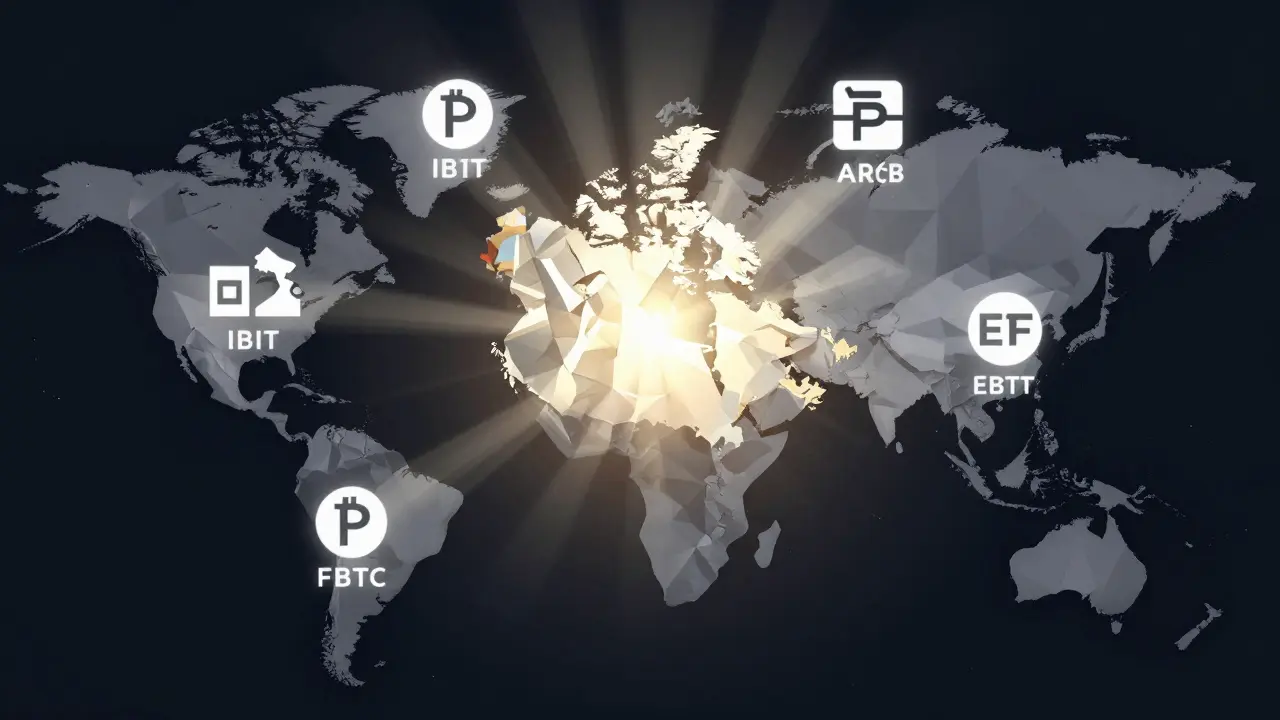
What Makes a Bitcoin ETF Work?
Not all crypto investment products are equal. Here’s what made Canada’s ETFs different:- Physical backing: Holds actual Bitcoin, not futures or derivatives
- Regulated custody: Uses licensed, insured custodians like BitGo
- Transparency: Daily NAV published, no hidden fees
- Eligibility: Can be held in TFSA, RRSP, RRIF
- Liquidity: Market makers keep spreads tight and premiums low
- Accessibility: Buy through any Canadian brokerage - no crypto app needed
Mike Reynolds
January 4, 2026 AT 16:06Man, I remember when I first heard about BTCC. I was sitting in my cubicle, sipping bad coffee, and thought, 'Wait, this is actually real?' No more juggling wallets or worrying about exchange hacks. Just buy it like a stock. Game changer.
Brooklyn Servin
January 5, 2026 AT 05:01Canada didn’t just get lucky-they got SMART. 🇨🇦🔥 The U.S. regulators were stuck in 2014 thinking crypto was a pyramid scheme. Meanwhile, Som Seif and the OSC built a product so clean, even your grandma could hold it in her RRSP. Why are we still debating this in 2026? 😤
Ian Koerich Maciel
January 5, 2026 AT 16:06It is, indeed, a matter of considerable significance that the Ontario Securities Commission, acting with due diligence and procedural rigor, approved the first physical Bitcoin ETF on February 18, 2021. This action, while seemingly modest in scope, represents a foundational shift in the regulatory architecture of digital asset markets. The implications are, frankly, profound.
Andy Reynolds
January 7, 2026 AT 03:46Big props to Canada for not waiting for permission. I’ve seen so many people paralyzed by ‘what if’-what if it crashes? What if regulators shut it down? But Canada said, ‘Let’s build it right and let the market decide.’ That’s leadership. And honestly? It’s the only way innovation survives.
Alex Strachan
January 7, 2026 AT 15:41Oh wow, Canada did something right?? 😱 Next you’ll tell me they have decent poutine and hockey players who don’t choke in playoffs. I’m gonna need a minute to process this. 🤯
Rick Hengehold
January 8, 2026 AT 21:34Spot Bitcoin ETFs work because they’re simple. No futures. No tricks. Just buy the asset. That’s it. Stop overcomplicating it.
Antonio Snoddy
January 8, 2026 AT 23:21Think about it: Bitcoin isn’t money. It’s not even really an asset. It’s a *concept*-a digital ghost in the machine of capitalism. And yet, here we are, institutionalizing it through ETFs like it’s a blue-chip stock. We’ve turned a radical act of decentralization into a brokerage account checkbox. Is that progress? Or just the final stage of co-optation? 🤔
Ryan Husain
January 10, 2026 AT 19:55The structure of Canada’s Bitcoin ETFs provides a model of regulatory innovation that balances investor protection with market access. This is not merely a financial product-it is a precedent for how traditional institutions can responsibly integrate emerging technologies. The global adoption of this framework underscores its efficacy.
Rajappa Manohar
January 11, 2026 AT 23:16canada did it first?? wow i didnt know that
Jacky Baltes
January 13, 2026 AT 18:47It’s funny. We didn’t set out to lead the world. We just wanted to give Canadians a safe way to invest. But the fact that the U.S. had to copy our model? That’s not about Canada being better-it’s about the U.S. being afraid to move until someone else proved it could be done. We didn’t innovate because we were brave. We just didn’t wait for permission.
dina amanda
January 14, 2026 AT 21:28Canada let a crypto ETF through? So what? Next they’ll let the CIA control the stock market. This is how they brainwash you. Bitcoin is a tool of the New World Order. You think they’d let this happen if it wasn’t planned? Wake up.
Adam Hull
January 15, 2026 AT 16:25How quaint. A nation with a population smaller than Los Angeles gets to set the global standard for financial innovation? How does that even compute? The U.S. has trillions in capital, the deepest liquidity, the most sophisticated institutions. And yet, the first spot ETF came from... Toronto? The same place that invented maple syrup and polite apologies? This is a joke.
Mandy McDonald Hodge
January 16, 2026 AT 22:06OMG I just bought my first BTCC.B through my RBC account!! 😭 I’ve been waiting for this since 2017. No more crypto apps, no more cold storage nightmares. My RRSP finally feels like it’s growing with the future. Thank you, Canada!! 💪💛
Bruce Morrison
January 18, 2026 AT 09:30Physical backing. Regulated custody. Transparency. That’s all you need. No fluff. No hype. Just the asset. Canada got it right.
Haritha Kusal
January 19, 2026 AT 07:53so canada was first? that’s so cool i always thought usa did it first
dayna prest
January 19, 2026 AT 08:32Let’s be real-Canada didn’t ‘lead.’ They just had regulators who didn’t care enough to say no. Meanwhile, the U.S. spent four years debating custody protocols while Canadians were buying Bitcoin like it was coffee. This isn’t innovation. It’s inertia with a maple leaf on it.
Phil McGinnis
January 19, 2026 AT 23:35The approval of the Purpose Bitcoin ETF was a catastrophic failure of regulatory oversight. The absence of centralized control in digital assets renders them inherently unstable. By institutionalizing Bitcoin through an ETF, Canada has legitimized a speculative instrument that lacks intrinsic value. This is not progress-it is the erosion of financial discipline.
Willis Shane
January 21, 2026 AT 05:55The regulatory clarity demonstrated by the OSC in 2021 remains one of the most consequential developments in modern financial history. The global adoption of Canada’s structural model confirms that prudent oversight, not obstructionism, is the true catalyst for innovation. This is not an accident. It is a blueprint.