
Benefits of Decentralized Storage for Security, Cost, and Control
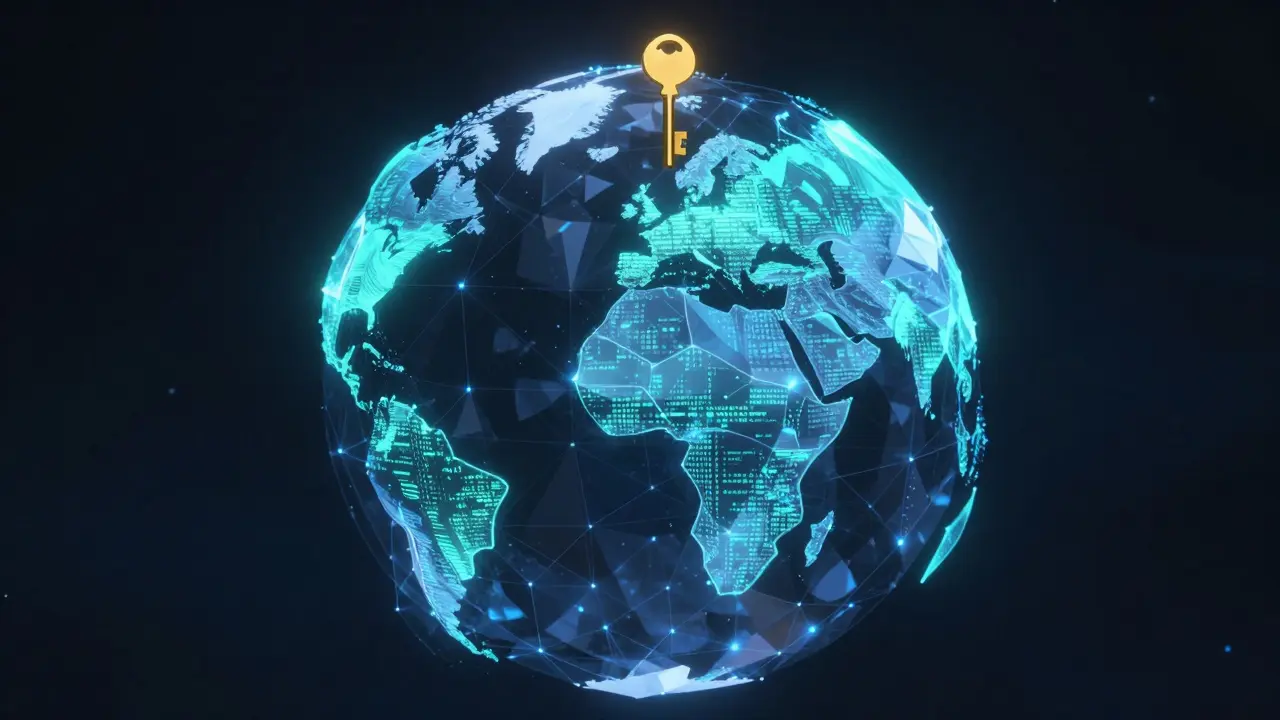
Imagine your data is scattered across thousands of computers worldwide-none of them owned by Google, Amazon, or Microsoft. No single company can see what’s on it. No server outage takes it offline. And you, not a corporation, hold the only key to unlock it. That’s not science fiction. That’s decentralized storage.
For years, we’ve trusted big tech companies to store our photos, documents, and business files. But every time you upload something to Dropbox or Google Drive, you’re giving them more than just space-they get access. And that’s the problem. Decentralized storage flips the script. It uses blockchain-powered networks to split, encrypt, and spread your data across dozens or hundreds of independent nodes. No central boss. No single point of failure. Just you in control.
Security That Doesn’t Rely on Trust
Centralized storage is like keeping your valuables in one vault. If the vault gets broken into, everything’s gone. Decentralized storage is like hiding the same items in 500 different safes, each with a unique lock. To steal it, you’d need to crack all 500 at once-and even then, you’d still need the decryption key only you hold.
Here’s how it works: Your file gets chopped into tiny pieces. Each piece is encrypted with your private key. Then, those pieces are sent to different nodes around the world. Even if someone hacks five of those nodes, they only get scrambled fragments. No usable data. No way to reassemble it. That’s not just secure-it’s mathematically impossible to breach without your key.
Compare that to Google Drive. Google holds the encryption keys. They can scan your files. They can hand them over to governments. They can change their terms tomorrow and delete your data without warning. With decentralized storage, those companies don’t even know what you’re storing. They can’t access it. They can’t sell it. They can’t even see it.
You Own Your Data-Really Own It
Data sovereignty isn’t a buzzword. It’s a right. And decentralized storage gives it back to you.
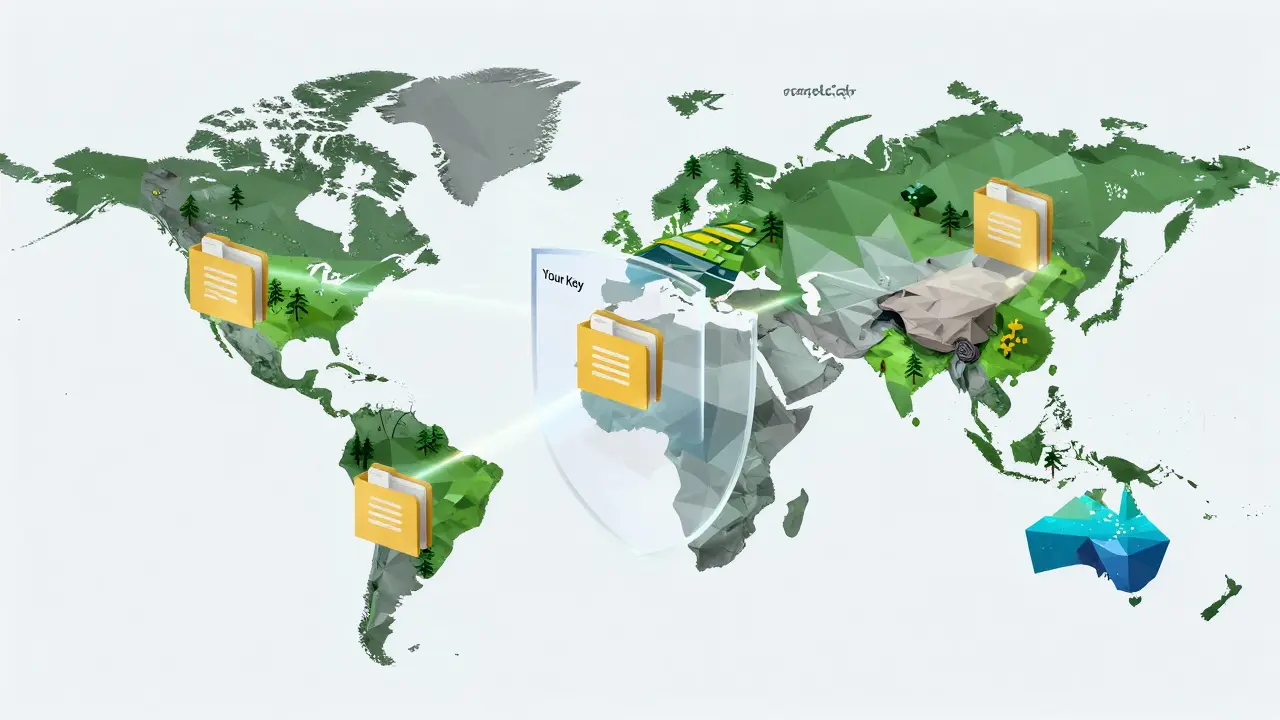
Under GDPR, EU citizens have the right to know where their data is stored. With centralized cloud services, you don’t. Your data could be in Virginia, Singapore, or Brazil-and you have no say. With decentralized networks, you choose. You can set rules: “Only store my files in nodes located in New Zealand.” Or “Only allow nodes that comply with ISO 27001.” That’s not possible with AWS or Azure.
And it’s not just about location. It’s about control. You decide who can access your files. You can grant time-limited access. You can revoke it instantly. No waiting for customer support. No digging through settings menus. You hold the keys. Literally.
Costs Drop-No Egress Fees, No Lock-In
Think your cloud bill is high? Wait until you try to download a 10TB backup from Amazon S3. Egress fees can hit $1,000 or more. That’s not storage-it’s extortion.
Decentralized storage doesn’t charge you to get your own data back. Ever. Because there’s no middleman controlling access. Nodes are paid in cryptocurrency to store your data. They compete. That drives prices down. Some networks offer storage at 1/10th the cost of AWS.
And you’re not locked in. If you’re unhappy with one provider, you switch. No contracts. No penalties. No 18-month commitments. Your data moves seamlessly between nodes. You own the keys. You own the data. You own the choice.

Faster Access, Anywhere in the World
Ever waited 30 seconds for a video to load because your server is in California and you’re in Sydney? That’s latency. Centralized systems force everyone to connect to a few giant data centers. Decentralized storage brings the data closer to you.
Because nodes exist everywhere-from a home server in Wellington to a data center in Tokyo-your files are stored near the people who need them. When someone in Brazil opens your file, they pull it from a node in São Paulo, not from a server in Ohio. That cuts load times in half. It’s edge computing, but without the corporate gatekeepers.
And when traffic spikes? The network scales automatically. More people join? More storage becomes available. No need to upgrade your AWS instance. No downtime. No panic calls to IT.
Never Lose Data Again
Remember when Dropbox had that massive outage in 2023? Millions couldn’t access their files for hours. Or when a single AWS region went down in 2024 and took down half the internet? Centralized systems are fragile. One power cut. One hacker. One misconfigured server-and everything vanishes.
Decentralized storage doesn’t have that problem. Your data lives on hundreds of nodes. Even if 80% of them go offline, the remaining 20% still have all the pieces. The network rebuilds automatically. You don’t even notice.
It’s like having 100 backup copies of your hard drive, scattered across the globe. One gets destroyed by a flood. Another by a fire. Another by a power surge. Still, your data survives. That’s not just reliability. That’s permanence.
Customization That Big Tech Won’t Give You
With centralized services, you get what they offer. No tweaks. No exceptions. If you want encryption with a specific algorithm? Too bad. If you need data stored only in the EU? Not possible. If you want to audit who accessed your files? They’ll charge you extra.
Decentralized storage lets you build your own rules. Want to store files only on nodes with solar power? Done. Want to pay in Bitcoin? Fine. Want to require multi-signature approval before anyone can view your files? Available. You’re not a customer-you’re a participant.
Enterprise users love this. Compliance teams can prove data stays within legal boundaries. Legal teams sleep better knowing no third party can access client files. Developers love the API flexibility. And auditors? They get full, immutable logs of every access attempt.
Who’s Using This Today?
It’s not just crypto nerds. Hospitals in Germany are using decentralized storage to keep patient records secure and compliant with GDPR. Film studios in New Zealand store raw 8K footage across global nodes to avoid vendor lock-in. Journalists in high-risk countries use it to archive sensitive documents where governments can’t seize or delete them.
One Wellington-based startup moved from AWS to a decentralized network last year. Their storage costs dropped 78%. Their data downtime? Zero. Their legal risk? Cut in half. And their team? They finally stopped worrying about cloud outages.
It’s Not Perfect-But It’s Progress
Decentralized storage isn’t flawless. User interfaces still feel clunky for non-tech users. Some networks are slower than enterprise-grade cloud services for small files. And yes, if you lose your private key, your data is gone forever. No recovery option. No “forgot password?” link.
But these are growing pains, not dealbreakers. The tech is improving fast. Better wallets. Simpler apps. One-click backup tools. Integration with existing software like Nextcloud and FileZilla. In 2025, it’s no longer a niche experiment. It’s a practical alternative.
The real question isn’t whether decentralized storage works. It’s whether you’re ready to stop trusting corporations with your most private data-and take back control.
prashant choudhari
December 25, 2025 AT 13:37Decentralized storage isn't just about security it's about sovereignty
Emily L
December 26, 2025 AT 04:05So what happens when I lose my key lol
Jake West
December 27, 2025 AT 07:37Oh great another crypto bro thinking blockchain solves everything. Your grandma can't use this and you know it. And don't even get me started on the energy waste.
Kevin Gilchrist
December 28, 2025 AT 07:33Bro I just want to upload my cat videos without some blockchain node in Kazakhstan having a copy 😭 I'm not a spy I'm just a guy who likes cats
Khaitlynn Ashworth
December 29, 2025 AT 18:54Oh wow you're telling me that if I pay in crypto I can finally stop trusting corporations? What a revolutionary idea. Next you'll tell me water is wet and gravity exists. 🙄
Gavin Hill
December 30, 2025 AT 02:44What does ownership mean if the system is too complex for most people to understand? Control without comprehension is just a new kind of alienation
surendra meena
December 30, 2025 AT 07:00THIS IS THE FUTURE!!!!!! THE END OF CORPORATE OPPRESSION!!!!!! NO MORE GOOGLE WATCHING YOU!!!!!! BUT WAIT WHAT IF THE NODES GET HACKED?????? WHAT IF THE ENCRYPTION BREAKS?????? WHAT IF I FORGET MY KEY AND LOSE EVERYTHING??????
rachael deal
December 31, 2025 AT 21:56I love this so much!!! You're changing the game!!! Imagine a world where your photos are truly yours!!! We can do this!!! Let's make it happen!!! 💪✨
Elisabeth Rigo Andrews
January 1, 2026 AT 05:10While the theoretical model is elegant, the operational overhead of key management, node redundancy protocols, and cryptographic verification introduces unacceptable latency for enterprise-scale workflows. The CAP theorem still applies, and you're sacrificing consistency for availability without adequate auditability.
Adam Hull
January 2, 2026 AT 02:14It's cute how you think this is practical. The UIs are still built by people who think 'decentralized' means 'confusing'. The average user can't even navigate their phone settings. This isn't progress-it's pretentious tech theater.
NIKHIL CHHOKAR
January 2, 2026 AT 05:07Let me be honest here. You're romanticizing a system that has zero real-world adoption beyond crypto circles. Who's actually using this? Who's paying for it? Who's maintaining the nodes? You're ignoring the human factor. This isn't freedom-it's a burden.
Mike Pontillo
January 4, 2026 AT 02:11So if I lose my key I'm screwed. But if Google goes down I can reset my password. That's not freedom that's just dumb.
Mandy McDonald Hodge
January 5, 2026 AT 13:13omg i just tried one of these services and it was so easy i cried 😭 my photos are finally mine!! thank you for sharing this!! i love you guys 💕
Bruce Morrison
January 6, 2026 AT 16:44There's a middle ground here. We don't need to abandon cloud services entirely. We need better tools to let users choose where their data lives. Decentralized storage can be part of that toolkit if it gets simpler.
Steve Williams
January 7, 2026 AT 12:13The philosophical implications of data sovereignty are profound. If ownership of personal information is a fundamental right, then the architecture of storage must reflect that principle. The technical implementation, while imperfect, represents a necessary evolution in the relationship between individual and institution.
Joydeep Malati Das
January 9, 2026 AT 06:04Interesting perspective. I've been using a decentralized node provider for my archival work. Costs are lower, uptime is better, and I don't have to worry about sudden policy changes. The interface needs work, but the core concept holds up under real-world use.
Willis Shane
January 9, 2026 AT 06:50Let’s be clear: this isn’t about technology-it’s about power. The corporations that control centralized storage have spent decades building regulatory capture, lobbying against data portability, and conditioning users to accept surveillance as a cost of convenience. Decentralized storage is the only viable counterforce. If you’re not supporting it, you’re enabling monopolistic control over human information. The moral imperative is not debatable.