
AML Requirements for Crypto Businesses in the EU: What You Need to Know in 2025
EU Crypto AML Compliance Cost Calculator
Calculate Your EU Crypto AML Compliance Costs
Get an estimate of your annual compliance expenses based on your business type and activity level.
If you run a crypto business in the European Union, you’re not just dealing with code and wallets-you’re navigating one of the strictest financial监管 regimes in the world. The rules aren’t suggestions. They’re legally binding, enforced by new authorities, and backed by real penalties. Failing to comply doesn’t just risk fines-it can shut down your entire operation. And unlike in the U.S., where rules shift by state and agency, the EU has built a single, unified system that applies across all 27 member states. This isn’t about staying ahead of the curve. It’s about surviving it.
What Changed in 2025? The New EU Crypto AML Rules
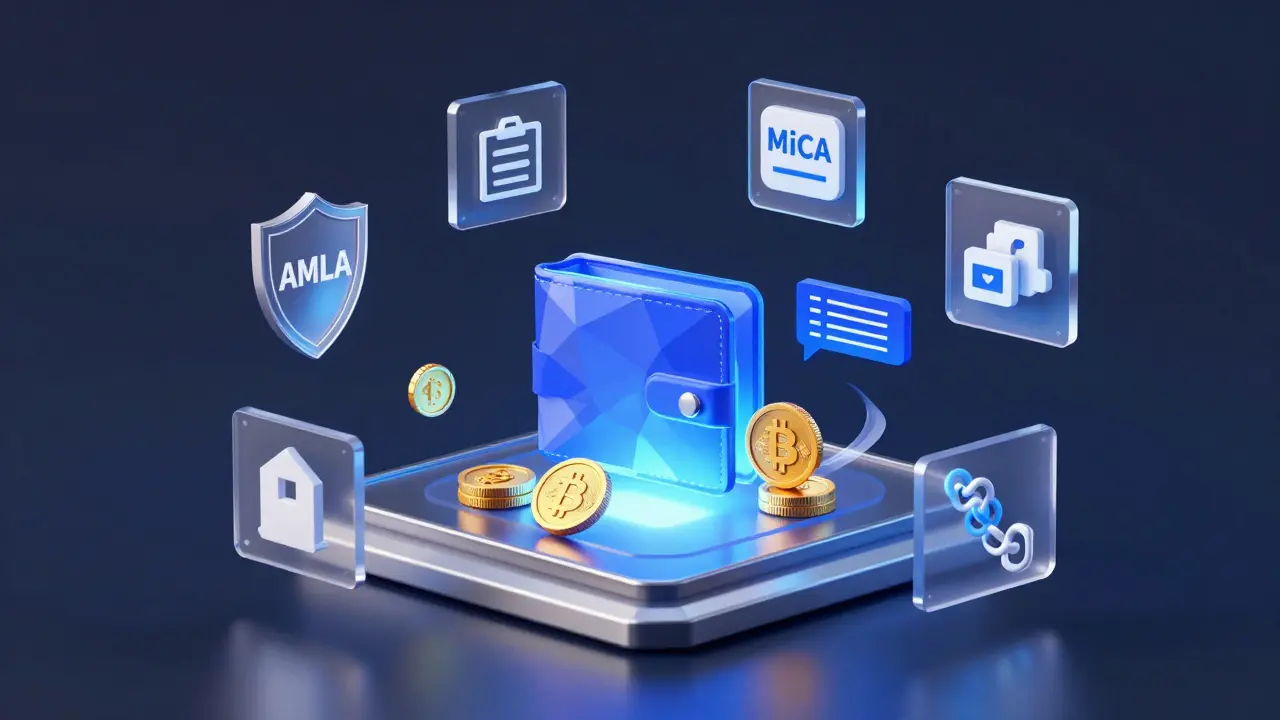
The EU’s approach to crypto AML isn’t just updated-it’s been rebuilt. In 2025, the Anti-Money Laundering Regulation (AMLR) a new EU-wide law replacing older directives to create a single rulebook for all crypto businesses officially took effect. This isn’t a tweak. It’s a full overhaul. The old patchwork of national rules is gone. Now, every crypto exchange, wallet provider, and DeFi intermediary must follow the same checklist, no matter if they’re based in Germany, Portugal, or Finland.The biggest shift? The Anti-Money Laundering Authority (AMLA) a new centralized EU agency that coordinates financial crime supervision across all member states began operations in early 2025. Before AMLA, each country handled its own crypto AML enforcement. Now, AMLA can investigate, audit, and penalize firms directly. Its chair, Bruna Szego, made it clear: "Europe is adequately protected from the risks of money laundering and terrorist financing stemming from this sector." That’s not a slogan. It’s a warning.
Another key player is the Markets in Crypto-Assets Regulation (MiCA) the EU’s comprehensive framework requiring crypto businesses to obtain a license to operate. MiCA became fully effective in 2024, and by September 2025, 217 companies had received full authorization. If you’re not licensed under MiCA, you can’t legally offer services to EU customers. Period.
Who Must Comply? The Obliged Entities
Not every crypto company is treated the same. The EU defines specific roles that must follow AML rules:- Crypto-Asset Service Providers (CASPs)-this includes exchanges, wallet providers, and trading platforms that handle fiat-to-crypto or crypto-to-crypto trades.
- Custodial wallet providers-any service that holds private keys on behalf of users.
- DeFi intermediaries-if your protocol has a central team managing governance, tokens, or user access, you’re likely covered.
- Token issuers-if you’re selling tokens to EU residents, even via a website, you need to comply.
What about decentralized protocols with no central team? That’s the gray zone. The European Banking Authority (EBA) the EU’s financial watchdog that monitors systemic risks and provides regulatory guidance says DeFi remains a major loophole. In early 2025, Germany’s BaFin documented cases where anonymous DeFi pools were used to launder over €40 million. But since no single entity controls the protocol, regulators can’t issue fines. That’s changing. AMLA plans to release guidance on DeFi in Q1 2026-and it won’t be lenient.
The Five Core AML Requirements
If you’re operating in the EU, you must have these five systems in place by law:- Customer Due Diligence (CDD)-You must verify every user’s identity. For transactions under €1,000, you need name and address. For €1,000-€10,000, you need a government ID. For anything over €10,000, you need proof of where the money came from and approval from your Money Laundering Reporting Officer (MLRO).
- Transaction Monitoring-Your system must flag unusual behavior: rapid deposits and withdrawals, clustering of small transactions, or activity from high-risk countries. The EBA identified 47 specific red flags that all CASPs must track.
- Suspicious Activity Reporting (SAR)-If you spot something odd, you must report it to your national Financial Intelligence Unit (FIU). In 2025, EU FIUs received over 18,000 crypto-related SARs-up 120% from 2023.
- The Travel Rule-This isn’t optional. For every crypto transfer over €1,000, you must collect and send six data points: originator name, account number, address or date of birth, beneficiary name, account number, and address. Unlike the U.S., which only applies this to transfers over $3,000, the EU applies it to every transaction above €1,000-even to self-hosted wallets.
- Staff Training-Compliance staff must complete 40 hours of AML training annually. Operational staff need 16 hours. Training must be documented and tested quarterly. Failure to train staff is a violation-even if the system is perfect.

How Much Does It Cost to Comply?
This isn’t a small expense. For startups, compliance is often the difference between survival and shutdown.A Kraken representative told CoinDesk in June 2025 that integrating with all 28 EU FIUs cost €2.1 million. That’s not a typo. Each national FIU has its own reporting format, deadlines, and tech stack. Smaller firms can’t afford that. The European Commission’s May 2025 SME Impact Assessment found that 68% of crypto startups with fewer than 10 employees consider AML compliance costs prohibitive. Forty-two percent have scaled back EU operations or moved their legal base to Switzerland or Singapore.
Getting a full MiCA license takes 9-12 months and costs between €350,000 and €500,000. That includes legal fees, compliance software, staffing, and audits. Major players like Bitstamp and Blockchain.com cut costs by using middleware like the Traveler platform, which reduced integration time from six months to eight weeks-but at a €420,000 price tag.
And it’s not just upfront. You need at least three full-time compliance staff. Annual audits, software updates, and staff retraining add another €150,000-€250,000 per year. For a small team, that’s more than half your budget.
What Happens If You Don’t Comply?
The EU doesn’t warn twice. Penalties are steep:- Fines up to 5% of annual global turnover.
- Temporary suspension of operations.
- Revocation of your MiCA license.
- Criminal liability for senior executives-yes, your CEO can go to jail.
In 2024, an Estonian-registered CASP was fined €12 million after moving €187 million in crypto through a Gibraltar entity to avoid stricter Estonian rules. Both the Estonian and Gibraltar authorities acted. The company’s CEO was banned from the industry for life.
And it’s not just about money. Your reputation is on the line. Regulated CASPs now capture 89% of institutional clients. Banks won’t work with you if you’re not MiCA-compliant. Payment processors like Stripe and Adyen won’t touch you. Your users will leave for safer platforms.

How the EU Compares to the Rest of the World
The EU’s rules are more aggressive than anywhere else:| Requirement | European Union | United States | Singapore |
|---|---|---|---|
| Travel Rule Threshold | €1,000 (all transactions) | $3,000 | $1,000 (but no self-hosted wallet checks) |
| Anonymous Transactions | Prohibited | Allowed if unregulated | Allowed with limits |
| Licensing Authority | AMLA + MiCA (EU-wide) | FinCEN, SEC, state regulators (fragmented) | Monetary Authority of Singapore (MAS) |
| DeFi Regulation | Unclear, but cracking down | Unclear, enforcement varies | Explicitly exempted if truly decentralized |
| Enforcement Speed | Fast (AMLA can act directly) | Slow (multi-agency, legal delays) | Fast, but less aggressive |
The EU’s biggest advantage? Consistency. You get one rulebook. The U.S. has 50 state regulators, FinCEN, the SEC, and the CFTC-all claiming jurisdiction. Singapore is clearer but less strict. The EU is the most comprehensive-and the most expensive.
What’s Coming in 2026-2027?
The EU isn’t done. Here’s what’s next:- Q2 2026: AMLA’s first coordinated audit of all licensed CASPs, focusing on Travel Rule compliance and beneficial ownership.
- July 1, 2027: The full AMLR takes effect. New rules include a five-working-day deadline to respond to FIU requests, a €10,000 cash payment cap for businesses, and mandatory verification for cash payments over €3,000.
- 2027: The list of obliged entities expands to include crowdfunding platforms, football clubs, and high-value goods traders.
- Q1 2026: New guidance on privacy coins and mixing services-expect a ban on services that obscure transaction trails.
By 2028, regulators predict illicit crypto transactions in the EU will drop another 40-55%-building on the 63% reduction already seen since MiCA launched. But that’s only if businesses keep up.
Final Reality Check
The EU doesn’t care if you’re a startup or a giant. If you serve EU customers, you play by EU rules. There’s no loophole. No gray area. No "we’ll figure it out later."Compliance isn’t a cost center. It’s your license to operate. The 217 MiCA-licensed CASPs aren’t just following rules-they’re winning market share. Institutional investors won’t touch unlicensed platforms. Banks won’t open accounts for them. Users are fleeing to compliant exchanges.
Some companies are leaving the EU because the cost is too high. But those who stay? They’re building the most trusted, transparent crypto businesses on the planet. And that’s worth more than any short-term savings.
Do I need a MiCA license if I only serve non-EU customers?
No, if your business has no EU customers, no physical presence in the EU, and no marketing targeting EU residents, you don’t need a MiCA license. But if even one EU user signs up through your website, you’re subject to the rules. The EU considers "targeting" by language, currency, or domain (like .eu or .de) as sufficient to trigger jurisdiction.
Can I use a third-party KYC provider to handle AML compliance?
Yes, but you’re still legally responsible. Using a KYC vendor like Onfido, Jumio, or Trulioo can save time and money, but the final responsibility for accurate verification, monitoring, and reporting rests with your company. Regulators will hold you accountable if the vendor fails. You must audit your provider annually and keep records of all checks.
What happens if my users use non-custodial wallets?
You’re still required to collect and verify the sender and recipient details for any transaction over €1,000-even if the wallet is self-hosted. If you can’t verify the recipient’s identity, you must block the transaction. Many firms now use blockchain analytics tools like Chainalysis or Elliptic to trace wallet ownership and flag high-risk addresses.
Are privacy coins like Monero banned in the EU?
Not explicitly banned yet, but they’re effectively blocked. All licensed CASPs are required to screen for privacy-enhancing technologies. Most exchanges have already delisted Monero, Zcash, and other privacy coins because they can’t comply with the Travel Rule or transaction monitoring requirements. AMLA plans to issue formal guidance in Q1 2026, and a ban is likely.
How do I know if my AML software is compliant?
Look for software certified under the EU’s AML/CFT Technical Standards or that integrates directly with national FIUs. The EBA publishes a list of approved vendors in its technical guidance documents. Avoid generic tools that don’t support the Travel Rule’s six data fields or can’t handle multi-FIU reporting. Test your system with simulated SARs before going live.
Florence Maail
December 16, 2025 AT 14:44Kelsey Stephens
December 18, 2025 AT 11:43Tom Joyner
December 18, 2025 AT 16:59Samantha West
December 20, 2025 AT 11:57Craig Nikonov
December 21, 2025 AT 12:46Donna Goines
December 22, 2025 AT 02:24Greg Knapp
December 23, 2025 AT 04:23Shruti Sinha
December 24, 2025 AT 07:40Cheyenne Cotter
December 25, 2025 AT 22:58Emma Sherwood
December 26, 2025 AT 12:49SeTSUnA Kevin
December 27, 2025 AT 05:06Timothy Slazyk
December 27, 2025 AT 10:52Madhavi Shyam
December 28, 2025 AT 13:12Jack Daniels
December 29, 2025 AT 03:44Bradley Cassidy
December 30, 2025 AT 03:26Abby Daguindal
December 30, 2025 AT 13:44Patricia Amarante
December 31, 2025 AT 11:08Mark Cook
January 1, 2026 AT 09:43Heather Turnbow
January 2, 2026 AT 13:55Jesse Messiah
January 3, 2026 AT 04:32